|
Summer 1999
Thirty-seven Countries Participate in '99 Newton-Evans EMS/SCADA Study In April 1999, Newton-Evans Research Company published the seventh volume of its series of reports entitled World Market Survey of SCADA and Energy Management Systems in Electric Utilities - 1998-2001. This report series has been prepared based on primary research survey data collected from utility operations managers for each world region during a study of the world market for SCADA and energy management systems (EMS). The research was conducted during the period of September 1998 - March 1999. More than 250 sites actively participated in this survey, while another 200+ control centers had responded to recent and related Newton-Evans Research surveys. Some of the input received for those related studies has been incorporated into this series of reports. The six geographic markets encompassing Volumes I through VI include: Western Europe; Eastern Europe; Latin America; Asia Pacific; Mideast, Mediterranean and Africa; and, North America. Part A of Volume VII contains a world market forecast and summaries. Part B of Volume VII contains profiles of the responding utilities. Volumes I through VI and Volume VIIA contain market estimates and forecasts, as well as summary narrative, color charts, and detailed tables. Topics examined in this research program include:
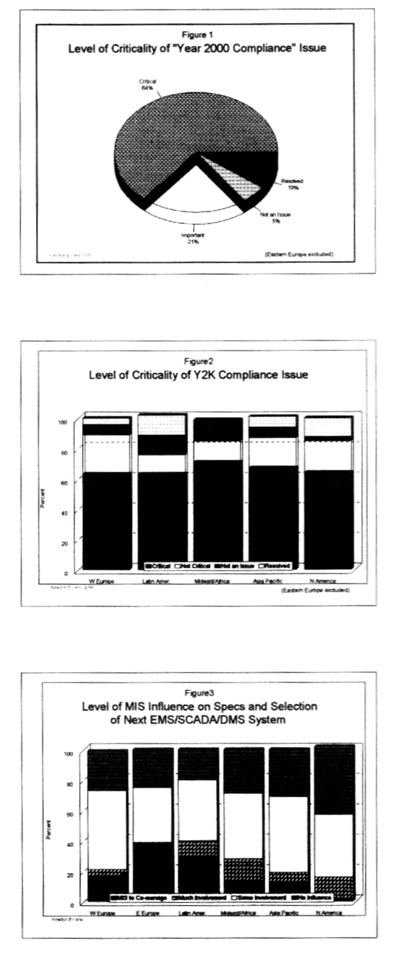
A current subject of great worldwide interest, and not limited to electric utilities, is that of dealing with the Year 2000 "computer bug" and the need to resolve this situation so that computer systems will properly recognize the correct year at the turn of the century. The "bug" could affect control center operations (for EMS, SCADA and in-plant generation control - known as DCS - systems) as well as the "embedded" technology found in field equipment and some older generations of intelligent electronic devices. Mainstream information systems operated by power and gas utilities for accounting, administration and others could also be affected. On a world summary basis, almost two-thirds (excluding Eastern European utilities which are looking to their federal agencies for assistance) are treating the Year 2000 issue as "critical." For all other world regions, other than Eastern Europe, at least 63% and as much as 71% of the utilities think the situation with regard to Year 2000 compliance is critical. Earlier this year, only three percent of North American utilities and up to 14% of Mideast, Mediterranean and African utilities believed that Year 2000 compliance "is not an issue". Only seven percent of the world's utilities participating in this study believe that they had, by March 1999, successfully resolved the Year 2000 compliance issue. See Figures 1 and 2. Another topic included in this research concerned the level of MIS influence on specification and selection of the next EMS, SCADA or DMS system. On a worldwide summary basis, 13% indicated that the MIS department would "co-manage" this selection, while another eight percent noted a "great deal of involvement" by this group. "Some involvement" was indicated by 42%, while the remaining 37% stated MIS would have "no influence". See Figure 3 for world responses.
ESCOs Take Hold Around the World Since 1996, Chuck Newton, president of Newton-Evans Research Company, has written a monthly column entitled AUTOMATION PERSPECTIVES published in Transmission & Distribution World magazine, in his role as Automation Editor. In the previous issue of MTD, selections from columns pertaining to substation diagnostics and RTUs role in T&D operations were featured. The focus of the article in the February 1999 T&D World issue was energy service companies. These new energy service companies (ESCOs) and other unregulated utility subsidiaries are being formed every month by electric utilities in North America and abroad. Established ESCOs appear to change names on a monthly basis as they merge, consolidate or establish new mission statements. Keeping track of these new market entrants, and the revamped existing companies, can be likened to tracking your favorite sports player as the player jumps from team to team through the free agency market. Some ESCOs are so new, or appear and disappear so quickly, that their holding company switchboard operators don't even have phone contact listings for their employees. · More than 85% of large U.S. investor-owned utilities now have one or more
ESCOs staffed and operating. In the past, ESCOs formed by utility holding companies focused their business
efforts on demand-side management initiatives, such as load control, lighting,
window tinting, insulation, energy audits, and residential appliance sales. As
deregulation of the industry takes hold, ESCOs must find ways to distinguish
themselves from their competitors. Establishing a line of distribution related products and services is one way in which ESCOs can improve their industry presence, fuel business growth and gain market share. Automation-related products and services currently offered by ESCOs include: smart lighting systems, facility energy management systems, building automation offerings encompassing more than energy management, telecommunications services ranging from simple local-area-bypass offerings to Internet offerings to total cable-based services. In states where industry regulations may force separation of services from the regulated utility (distribution network operations provider), ESCOs are offering metering and billing services. Illinova Energy Partners is one company currently developing electricity pricing and billing software for its customers. Puget Sound's subsidiary, Connext, is providing automated meter reading and customer information system services. Still others, such as Wisconsin Public Services' WPS Energy Services subsidiary, have begun to offer energy consumption software. DTE Energy Co.'s (Detroit Edison) Intelligent Link Project was a business unit established to send data messages to residential customers for residence temperature control based on a four-tier rate structure.
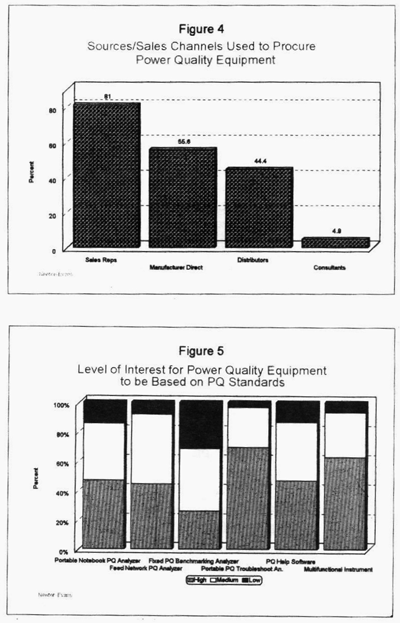
High Interest Level in Portable Troubleshooting Analyzers for Power Quality Power quality is a subject studied frequently by Newton-Evans Research Company in many facets of the electric utility industry. Recently, the company completed a study pertaining to the role of power quality standards in the power quality equipment marketplace. One area of investigation concerned the sales channels used to procure power quality equipment for electric utilities. On average, two channels were used, depending upon the specific product type and/or manufacturer being used. Sales representatives were most frequently used, cited by 81%. Over one-half (56%) of the utility officials indicated direct manufacturing dealing. Distributors were used by 44%, and five percent indicated using their PQ consultants as a source for PQ instruments. See Figure 4. Utility officials were also asked to indicate the level of interest they had in a variety of possible PQ-related product offerings. Portable Notebook PQ Analyzer. Nearly one-half (47%) of the respondents indicated a high degree of interest in this potential offering. Feeder Network PQ Analyzer. Forty-four percent of the utilities responding expressed a high degree of interest. Fixed PQ Benchmarking Analyzer. Only about 26% of the responding utility officials noted a high degree of interest. Portable PQ Troubleshooting Analyzer. This product received the
strongest level of high interest among the responding utilities. Nearly 70%
indicated that they would be very interested in this offering. Multifunctional PQ Instrument. The interest was very strong in this product, with 63% expressing a high degree of interest in such a product quality offering.
The World Market for Protective Relays in Electrical Utilities: 1999 - 2004 Earlier this year, Newton-Evans Research Company initiated the distribution of the Prospectus providing information about the company's newest relay research program. This study concerns the worldwide market for protective relays in electric utilities during the 1999-2004 time frame. This market study is being undertaken during the third and fourth quarters of 1999. In 1996, Newton-Evans Research conducted an extensive research program which provided a clear view of the protective relay marketplace in the United States. This newest study will examine the world market for protective relays. Newton-Evans will interview and survey more than 200 international and U.S. utilities. In addition, the research program will look at generator applications, transmission-line applications, distribution-feeder applications, and substation applications for protective relays. The study will provide an in-depth appraisal of what utilities will be requesting in their next round of procurements of protective relays for all applications. The world regions to be researched are: North American market; European market; Pacific Basin market; Latin American market; and, combined Mideast, Mediterranean and African markets. Some highlights of this series will include: · spending outlook for relay purchases Early subscribers to the series took the opportunity to review the pretest survey, and submit suggestions and questions to be considered for inclusion in the survey. Some topics for the proposed study series are listed below: · Product Awareness and Current Utilization: How familiar are electric utilities around the world with protective relays? · Vendor Evaluation: How do utility personnel in different countries find out about protective relay vendors? Who are the market share leaders in each world region? How do suppliers rate in various product and marketing categories? · Purchase Plans and Purchasing Decision: What specific plans do
utilities around the world have for acquiring protective relays? · Price Sensitivity: Is price sensitivity a key issue with smaller utilities in the international community? Also, what price ranges are acceptable for protective relays offering different functions? · Budget Authority and Procurement Policies: Who makes the purchase decisions for protective relay procurements? · Information Sources and Distribution Channels: How do utilities around the world keep up-to-date with advances in protective relaying? Also, which channels are used to purchase relays? · Primary Applications Activities: Are the usage patterns for other
world market areas similar to those being found among the North American
utilities, based on applications priorities and planning for new or add-on
applications? · What to expect from an "ideal" relay: What is an ideal relay to a relay engineer? What are the expected price points for an "ideal" relay? How many units are planned to be purchased if the "ideal" relay system is available by 2001? The findings from the study will be released in a sequential, volume-by-volume manner, based on geographic area. The anticipated report availability sequencing will be as follows: Volume I North American Market The targeted time frame for publication of the first two volumes is August 1999. Pre-publication pricing is still available; however, the sponsor input phase to the study design has been completed. The full payment pre-publication price of $4,500 must be received before July 31, 1999. The split payment plan ($5,000 total) is a second option. One-half ($2,500 is due before July 31, and the balance ($2,500) is due upon receipt of Volumes I and II. Post-publication price for the six volumes will be $5,500.00. Individual volumes may also be purchased.
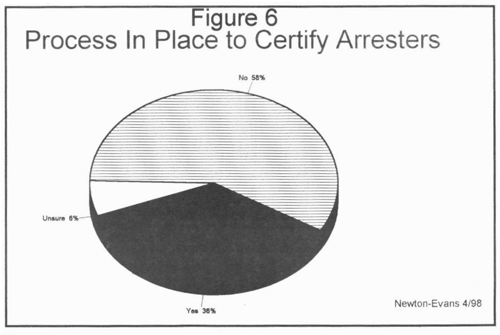
Products and Services in the Deregulated Energy Industry In the second half of 1998, Newton-Evans Research Company conducted a proprietary study that explored channel issues and the potential role of fiberglass insulation products and services in a newly deregulated energy industry. Six industry groups were surveyed for this report, including utilities and their energy services business units. It is evident that most major utilities have already formed energy services business units. Many have been set up as unregulated enterprises under the utility parent holding company. Most of these energy services business units (ESCOs) will focus primarily on energy-related services, and only secondarily on energy-related products. Newton-Evans Research has published an Executive Summary report containing over 60 profiles of energy services businesses formed by electric and gas utility companies. Information found in the profiles includes the planned focus and scope of the ESCO activities. For report pricing information, please call 1-800-222-2856. More information on the topic of ESCOs may be found in this newsletter on page 3 which contains excerpts from Chuck Newton's monthly column that appears in Transmission & Distribution World. Proprietary Research Topics over the Last Eighteen Months Newton-Evans Research recently completed a study of the international electric utility market to determine present and planned usage of distribution arresters. Respondents to this research study were asked to indicate if their utility had a process in place to certify arresters. Fifty-nine percent indicated that their utility did not have a distribution arrester certification process available. More than one-third (36%) reported having such a certification process in place. Figure 6 depicts this information in graphic form. Other recent proprietary topics researched by Newton-Evans include the following: · optical sensor-based substation power management system
For pricing and additional information on this new series of reports, please
call Newton-Evans Research at 1-800-222-2856 (or internationally,
1-410-465-7316) or visit us on our website at www.newton-evans.com. |