|
Summer 2000
In August 2000, Newton-Evans Research Company announced the publication of its multivolume study of the U.S. and international electric utility markets for substation equipment and instrumentation during the 2000 - 2004 frame. This publication is entitled The Worldwide Market for Substation Automation and Integration Programs in Electric Utilities: 2000-2004. This report series includes the following publications: Volume I - Survey of Substation Planning Officials in North America Volume II - Substation Automation Programs: Case Studies from Eleven Major Utilities Volume III - Substation Equipment, Intelligent Electronics Devices, and Communications Products and Services: Supplier Profiles Volume IV - Survey of International Utility Substation Planning Officials Volume V - World Outlook for Electric Utilities and Substation Automation: Market Forecast and Assessment Volume V contains detailed substation equipment and instrumentation spending
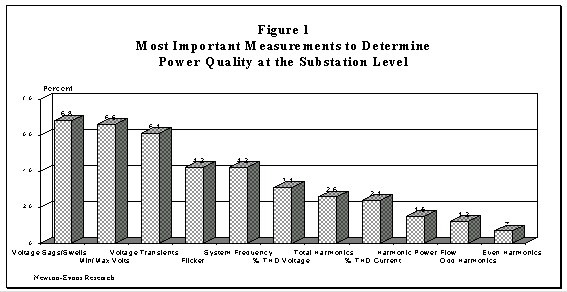
forecasts. Forecasts are provided for each major world region. Statistical compilation in the report consists of summary tables and cross-tabulations based on geographic location of respondents. The following are some key findings from Volume V of this study. On a worldwide basis, the most popular protocols currently in use include DNP 3.0-serial (32 percent) and Modbus Plus (25 percent). On a summary basis for North American utilities, both DNP LAN (24 percent) and UCA2/MMS (22 percent) led the way in mentions for planned use. Plans by international utilities to use (or change) protocols in substation automation programs centered on DNP 3.0 LN (15 percent) and also IEC 870-5 (13 percent). Respondents were asked to rank the importance of "potential obstacles" to implementing substation automation for new substations. None of the nine listed potential obstacles on the survey were viewed as particularly difficult to overcome. While there are some substantive differences between the North American and international groups of respondents, on a summary basis, lack of standard protocols, lack of perceived benefits, and lack of economic justification were the key potential obstacles. Currently, almost one-half (49 percent) of the utility officials responding to this study indicated that substations only communicate with EMS and SCADA systems. An additional 35 percent mentioned feeder IEDs, followed by protection engineering groups (27 percent) and load management or demand side management systems (20 percent). In terms of future plans, the most important new addition is likely to be the inclusion of trouble call management systems to communicate with substation equipment, as was indicated by 35 percent of those citing plans to add links. Another interesting topic concerned the importance of certain measurements
used to determine power quality at the substation level. Included in the list
were: harmonic power flow, total harmonics, odd harmonics, even harmonics,
min/max volts, system frequency, percent THD on current and on voltage, voltage
transients, flicker, and voltage sags and swells. Key measurements for the overall group of 69 North American respondents included sags and swells (77 percent), voltage transients (67 percent), and min/max volts (59 percent). Co-ops added flicker (61 percent). Key measurements for the overall group of 47 international utilities included min/max volts (77 percent), system frequency (68 percent), along with voltage sags and swells (55 percent), and voltage transients (53 percent). European officials were particularly strong users of min/max voltage measurements, as were utilities in the African and Middle Eastern regions.
For additional information and pricing on this new series of reports, please call Newton-Evans at 1-800-222-2856 (internationally, 1-410-465-7316) or visit our website at www.newton-evans.com.
Chuck Newton is Scheduled Speaker at DistribuTECH: EUROPE 2000 DistribuTECH's DA/DSM Europe 2000 Conference will be held from October 10 -12 in Vienna, Austria. Chuck Newton will speak on "Substation Automation and Integration Programs: World Outlook for 2000 - 2004." Copies of Chuck Newton's speech are available upon request. Upcoming Newton-Evans Research Report Series Since 1978, 30 public studies of utility-related control systems, as well as more than 150 commissioned utility industry product and market studies, have been completed by Newton-Evans Research. During the remainder of 2000 and into year 2001, our research firm will be conducting three new multiclient studies in the utility sphere. In fourth quarter 2000, we will be conducting a worldwide study of EMS/SCADA usage and trends in electric utilities. This will be Newton-Evans third series of worldwide reports in this area undertaken since 1996. Another area of focus in the final months of 2000 concerns the world's market for ISO and automated power exchange systems. Information technology trends in electric, gas and water utilities will be the main focal point for a report series beginning in first quarter 2001. Cinergy's Business Process Transformation In late 1999, Dale Justis, retired general manager of customer operations at Cinergy and an active participant on the Edison Electric Institute's Customer Operations workforce, spoke with Chuck Newton and Rick Bush, chief editor of T&D World, during the Partnering Conference held by Transmission & Distribution World magazine. Mr. Justis was a leading figure in shaping the transformation of Cinergy's customer-impinging activities in this era of profound change affecting the electric power delivery industry. This change has affected Cinergy as much as any single company in the industry. Unlike some investor-owned utilities, Cinergy had done its re-engineering first, and only thereafter did it attempt to apply technology to the reconfigured, scaled-down utility organization. According to Dale, the biggest and most significant technology change within the company has taken place within the operations side of the business. In Dale's words, the corporate change was profound and permanent. "We went from an engineering centered business to a customer focused organization in a matter of months. The pace of change required the project development team to interact closely with internal people (users). The impact this change in systems development efforts has had on our customers is enormous. There is much more consistency in service provision and in customer responses today than ever before at Cinergy, as a direct result of the work effort which necessarily included cutting across several operating utilities." "When the company was formed there were three distinct business processes for the traditional utilities that had been merged. There were over 90 systems just in Energy Delivery to deal with, and everything, the people, the process and the technology needed to be changed. We had to become a single corporation, we needed to improve productivity with a streamlined design process, deploy enabling technology rapidly and set a foundation for the evolving competitive environment." Technology change occurred from top to bottom within the utility enterprise. Cinergy began to work hand-in-hand with Convergent Group to re-engineer the IT efforts within the company. This partnership has been successful for the company. Some of the benefits of this partnership include operations department successes. Re-engineering efforts involved the development of technical and operating standards for use by all utilities merged into Cinergy. Design and procurement standards were put in place as well. In the operations area, live line work is dispatched via on-board computer today. Workers can be dispatched from home. Field work orders are processed remotely, via computer - from issuance through to completion. One key issue for the partnership is the need to accommodate ongoing change within the operating companies. "In order for the partnering effort to make a difference in day-to-day job performance, we need to maintain a close relationship with the various line organizations. The importance of single source data has spread, where the field engineer is the initiator of an order, performs updates and posts job status directly, eliminating the need for manual work order closing. It is only within the last ….36 months that IT has matured to the point that it can effectively support these field processes." Dale iterated that a third-party integrator equipped with a 'service' shop attitude and capability is the way to approach these difficult IT transitions. Putting the various software pieces together is the easy part of the job. Managing change with the workforce is the more difficult part of implementing technology advances in the form of these super systems. "Unifying a company's workforce, pulling people into the effort who then form multidepartment interdependent team is the objective. Making the people part of the solution - pre-selling the change…helping people become empowered to see a bigger role in their own job. This is especially critical in an organization undergoing re-engineering and trying to do more with fewer human resources." As Dale indicated, "You have to acknowledge that the individual job is actually becoming more complicated - a job that is not resolved with simple keystrokes or with button pushing. Workers are becoming the process owner here….the remaining job functions are absolutely becoming more critical." The Role of the Internet and Extensible Systems at Cinergy Mr. Justis insisted that the future of web-based systems is here today. "Web-enabled systems will allow our end use customers to order and to discontinue various services offered by the company. New technology tools are available to help the company transform to an e-utility and cited the need to exploit information to the advantage of the company and its customers." Dale indicated that the web-based technology - in an Intranet form - is now being used to provide internal operating units with real time information on just about any aspect of operating conditions, especially vital for outage management. At the same time, the Internet is becoming the key vehicle to keep customers informed about the company and about customer operations. According to Dale, extensibility (a term used in the interview) means that the ability to duplicate the approach to work flow at Cinergy could be readily adopted on a global basis, not just a national basis, should the company acquire an international utility at some point. The current system is flexible enough to permit another round of process re-engineering. Customer Information Systems at Cinergy The downside of all this progress in the CIS arena, is the inability to any
longer share very much of what one company does with another industry supplier -
all because of increasingly open competition in the industry. Dale indicated
that there will continue to be communications among utilities regarding their
CIS efforts, but that these will become 'guarded' and information sharing among
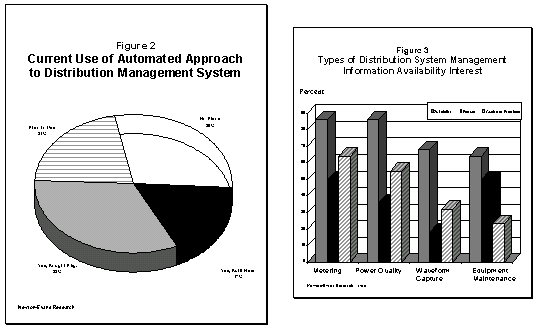
utilities will be a lot less in the future, than was historically the case. Recently, Newton-Evans completed a proprietary study on distribution system management, monitoring and control among 25 of the top 100 U.S. electric utilities. Operations and engineering officials were interviewed in this information-gathering project. Fifty percent of those responding indicated that their utility was currently using an automated approach to distribution system management. Of these, one-third indicated use of home-grown approaches and the other two-third noted that their utility have purchased packages. Twenty-one percent indicated there were plans to use such an automated approach, and the remaining 29 percent noted no plans in the near future. Refer to Figure 2. The utility officials were also asked what types of distribution system management information would they want to have available in an automated manner at substation, feeder and customer premise levels.
Substation level - metering and power quality information led in mentions among the types of information listed. Equipment maintenance status and waveform capture were also fairly popular at the substation level. Feeder level - One-half of the group wanted to have metering data, and equipment maintenance status information. About one-third wanted power quality information, but only 18 percent thought that waveform capture would be useful. Customer premises level - nearly two-thirds of respondents indicated that metering data was vital, while over one-half concurred that having power quality data at the customer premises was important. One-third mentioned waveform capture, and nearly one-quarter cited equipment maintenance. Protective Relays - North American and European Usage Patterns One of the first Automation Perspective columns that Chuck Newton wrote for Transmission & Distribution World magazine discussed the changing usage patterns for protective relays, based on Newton-Evans' then current study of utility protection and control staffs. Now, four years later, Chuck is Automation Editor and once again talks about the relay marketplace and products. As in the 1995 column, the pace of technology change has continued unabated through mid 2000. While numerical or digital relays continue to make inroads in every application area within the electric utilities of the world, and every week seems to bring the announcement of a new digital relay product, the use of electro-mechanical (e-m) relays is still extensive, and the purchase of new electro-mechanical relays continues to account for significant levels of unit purchases, and for 25 percent - 30 percent of dollar values. In the most recent Newton-Evans' series of global protective relay usage studies, there are a number of interesting findings to report. Some of these topics are purchase plans, budget ranges, relay budget allocations, continuing purchases of electro-mechanical relays, and the need for outside resources to assist in protective relaying activities. Relay Purchase Plans: Relay Budgets: While installation costs take up only eight percent of Eastern European budget, they account for a much higher 26 percent in North America and 21 percent in Western Europe. Engineering services account for eight percent of the Eastern European budget, and about 13-14 percent for both North America and Western Europe. Other budgeted line items account for the remainder of the relay budget, according to the more than 140 utilities that took part in this survey. These "other" items can amount to quite an investment, and as mentioned by some utilities, include site testing, drafting of schemes, and panel fabrication costs. See Table 1. Digital Relays …..Continuing to Increase Share of Total Relay
Installations: Growing Need for Outside Services Providers: Table 1: Relay Budget Allocation Comparison
Visit Our Newly Revamped Website Please visit us at our newly revamped website, www.newton-evans.com and provide us with some feedback on our new look, as well as any additional information you would like to see available on the site. Our website contains company information, technical articles, upcoming utility trade event listings, and links to other related energy industry sites.
Newton-Evans has now established business partner centers in Argentina, Russia, China, and Cyprus, thus expanding native language survey capabilities when requested by clients. In a recent proprietary study, Newton-Evans translated the survey into five languages (Chinese, Japanese, Spanish, Arabic, and Portuguese), allowing for a more inclusive approach to survey research. Newton-Evans has also recently conducted two energy-related market studies in the Russian language.
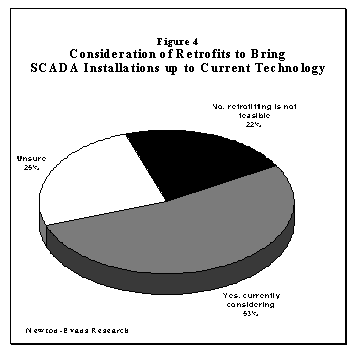
Figure 4 and Figure 5 summarize these findings on the consideration of
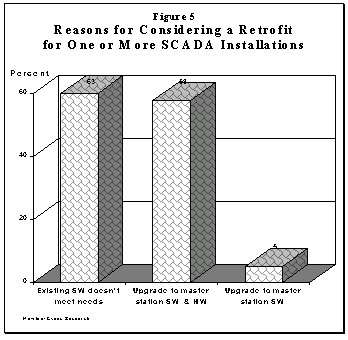
retrofits of SCADA installations. Consideration of Retrofits of SCADA Installations by Gas & Oil Pipeline Operations In July 2000, Newton-Evans published its three-volume report series entitled The World Market for Supervisory Control and Data Acquisition Systems in Gas & Oil Pipeline Operations: 2000 - 2004. This report series was prepared based on primary research survey data collected from gas/oil pipeline engineering and operations managers worldwide. Volume I is the global summary of research findings based on 76 pipeline operations worldwide. This total includes 37 U.S. pipeline companies and 39 pipeline officials representing 13 countries. Participating countries include: Australia, Canada, Colombia, Hong Kong, Mozambique, Netherlands, Pakistan, Puerto Rico, Romania, Russia, South Africa, Tanzania, and Uruguay. Volume 2 includes profiles of more than 50 pipeline SCADA vendors and Volume 3 consists of the pipeline SCADA market analysis and forecast. Respondents to the survey were asked if their company was currently considering, or has considered, a retrofit to bring one or more of the company's SCADA installation up to current technology. Just over one-half (53 percent) indicated that they are currently considering such a system retrofit. Another 22 percent indicated that retrofits simply were not feasible for their installations, and one-quarter of the group was uncertain about the merit of retrofitting their SCADA system. Respondents noting that their utility was considering retrofits were then requested to indicate if their existing software functionality is good enough to meet their current requirements. These officials were also to indicate if the upgrade would be the master station software only, or would be upgraded to master station hardware and software. Sixty-three percent of the responding officials noted that their existing software does not meet their current requirements. Fifty-eight percent noted that they would consider upgrade to master station hardware and software, while only five percent indicated that the upgrade would be to the master station software only.
For pricing and additional information on this new series of reports, please
call Newton-Evans Research at 1-800-222-2856 (or internationally,
1-410-465-7316) or visit us on our website at www.newton-evans.com. |