|
Winter 2000
"Sun" of Y2K, New EPRI Warnings, No, this title is not a misspelling, unfortunately. As soon as one dragon is slain, i.e. the Y2K bug, it seems another pops up to take its place, and no, I don't mean Y10K! I mean the sun, Helios, old Sol, the sine qua non for our planet's existence and, hence, our survival. In fact, by the time you read this, the sun may already be hard at work,
interrupting electricity power flow somewhere in the world. This year marks the
cyclical "high-point" for solar magnetic storms, the last zenith of
which occurred in 1989. Then, the entire province of Quebec was in the dark for
about 12 hours, thanks to the early effects of one such large solar magnetic
storm. Other areas of the plant suffered milder effects on their electrical
T&D systems. This time around, things could get worse. We are putting far more demanding load conditions on the world's electricity grid than we did in 1989 and the end-user load is far more sensitive to voltage fluctuations. Even more importantly, we have invested far too few dollars in electric power-related spending for advanced research and development, and too little investment in infrastructure upgrades, according to a recent critical warning statement issued by the Electric Power Research Institute. Impressively, 150 participants contributed information to the EPRI report which suggests that prior electric industry research has paid huge dividends, but with the current shortfall in such research, there will be few new gains realizable in the new century. The report goes on to indicate that the current T&D grid in the U.S. is outdated and poses not just some concern, but a "serious threat" to the U.S. economy. The report's premise is this: Deregulation is speeding up the obsolescence of today's T&D grid architecture and infrastructure, implying that the vastly increased number of electricity trades across interconnected lines is stretching the nation's grid beyond its design specifications. I would add this applies equally across the majority of the world's electrified regions. The findings from hundreds of studies conducted by Newton-Evans over the last two decades into various electric power T&D technology spending issues have resulted in a lowering of expectations among the manufacturers and applied research firms that sponsor such research programs, because utility officials continue to plan too few investments in advanced technology. Such industry executives are taking a narrow, sometime self-serving and dangerously naïve, view of a business that is crying for longer-term infrastructure investments to assure continued electric power T&D reliability, integrity and security. Over the next ten years, distributed generation will undoubtedly mature to the point that the situation may be alleviated somewhat, lowering the requirement in future years for the level of large-scale infrastructure spending that needs to be allocated at this time. However, ten years or more is a long way out, and without substantive investment soon, we are not likely to bridge that coming decade long gap without serious negative consequences. Note: These comments are excerpts from Chuck Newton's Automation Perspective
column that will appear in T&D World magazine in January 2000. World Market for SCADA Systems in Newton-Evans Research Company's newest area of research concerns the study and assessment of the market for supervisory control and data acquisition (SCADA) systems in gas and oil pipeline operations during the 2000-2004 time frame. This global market study is beginning in December 1999 and will be completed in May 2000. While Newton-Evans has conducted several research programs providing a clear view of the North American market for SCADA systems among electric, water and gas utilities, and gas and oil pipeline companies, this will be the company's first worldwide study of the gas and oil pipeline market. Newton-Evans recently developed strategic research partnerships in Russia and
the Middle East. This development provides an ideal opportunity to conduct a
global research program for the oil and gas pipeline business. Several recent
computer and communications technology developments, the changing structure of
the oil and gas pipeline industry worldwide, the arrival of new market
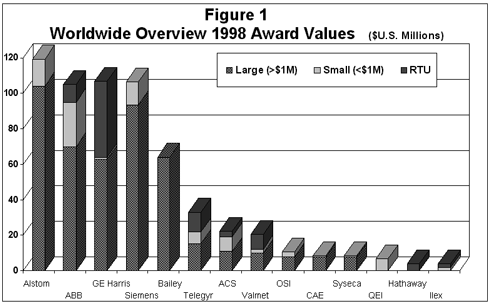
participants, and growth in the use of modern This study will result in a comprehensive series of reports on the control systems usage patterns and plans of pipeline operations worldwide. The project will measure current market sizes and contain world region market projections for the next several years. A separate report will profile more than 60 suppliers of oil/gas pipeline SCADA-related systems, software and services. Following are topics included in this research effort: The North American Market volume is scheduled for publication in March 2000. Pre-publication prices are still available. For this information, check our website at www.newton-evans.com or call the office at 1-800-222-2856. Significant Projects Awarded in 1998 to Thirteen suppliers of supervisory control and data acquisition (SCADA) systems, energy management systems (EMS), and RTUs provided a listing of awards received during 1998. Awards were categorized into three areas: awards less than one million dollars, one million dollars and more, and RTUs. Newton-Evans also asked the suppliers to designate domestic and international awards. Highlights garnered from the information supplied by these vendors include: · The participating companies represent about 90% of all domestic U.S. values for awards made in the calendar year 1998. · More than $164 million in North American systems, software and services awards were made by the electric power industry to this group of market participants. · The North American operations of these businesses won international contracts worth more than $150 million. · In North America, large awards (>$1 million) were down somewhat (five percent) during 1998, reaching $135.5 million, as compared to $142.7 million during the previous year. Small awards (<$999,999) were up significantly (70 percent) in 1998, reaching $51.4 million. During 1997, small awards amounted to $30.2 million. RTU awards were 13.6% lower in 1998, totaling $36.7 million, which was down from $42 million. · On a worldwide basis, large awards recorded during 1998 ($409.5 million) were 59 percent higher than those noted during 1997 ($256.3 million). During 1998, small awards amounted to $64.5 million, 51 percent higher than that reported during 1997 ($42.6 million). RTU awards for 1998 ($69.4 million) were 24 percent higher than that noted the previous year.
"Price Per Function" Rated the
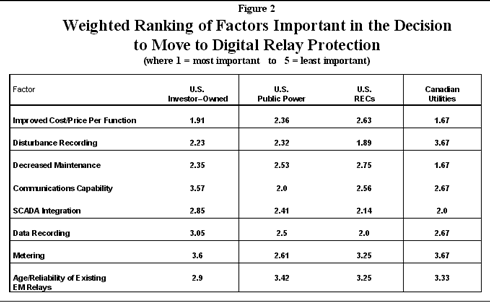
The previous edition of MTD made mention of Newton-Evans' newest relay research program, concerning the worldwide market for protective relays in electric utilities during the 1999-2004 time frame. Volume I of this report series has been released and provides information on the North American relay marketplace. The U.S. and Canadian utilities that participated in this survey represented approximately 20 percent of the estimated total of North American customers, and 22 percent of North American electric utility revenues. The U.S. participants account for 23.6 percent of all U.S. electricity customers, and for 26.6 percent of U.S. electricity revenues. These participating utilities have relay purchase plans that indicate as many as 14,000 relays will be purchased over the 1999-2004 time frame. It appears that investor-owned utilities will dominate purchases from the relay market in about the same percentage as it dominates the power supply industry generally (73-77% of total utility customers, revenues, production capacity, transmission lines, etc.). The Executive Summary volume will provide readers with detailed market information for the North American region as well as an international overview. Newton-Evans Research Company estimates from its 1996 relay market study indicate that the North American relay market stood at about $180 million. Even with decreasing prices, increasing functionality and stiff price-based competition eroding profits in some selling situations, the domestic market is likely to have remained fairly stable because of increased digital relaying applications, and the integration of relay devices within other larger devices and subsystems. Keep in mind that the utility market for protective relaying products forms only about 60% of the total protective relay market, with additional sales going to OEMs, IPPs, and industrial and commercial end-users of electricity, especially those organizations buying bulk power from utilities. One topic considered in the current relay study concerns the ranking of factors important in the utility's decision to move to digital relay protection. Eight possible reasons for moving to digital relay usage were listed in the questionnaire for utility officials to rank. The factors included: improved cost/price per function; disturbance recording; decreased maintenance; communications capability; SCADA integration; data recording; metering; and, age/reliability of existing electromechanical relays. Overall, for the North American market, improved cost/price per function was rated as the most important factor (2.17 - on a scale where 1.0 was the highest rating possible). Disturbance recording was rated at 2.28 overall, followed by decreased maintenance at 2.4, communications capability at 2.43, and SCADA integration at 2.53. Note in Figure 2 that there were substantial differences in rankings of these factors based on the subgroup (type of utility) responding. The investor-owned utilities were most concerned with improved cost/price relationships, while public power utilities were primarily concerned with communications capability. Rural cooperatives were most concerned with the ability to perform recording functions. Among the Canadian utilities, improved price per function was key, as was decreased maintenance. Forward Price Curve Is an In mid-1999, Newton-Evans Research Company conducted a proprietary study on
the market for online electricity industry marketing and planning services.
Specifically, the objective of the study was to assess the demand for market
simulation products.
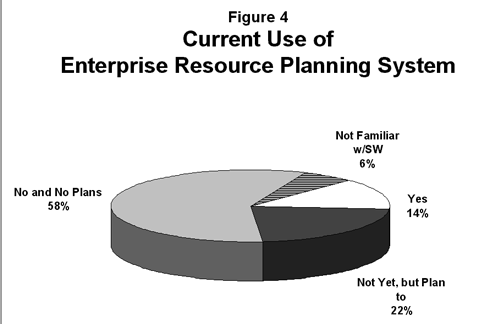
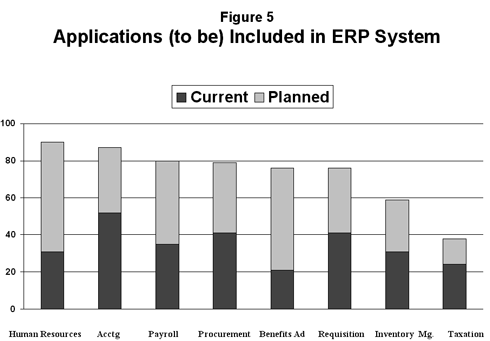
The Slow Pace of Feeder Automation In his role as Automation Editor for Transmission & Distribution World magazine, Chuck Newton writes a monthly column entitled AUTOMATION PERSPECTIVES. Chuck, president of Newton-Evans Research Company, recently reviewed the slow development and growth of distribution feeder automation and the implementation of intelligent electronic devices (ied) in the field, and their effect on unplanned electric outages. The mandate to serve will continue to lie with the electric distribution entity in our new deregulated world. Just look at the current federal and state level boards of inquiry that are being established to look into a few recent outages in key areas of the United States. Presently, these boards are not reviewing the status of generation, nor are they focusing their efforts on transmission, but they are clearly intent on assessing the role of distribution operations. These boards will undoubtedly note that the industry is relying on control principles and technology that has matured over the last three decades, but has not grown to the point where the distribution network is monitored and remotely controlled as a system, let alone centrally managed. Limiting the effects and duration of unplanned outages is a top concern for many distribution operations managers worldwide. We are seeing some progress in areas such as SCADA and distribution management systems applications. However, in terms of distribution automation and the implementation of ied's in the field, growth is not constant among utility segments. In addition it seems to move in fits and starts, represented by a few large procurements here and there around the world, along with a few hundred pilot programs. Taking a closer look at the dimensions of the distribution feeder market, there are likely to be more than 750,000 primary distribution feeders energized in the world currently, and as the lights come on in developing nations of the world, this number will grow to more than one million units. The majority of today's feeders are overhead units. In the U.S., as one example, the ratio is about 5-to-1, overhead to underground, with the majority of new feeder installations being underground. The "typical" feeder has at least three switching devices in place along the feeder route. These devices include reclosers, sectionalizers, disconnecting switches, air brake switches, and fuses. Large utilities typically operate a thousand or more distribution feeders. In the U.S., even mid-sized public power and cooperative utilities typically will operate more than 100 distribution feeders. There are about 50,000 utility-operated distribution substations installed in the U.S., and about 250,000 on a worldwide basis. In overhead applications, reclosers are widely used as switching devices, followed by sectionalizers. For underground feeder applications, pad switches are commonly used, with manually operated switches also of importance. Indoor switchgear often supplements the use of pad switches in North America. Fuses, vaults, submersible switches also are used in conjunction with underground feeders. Where feeder automation programs have been justified, this typically has been to improve the performance of the utility's worst performing feeders, followed by a reduction in operating costs. Many utilities are developing feeder management strategies. In addition to the role of improving feeder performance, the issue of high-quality service to key accounts is vital. Today, the strategy of improving overall network performance as part of any substation automation strategy should be linked with feeder automation programs, which are dependent on substation automation to some extent. Distribution operations managers may want to move forward with more automation programs sooner rather than later. After all, "boards of inquiry" are not something that we need to hear much about with all of the other changes permeating the electric power industry at this time. In the first half of 1999, Newton-Evans Research Company conducted a significant research study concerning the extent of use of three specific software products in U.S. city and county governments. These products include: enterprise resource planning (ERP) software, automated procurement software, and data mining/data warehousing software. More than 100 local government officials participated in this research project. At this point, approximately 15 percent of these officials indicated current use of ERP systems. Nearly 25 percent plan to acquire such systems in the near future. More than one-half of the group (58 percent) indicated no use of enterprise resource planning systems, with no plans to utilize such software in the future. The remaining five percent of these officials indicated that they were not familiar with ERP software. The smaller local jurisdictions were more likely than were the mid-size and large city and county groups to have no use and no plans to use ERP software. The group of respondents that indicated current/future use of ERP systems were asked to respond to a question concerning which applications are or would be included in the organization's ERP system. Eight applications were listed on the questionnaire: accounting, benefits administration, human resources, inventory management, payroll, procurement, requisitioning, and taxation. Fifty-two percent cited current use of accounting modules (representing 94
percent of the 16 jurisdictions with current systems). Forty-one percent
indicated both procurement and requisitioning modules. Plans were centered around additions of human resources modules, benefits administration and payroll. Procurement, requisitioning and accounting followed. Figure 4 and Figure 5 summarize these findings on enterprise resource planning systems.
In fourth quarter 1999, Newton-Evans Research Company initiated the distribution of the Prospectus providing information about the company's newest substation automation research program. This study concerns the worldwide market for substation automation and integration programs in electric utilities during the 2000-2004 time frame. This market study will commence in January 2000. In 1997, Newton-Evans conducted its first extensive research program which provided a clear view of the worldwide substation automation marketplace among electric utilities. This new series of market studies will measure current market sizes, and will estimate and forecast demand for substation automation equipment by specific product categories in unit shipments and dollar values on a year-by-year basis for the years 2000-2004. The program will also focus on defining the broader product and market requirements which suppliers must meet in order to successfully participate in the substation automation program within electric utilities worldwide. This new round of research will provide an appraisal of products, instruments and related substation equipment, that electric utilities of all sizes will be specifying, recommending and purchasing. Recent technology developments, new market participants, increased level of knowledge and growth in the use of control systems and communications within the utility industry, contribute to the value and need for information regarding substation automation plans of the early 2000's and beyond. Key issues to be addressed in this proposed study series include: Product Requirements. Perhaps the most important topic in this study series, the research program identifies the specific product functionality required in substation automation programs. Vendor Requirements. The future role of smaller, specialized providers of substation equipment, and protection and control equipment, in light of large "generalized" transmission and distribution equipment manufacturers will be studied. Vendor Evaluation: How well do the substation planning engineers in electric utilities around the world know the various strengths and weaknesses of vendors serving the market? Purchasing Plans and Decisions: What are plans for spending and acquiring substation-based equipment, instruments and related services? Product Awareness and Current Utilization: What is the extent of current penetration of substation automation programs in utilities? Remote Terminal Units (RTUs) and Programmable Logic Controllers (PLCs): Is today's RTU technology appropriate for the substation of the future, or is the technology behind PLCs better suited for substation automation programs? The findings from this research program will be released in a sequential, volume-by-volume manner. Volume 1 - Preliminary Findings The targeted time frame for publication of the first two volumes is March 2000. Pre-publication pricing is still available, and the sponsor input phase to the study design is open through January 15, 2000. For information on this upcoming study, please call Newton-Evans at 1-800-222-2856. Also, check our website at www.newton-evans.com. For pricing and additional information on this new series of reports, please
call Newton-Evans Research at 1-800-222-2856 (or internationally,
1-410-465-7316) or visit us on our website at www.newton-evans.com. |