|
Winter 2001
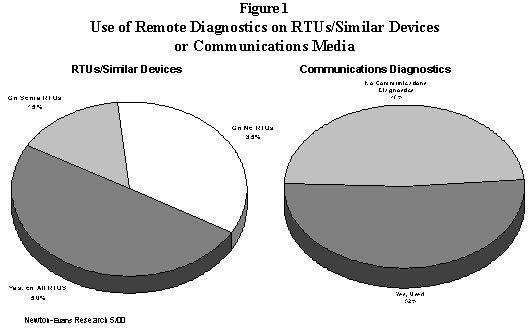
On The Road Again….. The Millennium Year In Review December rolled around mighty quickly for us again this year. The conference season started for me with a trip to New Orleans in February to speak on automation trends in monitoring at the EPRI Substation Diagnostics Conference. Some great presentations and discussions, but like so many areas of electric utility operations and engineering, the diagnostics and monitoring segment continues to make technical breakthroughs, and lowering equipment costs, but the group still has to fight hard for every sale. Later in February, it was off to Miami to participate in Distributech 2000, a more “globally themed” conference and exposition, with participation from technology and automation providers serving the oil, gas, water, communications and electric energy businesses and utilities. In March, the ENTELEC Conference and Expo was held in Dallas provided the chance to see some solid new control-related technology from the likes of Honeywell, Bristol, Foxboro, Neles and others. This was a nice tie-in for our international study of oil/gas control systems. At the end of the month, it was off to Prague for the Eastern European Power Conference. This meeting was attended by the energy industry’s movers and shakers from the ministerial level on down, from a dozen eastern and central European countries. April meant time spent in Cincinnati, site of this year’s T&D World Expo and Conference. The conference was electricity specific, but had great content. A full day roundtable discussion involved representatives from the management-consulting field; IT services providers, an ISO president, the Intertec staff and the EEI. I was privileged to be a part of this intensive topical discussion group. With June came the second opportunity in a year to visit Nice (1999’s site of the CIRED power distribution Conference). This June, Nice hosted the global natural gas community’s tri-annual get-together sponsored by the IGU (International Gas Union), with about 5,000 attendees from every corner of the globe. IEEE’s Summer Power Meeting was held in Seattle in July. As a member of a substation committee panel session, it was terrific to share insights with a group of excellent, well-prepared participants and an interested and knowledgeable audience. At the end of August, it was back to Europe to France, to participate in the CIGRE Conference, held every two years in Paris. The exhibition provided the two thousand attendees with opportunities to see demonstrations of the newest in computer and automation technology from about 100 global and regional market participants in the high and medium voltage market. Vienna was home this October to Distributech Europe, which provided the venue for another speaking engagement. The topic was substation automation, and developing Internet technologies. In November, participation in an international power systems conference held in Iran stressed the fact of our common humanity and the issues that face us day-to-day making energy available, and keeping the power flowing. All of these common issues help unite rather than separate us. With nearly 2,000, mainly Iranian, delegates, the conference was topnotch. In mid-month, I attended the GE-sponsored substation monitoring and diagnostics User Group meeting. Related companies were invited to exhibit as well, working as a community to help spur the growth of the whole market segment. Also in November was the UTECH 2000 conference which attended by electric, gas, water and communications people. A presentation on “extranets” affecting the energy delivery business was exciting to prepare and to deliver. Bottom line, the planes are more crowded, but the airlines have been doing a great job keeping things moving. Customers are interested in moving ahead with automation, but suppliers are not yet providing the “worksheets” to enable customers to properly evaluate the cost/benefit ratios that would convince management to fund more advanced projects and get customers beyond “pilotitis.” Industry growth in use of automation and control technology is positive, but is still affected by cyclical buying, by uncertainty over electricity deregulation, and by a “don't fix it if it ain't broke” mentality in some organizations. Oh, yes, another 40 trips to as many cities to meet with client firms! Newton-Evans Research has compiled a comprehensive list of upcoming trade shows, conferences and exhibitions for the three utility groupings through year-end 2001. The complete list of nearly 50 functions can be found on the Newton-Evans website. A sampling of key events include: ELECTRICITY EVENTS IEEE Power Engineering Society (PES) Winter Meeting Electric Power 2001 American Power Conference Power Engineering Society Power Industry Computer OIL AND GAS EVENTS DistribuTECH 2001 NPRA International Petrochemical Conference 18th World Energy Congress WATER EVENTS Water Information Management & Technology Conf. AWWA Annual Conference 2001 Remote Diagnostics Usage in Remote Terminal Units Earlier this year, Newton-Evans Research Company conducted a proprietary study on determining trends in the area of remote control and remote monitoring of the distribution system, including distribution substations and distribution feeders. Electric utilities in both the United States and in Canada participated in this research effort. One topic covered in this research effort included the use of remote diagnostics on remote terminal units (RTUs) and similar devices, as well as on communications media. One-half of all the respondents to this question indicated use of remote diagnostics for all RTUs. Fifteen percent use remote diagnostics on some remote terminal units, while the remaining 35 percent noted no use of remote diagnostics for any RTUs. There is some difference among the respondents from Canada compared with those from the U.S. Canadian utilities are less likely to use remote diagnostics on all RTUs (by 43 percent to 52 percent). However, 36 percent of the U.S. utilities were not using remote diagnostics at all, compared with 29 percent of the Canadian respondents. Overall, 52 percent of the group reported use of remote diagnostics on their communications media, including one-half of the U.S. respondents, and 60 percent of the Canadian respondents. See Figure 1 for a graphical representation of the use of remote diagnostics on RTUs/similar devices or communications media. Respondents were then asked if RTU software can be upgraded remotely. In only about 18 percent of the cases was this considered possible (19 percent - U.S. and 11 percent - Canada).
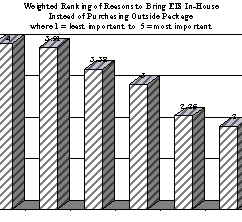
Energy Information Systems Software in Generation Companies and the Power Marketing Business Recently, Newton-Evans researched the area of the use of energy information systems (EIS) by generation companies and the power marketing business, in an attempt to portray the trends occurring in this market. EIS software is basically defined as asset optimization, system trading, risk management, settlement/billing systems, or overall energy information management system. One segment of the study related to internally developed EIS. Respondents ranked the importance of six decision-making factors that could cause or did cause them to bring the EIS effort in-house. Two factors outranked the others in terms of importance to this group. These were: "did not find a software solution that could easily integrate into our current platform” (rated as a 4.0) and “did not find a software solution that adequately met our functional requirements” (3.91). Next were “feel our in-house systems are adequate” (3.38) and “financially capable, but can't justify value of out- side systems to internal management/users” ( 3.0). Two lower rated reasons were: “budget constraints – most systems have been too expensive to consider” (2.25) and “trading volume and/or generation assets are not yet at a point where purchase can be justified.” This was rated as a 2.0.
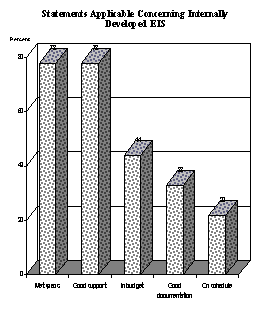
Survey respondents were then asked to indicate which, if any, of five statements characterized their in-house
EIS systems efforts. Response alternatives:
The two most prevalent statements were that the system performance was up to specs and that the system is adequately supported, mentioned by more than three-quarters of those responding to this question. Forty-four percent indicated that the systems were developed within or under budget; 33% mentioned that the documentation was thorough and well-maintained, and twenty-two percent noted that the system met the implementation schedule. Worlds Apart: Comparing Regional Utility Approaches to Automation Over the past several years, whenever possible, Newton-Evans Research has included one of Chuck Newton's monthly columns entitled AUTOMATION PERSPECTIVES published in Transmission & Distribution World magazine. The following article appeared in the September 2000 edition. A majority of the North American and International utilities that participated in the Spring 2000 survey covering substation automation trends have now established some strategy for substation automation efforts. However, a substantial difference in perception between these two geographically different groups exists when it comes to obstacles to implementing these strategies. The 51 international utilities ranked “lack of standard protocols” as the most important obstacle, in spite of fairly strong acceptance and use of IEC’s 870-5-based approach. “Lack of economic justification” followed, with “uncertain management philosophy” next. Among the 69 participating North American utilities, “benefits not outweighing the costs” was the most important obstacle. “Lack of funding” was next, followed by “not enough skilled internal staff.” These are fairly important differences. It is no wonder global corporations addressing this market cannot take a single worldwide-solution approach, since the needs and working environments of utilities are approached quite differently based on location – at least in the context of North America versus international regions. Continuing with some of the key differences between the two groups, spending estimates differ on a scale of 15 to 1 (international to North America) for the level of planned spending on new substation programs, in favor of the international community. For retrofit programs, the ratio of spending is not quite as strong (9 to 1) but is still impressive. One of the underlying reasons for such a difference in spending may be found in responses to subsequent questions in the survey. For example, international utility officials are far more likely to buy from larger suppliers (28 percent to 7 percent) and from systems integrators (22% to 3%), and are still more likely to bring in consultants to assist in planning their substation programs. In other words, the commitment is bigger and the funding is more significant in the rest of the world than it is in North America. More than one-half of the North American utilities indicated plans to “buy the required equipment and do their own integration.” This approach seems to fly in the face of later responses that indicated that utilities are quickly approaching the time when they will have to outsource a variety of related services, such as training, commissioning and testing, and IED configuration support. Also, it appears that North American utilities are slower to move to data-warehousing technologies than their international counterparts. One-third of international utilities already use data-warehousing techniques, while less than half that percentage of North American utilities do. Another partial explanation for the discrepancy may be the amounts and types of substation data being brought back to the control center. International utilities are likely to bring back more types of data on a continuous basis than are their North American counterparts. Plans in both regional groups call for more relay data, harmonics information and equipment temperature data being transmitted. Another key to understanding the substantial differences in plans for substation automation may be found in the stage-setting levels. International utilities might be further ahead by virtue that they have made more and broader investments in smart RTUs. Such RTUs are in place in 60% of international utilities, compared with 38% in North American utilities. Plans call for North American utilities to catch up over the next five years. Today, North American utilities are likely to restrict substation data brought in only through supervisory control and data acquisition (SCADA) or energy management systems (EMS) centers (49%, compared with 35% for the international community). North Americans also are more likely to communicate with feeder IEDs and load control systems, while the international community is more likely to send substation data to trouble call management systems and regional control systems. Plans across the world’s utilities call for automated substations to communicate with more varieties of systems in the not-so-distant future, including distribution management systems, AM/FM/GIS, trouble call management and protection engineering desktop systems. How will these discrepancies in substation automation tactics and strategies converge over the next few years? The answer lies in whether electric-utility deregulation becomes more of a national-level mandate in the United States and Canada, just as it has in other parts of the world. This has made the biggest difference, because resulting “utilities” or energy entities know exactly where they stand. In North America, deregulation has become a tedious, drawn-out and perhaps inequitable process with little regard for the ultimate benefits of the smaller electricity user. With all eyes on profits, little heed has been paid to the need for infrastructure spending in this extended interim of uncertainty over deregulation. Recently considered a dead issue, load control is now resurfacing as a hot topic in those regions where demand is approaching and/or exceeding capacity. In other regions, utilities are phasing out load management/demand side management (LM/DSM) programs. Similarly, some public service commissions are actively promoting load control, while others are doing nothing. Chuck Newton's January 2000 Automation Perspective Editorial in T&D World magazine explores this duality, and Newton-Evans first LM/DSM study since 1996 will shed light on the status of load control in U.S. utilities. The research will be completed by year-end 2000, and results will be available early next year. Several topics of interest that will be investigated include: The Role of the Research Institute in the Evolution of Electric Power Systems in Developing
Nations: The Example of Iran As a large 1.6 million square kilometers), and heavily populated 62 million residents), developing nation, Iran has struggled with growth in electricity usage over the past several years. During the 1990’s, the country made real progress with regard to its electric power industry on two fronts: first, in privatizing major components of its electric power industry, and secondly, in decreasing both the frequency and duration of electric power outages. This article addresses the role of the Niroo Research Institute (NRI) and the relationship of NRI to the electric power industry in Iran’s push for modernization. It also addresses the viability of public-private sector cooperation to advance a developing nation’s infrastructure and self-reliance. “Niroo” is the Persian word for “power”. The NRI is the top-level organization encompassing the country’s Electric Power Research Center, EPRC, the Iranian version of EPRI. EPRC contains five research centers, including: control and dispatching; T&D; power generation; renewable energy and environment; and power system. The control and dispatching research center includes four departments: electronics and controls; dispatching; communications; and computer. The NRI’s EPRC has had some real successes, including the design of DMS, SCADA and GIS applications and systems. The Institute is also active in the development of power analysis and short circuit analysis software. As well, NRI has successfully designed a new generation of RTUs (substation and distributed types), relays, programmable logic controllers, and power line carrier hardware. The Center has recently completed design of a distributed RTU suitable for the Iranian distribution network. The next step, now underway, is the solicitation of interest by NRI for a technology transfer license among private sector Iranian companies, who will then have the rights to manufacture and sell the RTU. In the mid-1990’s NRI had been the principal specifier and buyer as well as instrumental in designing and commissioning a very modern control system for coordinating generation and transmission activities. Consisting of a national control center featuring an ABB-supplied energy management system, and six regional operating center control systems supplied by Hitachi and ABB, this significant national effort has now been successfully implemented for a few years. Currently, NRI’s attention is being turned to the need for better electric distribution service to support a growing commercial and industrial base, especially in the greater Tehran region. The biggest problem, according to Ali Reza Shirani, Vice President of Research for NRI, is still the frequency of electricity outages. The country suffers through a few distribution level outages annually, adding up to about 30.5 hours of power outages. This distribution outage level is down significantly from ten years ago, due to the significant research and development made in the optimization of the country’s transmission of power, also designed and engineered with the help of NRI. In total, the distribution load is served via a network comprised of 202,521 kilometers of 20 kv lines, and another 187,450 kilometers of 400 volt lines. There are more than 60 electric power distribution companies operating within Iran to serve a mixed distribution load. Residential use accounts for about 36% of electricity demand, while the industrial load is about one third of the total demand, and commercial, agricultural and public use accounts for the remainder. Today, the problems faced by the Distribution Operations departments of the five electricity distribution companies serving the Tehran region are significant because at the present time there are no computer-based systems of control available at the distribution level. Everything is paper-based. So it is a labor-intensive effort to determine the location and cause of outages, and then resolve the outage condition and restoring power. This is an effort that currently takes about three hours (MTTR) per outage occurrence. Mr. Shirani is hopeful that within a few years, the country will be able to implement distribution automation techniques, controls and intelligent electronic devices that will serve dual roles. The primary role will be to provide an outage management capability, and secondly, the equipment and centralized control computers will serve as a distribution management system. As mentioned earlier, five of the country’s electric power distribution companies serve the greater Tehran area. The city of Tehran is huge, both in terms of population (12 million residents) and in terms of service area (80 km x 100 km). The current situation is one in which there simply is no control system in place at the distribution level. There is a concurrent need for a distribution-dispatching center. According to Shirani, the four objectives for a computerized distribution management system for the Tehran area include: first and foremost, a fault location capability; then fault removal; then re-energization of the unaffected feeders, and finally, total power restoration. NRI has succeeded in developing a line of relays and RTUs for use in development of an approach to better distribution system management. Around Tehran, leased lines are currently used for utility communications, with a move to digital line carrier technology underway. One of the problems encountered in the Tehran area is the loss of line carrier signal reliability caused by significant load growth, centered on increased use of motor drives by industrial segments and by expanded use of fluorescent lighting in the commercial sector. Future communications planning is being centered on the installation of optical fiber lines and the use of spread spectrum technology. To meet the increasingly demanding customer requirements in the Tehran area, NRI has developed a fault impedance relay, and a local manufacturer has been selected to manufacture this relay. The design objectives include fault recording, event recording and a capability to distinguish between faults and loads. This is made more difficult because distribution loads are running close to short circuit limits. The use of the new distribution automation developments made by NRI is expanding beyond Tehran. Already the Qom city area, just south of Tehran, has contracted for a similar distribution automation program, as has Kermanshah, another important city that had suffered infrastructure damage during the Iran-Iraq war. These represent different customer types, with different load mixes and different climates and topologies. Within this developing country, with its recent history of rapid urbanization, NIROO RESEARCH INSTITUTE (NRI) has played a vital role in ensuring a more reliable supply of electricity to support the development of industrialization within Iran, and to provide the expanding urban population with an increasingly reliable supply of power. By designing, developing and then licensing the manufacturing of automation systems, products and equipment, such as protective relays, remote terminal units, SCADA systems, power system analysis software, programmable logic controllers, power line carrier management systems, and similar efforts, the NRI is making a major contribution to the country’s infrastructure development. The relationship of NRI to the electric power industry in Iran’s push for modernization can serve as a model for other developing nations. The Institute has successfully demonstrated the viability of public-private sector cooperation to advance a developing nation’s power delivery infrastructure and self-reliance from needed technology design through to product and equipment manufacturing. For further information on this study, please
call Newton-Evans Research at 1-800-222-2856 (or internationally,
1-410-465-7316) or visit us on our website at www.newton-evans.com. |