|
Winter 2002
Outage Management and Trouble Call Systems: Then and Now As Automation Columnist for Transmission & Distribution World magazine,
Chuck Newton has recently written several timely articles, including:
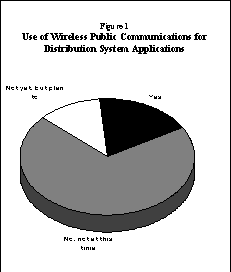
The following article on outage management and trouble call systems appeared in the May 2001 edition of Transmission and Distribution World. Automation Perspectives last featured a discussion of computer-based outage management and trouble call systems in early 1996. Of real concern for the industry was and still is the issue of managing unplanned outages, such as those caused by storms, other acts of nature and major equipment failures. In the intervening five years, there has been a proliferation of new product announcements relating to the provision of outage management systems and packages from several provider types. The available varieties of OMS range from trouble call and/or outage "modules" available from supervisory control and data acquisition (SCADA) and distribution management systems (DMS) suppliers, the geographical information system (GIS) community, and customer information system (CIS) package providers, to firms specializing in building links between operational control-center-based resources and enterprise-computing applications. Still others not only build the linkages, but also provide work and asset management and crew scheduling software packages, incorporating outage management modules to one or more types of public services. There is also great variety in the depth and breadth of individual modules, packages and approaches to OMS. For some utilities, a modular approach to OMS is a workable solution. For other utilities, especially the Top 100 or so, a complete DMS, integrating an OMC capability, may be a better solution. When we take a look back at what else has changed over the past five years, it is interesting to note that many utilities have continued to discuss the need for trouble call and outage management. However, they have not been successful in implementing their OMC plans because of any number of factors, from budget limitations, to lack of human resources, to a continuing concern with deregulation in their states, to other utility and information technology (IT) priorities. Industry marketing studies continue to report that outage management (as well as other distribution network management systems) will continue to grow in importance as power-delivery-system reliability becomes a competitive factor, and as reliability-performance measures become an increased interest of public utility commissions. These findings have been reported in North American and international electric-power industry studies of electric-power SCADA/DMS and distribution automation. One of the overriding concerns of utility IT management today is phased developments on large information technology projects, where they are on the "'enterprise" side of the business or on the operational side. What this often means is that only one or two major IT projects are worked on concurrently in any company. In addition, utility information technology staffs have not grown measurably since 1996 and budgets remain tight, at least in the public sector utilities. One of the issues facing potential new users of outage management software is that of the "stand-alone" versus the "integrated" nature of the application. Unlike many other utility applications, outage management is totally reliant on external linkages to consumer information systems, SCADA/DMS systems and service dispatching-crew- scheduling operations. The need for OMS suppliers to combine elements of the real-time SCADA system with transaction-oriented and event-driven information systems is critical. The need for OMS to be geographically driven is yet another consideration. There are still hundreds of utilities in North America, and hundreds more worldwide, without any significant GIS available. Substantial progress has been made in many of the Top 100 utilities of the country and another Top 100 around the world, whether these are investor-owned, publicly operated or cooperatively owned. It is the middle tier and smaller electric power-delivery utility that struggles to staff and fund programs that will enable computer-based outage management. The more people in the industry with whom one discusses these related issues, the more one realizes the OMS area is a lot like the topic of substation integration, and automation activities - a need exists for strong interdepartmental coordination, buy-in and agreement. No single business unit is totally responsible for outage management. A coordinating, interdepartmental project team seems to be the best way to undertake these "enterprise-type" programs and projects. If anything, OMS cuts across even more areas of the utility than substation integration does. The great majority of managers interviewed in one recent study stated that interdepartmental project teams proved to be a help and not a hindrance in technology projects such as OMS planning and development. The Internet is also quite likely to be playing a role in OMS activities. Nearly one-third of North American utilities today indicate some use of the Internet or corporate intranet to provide outage updates, which is a higher Internet usage rate than for any other of the distribution-related applications listed. Wireless Public Communications vs Private Wireless Approaches to Distribution System Application Commencing in first quarter 2001, Newton-Evans Research began publication of its five-volume report series entitled "The Worldwide Market Study of Supervisory Control and Data Acquisition, Energy Management and Distribution Management Systems in Electrical Utilities: 2001-2003." This report series was prepared based on primary research data collected from electric utility engineering and operations managers worldwide. Volume I is the North American summary of research findings based on 297 U.S. electric utilities and 37 Canadian electric utilities. Volume II is the international market survey and analysis, representing 72 utilities from 52 countries. The next part contains a world market assessment and forecast. Volume IV profiles 26 EMS/SCADA suppliers, and the final volume contains a two-page description of each responding utility worldwide. Respondents to the survey were asked to indicate any current or planned use of either wireless public communications (such as cellular) or private wireless approaches to distribution system applications. A total of 252 North American utility officials replied to the first part of the question. About a one-in-five rate of use of wireless public communications was indicated, with another 12 percent likely to begin using this type by 2003. Seventy-one percent of these officials were not using, and had no plans to use, wireless public communications in the foreseeable future. It can be noted in the study that the largest utilities are much more likely to be using wireless public communications today than are their small utility counterparts. See Figure 1.
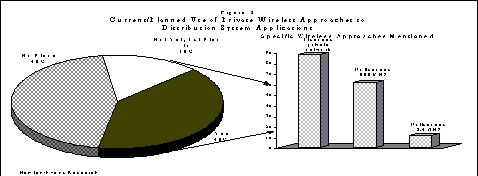
The specific applications mentioned by many current users of public wireless communications from these respondents centered on metering - either AMR or substation metering. Other distribution automation and management applications mentioned included poletop device communications, capacitor switching, feeder automation, and distribution SCADA. Wireless communications technology use centers on cellular and CPDP, followed by radio (MAS and spread spectrum). The second part of the question elicited responses from 245 officials. Summarily, 40 percent of the officials indicated that they were currently using private wireless approaches to perform distribution system applications. Another 15 percent had plans to do so within the next 36 months (by the end of 2003). Utility officials were then requested to identify whether the private wireless approaches are or would be private licensed networks or unlicensed in either the 900 MHZ range or the 2.4 gigabit range. Seventy percent who indicated some use or plans to use private wireless approaches cited use of a licensed private network. Forty-nine percent also cited use of unlicensed 900 MHZ. Nine percent of the officials indicated use or plans for using 2.4 GHZ unlicensed radio. See Figure 2 for this information.
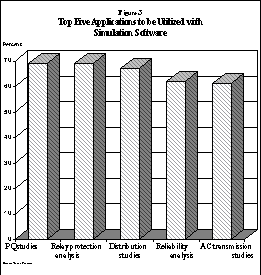
Power Quality Studies Applications to be Used with Simulation Software Newton-Evans completed a study on the use of general purpose time domain simulation tools for studying transient behavior of electrical networks. Simulation software was defined as software used to simulate any circuit of any size accurately and efficiently. The software has many advanced features to boost productivity, including intelligent data forms, interactive control and feedback, up-to-date documentation of the circuit along with plans and comments, context sensitive help, hierarchical designs and multiple levels of zooming. The product is multiplatform, totally graphic, and modular. Respondents were requested to indicate the applications utilized or to be utilized on this type of product. Of the 17 applications listed on the questionnaire, the top five with the most mentions were: power quality studies, relay protection analysis, distribution studies, reliability analysis, and AC transmission studies. See Figure 3.
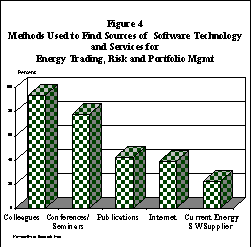
Power Marketing Business of Interest to Newton-Evans Clients One area in which Newton-Evans has recently completed research studies concerns power marketing businesses and electricity generation companies. One study was conducted in order to determine the direction in which energy trading will be proceeding over the next several years, from the viewpoint of officials in generation companies and the power marketing business. Respondents were asked what channels were used to find sources of software technology and services for energy trading, risk assessment and portfolio management. Eight methods were listed on the survey, including: print and on-line publications; Internet search; attendance at conferences and seminars on related topics; contacting the company's current IT hardware suppliers, enterprise systems suppliers, and energy software suppliers; checking with trade associations, and, talking to colleagues in the industry. Ninety-four percent of the respondents indicated that they would first talk to colleagues in the industry, followed by 78 percent making use of energy trading-related conferences and seminars. Forty-two percent use print and on-line publications, and 39 percent indicated they would search the Internet for software and related services sources. The remaining methods listed received less than one-fourth response. Contacting current energy software supplier was mentioned by 22 percent, and 19 percent mentioned calling their current enterprise system suppliers. Only 14 percent indicated that they would check with trade associations, and 11 percent would contact their current IT hardware supplier. See Figure 4.
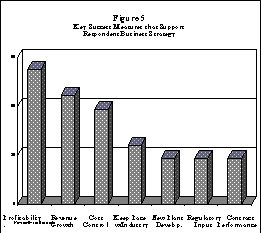
Specific mentions of print and on-line publications included: Risk Magazine, MW Daily, Power Markets Week, Hart's Energy Market, Energy & Power Risk Management, BTU Weekly. Another topic researched by Newton-Evans in this subject matter related to the determination of business planning practices for Gencos and power marketers throughout the U.S. Respondents were asked to indicate the key success measures that support their company's business strategy. Seven specific success measures were listed on the survey. Based on these measures, in the short term, respondents ranked profitability as the most frequently mentioned success measure, as identified by 83 percent of the group. This was followed by revenue growth (67 percent), cost control (58 percent), and keep pace with industry changes (36%). See Figure 5.
Reduction of System Peak Is Most Important Priority for Survey Respondents A three-volume series of reports on the outlook for load management and DSM initiatives in a deregulated U.S. power industry was released by Newton-Evans Research in Second Quarter 2001. This research was an intensive effort at assessing the future for load management and demand side management programs in an era of deregulation. The definition of load management used in our research was "involves controlling system loads by remote control of individual customer loads by switching a very large number of customer loads to reduce total system demand, station or feeder loads for normal or emergency conditions; and switching meter registers - to accommodate time-of-use rate structures, where these are in effect. May include optional monitoring of substations and feeder loads to verify that the required magnitude of load reduction is achieved for normal and emergency circumstances; and switch status - system configuration information required when LM is involved as a remedial measure." U.S. electric utility officials were asked to rank 25 load management objectives as practiced by their utility. Across all respondents, reduction of system peak was the most highly rated objective for load management systems. Reduction of high cost energy purchases and economic advantage for the utility and consumer savings followed. Investor-owned utilities were likely to rate all other considerations higher than did their counterparts from the public power or cooperative segments. One exceptions to this was that cooperatives were adamant about wanting to capitalize on their existing load management/DSM. Investor-owned utility participants placed higher levels of importance on many objectives, including these: reduction of reserve requirements; reduction of capacity constraints; do our part to maintain overall system stability; defer generation requirements; provide a societal benefit; stay ahead of the competition; provide the customer with a choice of when, and at what price, to buy electricity; fulfill the utility’s obligation to the ISO/pool; and, be in regulatory compliance. Figure 6 depicts this information on a summary basis.
Newton-Evans Services and Reports Our primary business is providing client-exclusive marketing research. The high quality of our action-oriented research reports is known throughout the industry. Marketing analysis and business recommendations are crisp, clear and based on real-world information and marketwise intelligence. Newton-Evans also regularly publishes multiclient (syndicated) research studies of energy industry uses and plans for computer, communications and control systems and related fields, such as metering, monitoring devices and power equipment used in power generation transmission delivery and in pipeline operations for gas, oil and water. Services provided include teleconference consulting, telephone inquiry service and onsite briefings. Following is a list of currently available multiclient marketing research reports.
Our next two multiclient series will cover:
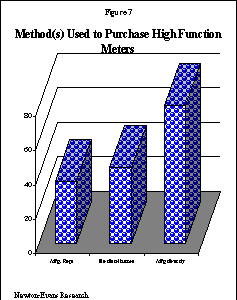
Preferred Method of Purchasing High Function Meters The high function meter market is divided into three levels. A level 1 meter consists of 4 quadrant metering, power quality, outage, transformer loss compensation, telephone and cellular modem 4 channel data recorder. The price range for these meters is below one thousand dollars. A level 2 meter contains all the level 1 elements, plus 4 cycle analysis, more communication operations, and 12 channel data recorder. The price range for these meters is between $1,200 and $2,000. A level 3 meter contains all the level 1 and level 2 elements, plus 48 data channel recorder, DNP communications, ˝ cycle analysis, waveform analysis, Ethernet, and multiport data communications. The price for these meters is over $2,000. One question in a proprietary study completed by Newton Evans in 2001 concerning high function meters was to indicate the method(s) used to purchase such meters. Three methods were listed on the survey, and all three methods of high function meter procurement were important to the responding group of U.S. electric utility officials. The list included: manufacturer direct, distributors, and manufacturers' representatives. Manufacturer direct was the most important of these channels. Eight-five percent of the utilities purchase at least some high function meters directly from the manufacturers. Forty-four percent make some use of electrical distributors, and 36 percent utilize manufacturers' reps. See Figure 7.
Newton-Evans' International Focus Continues to Grow Newton-Evans Research has quietly developed strong partner relationships with a number of international research and consulting organizations over the past three years. Yet another partnership is being formed in the People's Republic of China. Our international partners and affiliates are based in Buenos Aires, Argentina (providing coverage of Central and South American utilities and pipelines): Limassol, Cyprus (covering the Mediterranean, Middle Eastern and North African regions); Oss, The Netherlands (covering Western Europe in native language surveys); Novgorod, Russia (covering Russia, Ukraine and Eastern European markets). We have multilingual staff support in these international locations, enabling us to conduct native language research programs with engineers and managers in utility and pipeline operations around the world. Each office has now participated in several international client and company studies. For further information on this study, please
call Newton-Evans Research at 1-800-222-2856 (or internationally,
1-410-465-7316) or visit us on our website at www.newton-evans.com. |