DISTRIBUTION MANAGEMENT OBJECTIVES REMAIN THE SAME Transmission & Distribution World November 1996 By Chuck Newton, Automation Editor
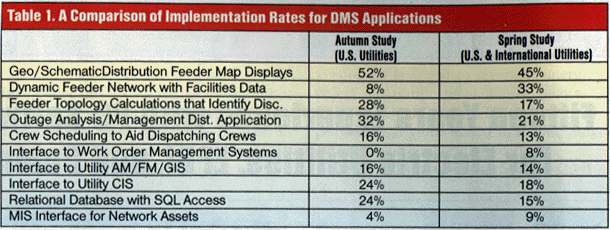
Newton-Evans Research Co. recently completed its second survey of the year on plans for distribution management systems (DMS) at electric utilities. Out first study, conducted in the first quarter of this year, surveyed utility officials from 20 countries. A summary of this "baseline" study was included in the April 1996 Automation Perspectives department. A brief review of the spring 1996 study shows that the survey included a ranking of DMS objectives by more than 125 utility officials. This group indicated the importance of two of seven listed objectives - minimized outage duration and extent, and improved customer service response. Nearly two-thirds ranked these as the most important or second most important objectives of distribution management systems. The determination of outage location was the next most important objective, followed by actual cost savings. On that same survey, respondents provided information regarding communications linkage required between the DMS and other systems. Not surprisingly, direct real-time links were cited as required for supervisory control and data acquisition (SCADA) (82%), service dispatch (57%), customer information systems (53%) and automated mapping/facilities management/geographic information systems (AM/FM/GIS) (43%). The new survey, undertaken in autumn 1996, requested activity and usage information on various DMS applications. Among the subset of respondents with true DMS capabilities, feeder map displays were indicated as being in use by 52% of the reporting sites, followed by outage analysis (32%) and feeder topolgy calculations (28%). Plans for implementing additional applications centered on interfacing to an AM/FM system (56% citing plans to do so by 1998). This was followed by interfacing to work order managment systems (48%) and relational database/SQL interface plans (40%). Table 1 shows a comparison of implemented applications among the two utility groups participating in these research programs.
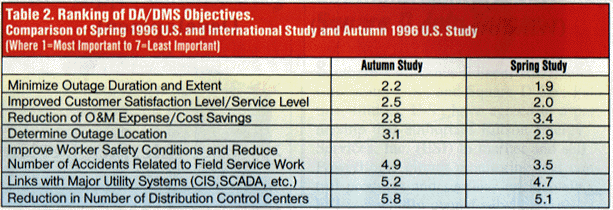
When it came to "sourcing" for the various DMS applications, "third party" software and DMS specialists were looked to for these applications more than internal efforts for SCADA vendors for all applications (except the relational database/SQL interface). Most reassuring to me as a survey-based researcher was a finding from the autumn study, which was conducted with a different group (less than 5% overlap in respondents) of utilities than had participated in the spring 1996 study. Just as we had requested in the spring study, the autumn study asked the respondents to rank the importance of alternate DMS objectives. The objective mentioned most was "minimizing outage duration and extent," followed closely by "improved customer satisfaction levels." Table 2 compares rankings of DMS objectives reported by both study groups.
The distribution automation portions of this newer study also requested voltage levels to which capabilities for remote monitoring and control would be provided. Nearly two-thirds of the respondents indicated that they would provide coverage to specific distribution voltages, centering around 12 kV. The remaining one third said that they plan to provide distribution automation capabilities down to the "customer premises" level for both residential and industrial sites. Communications methods used and planned for as reported in the autumn study also corroborated the findings from the earlier study. Here, leased lines and two-way radio remain very important. Plans to use center around fiber and two-way radio and cellular. The only communications method cited by respondents as "plan to discontinue" was the used of leased lines. We will continue to follow the evolution of the DMS and distribution automation markets at least semi-annually in future columns. |