| MAKING THE CASE FOR SUBSTATION AUTOMATION
Transmission & Distribution World December 1996 By Chuck Newton, Automation Editor
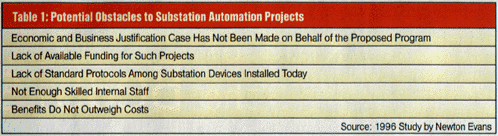
As I have stated before in this column, justifying a business case for all types of T&D technology is increasingly critical with the dawn of the competitive utility era. Substation automation is no exception. Respondents from a recent substation automation study ranked the "lack of economic and business justification" as the most important potential obstacle to implementing substation automation programs (Table 1).
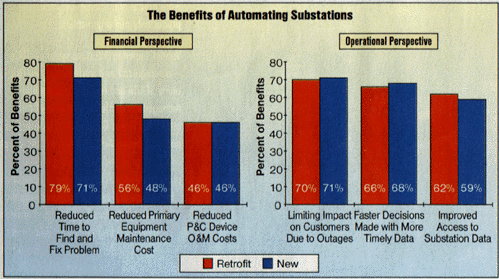
Managements interest in programs varies depending on whether the issue is retrofitting older substations or constructing new state-of-the-art substations. For both new and retrofit substation programs, the primary financial benefit listed by the survey respondents was "reduced time to find and fix problems." This was followed by "reduced primary equipment maintenance cost" and "reduced O&M cost for protection and control devices." For new applications, "reduced wiring costs" was also identified as an important benefit. A review of responses from operations personnel revealed 16 potential benefits associated with substation automation and integration programs. The 100 substation planning engineers and managers surveyed said that the most important issues to them were "limiting impact on customers due to outages," "faster operational decisions made with more timely data," "improved access to substation data" and "improved power system flexibility and reliability (see chart)."
Data Requirements "Alarm data" is the most important type of substation information that must be reported back on a continuous basis to the master station location. However, alarm data is just one of a cluster of data points to be reported continuously. Other key items include circuit breaker status, line voltage readings and real-time data sampling (watts, VARs, volts, and amps). Emerging Trends Utility engineering staffs participating in this research program reported "an increased recognition, understanding and acceptance of the benefits and importance of substation automation" by a whopping 73% versus 25% who did not report such a change over the last 24 months. |