|
Striking a Balance in T & D Operations Transmission & Distribution World July 1996 By Chuck Newton, Automation Editor
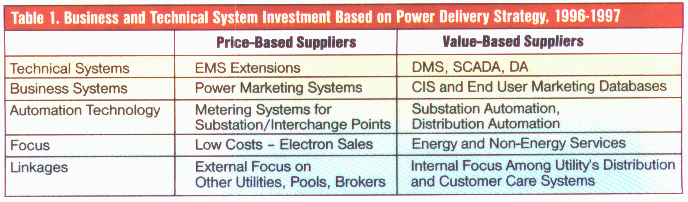
Every senior and mid-level manager in hundreds of electric utilities like yours around the world is aware of the conflicting needs -- repeated at almost every industry conference, company meeting and documented in current trade literature -- to cut operating costs and pare staff to "survive," let alone prosper. And yet, that seemingly goes against the logical grain of reinvesting in order to attain or maintain a truly reliable, customer-focused T&D network. Ah yes, conflict resolution at its best ... or worst. In the current cost-cutting environment of the utility business, it seems like we are operating out of synch, if not out of reasonable concern, with likely future demands on our electrical systems. In retrospect, we owe a debt of gratitude to engineers in utilities and in industry, who perhaps foresaw an era of tightfisted spending when creating a "gold plated" T&D infrastructure. "Paring costs to the bone" offset by cries to "invest now in automation and increased information technology" are causing a "do-nothing" attitude concerning new investment programs. In several utilities, it seems that the greatest requirement is for operations and engineering managers to be able to make strong business cases to support activites they believe are in the utility's best interests. Instead of relying solely on cost cutting to be competitive and thereby making price the principal differentiator between electricity supplies, the "winners" over the long-haul will be those utilities that strike a balance between reasonable and prudent budgeting for T&D operations, including funding for automation programs. With this balance, these utilities will be able to focus on customer services, power quality and energy services as a principal product differentiator. These utilities will tend to invest more in various types of distribution management and automation systems. Utilities that decide price will be the principal market differentiator for their current and potential customers are making a big mistake if they do not invest in and expand their real-time information networks, interfaces to other utilities and power brokering organizations. The expansion of today's energy management systems capabilities will be vital to these organizations. Access to real-time electron pricing will be fundamental to their decision-making capability. For the utilities that focus on services and value differentiators, the distribution and marketing-centered information and automation systems (such as power quality monitoring and customer premises displays, instruments and monitors) need to be considered early on to help position these utilities properly. Interestingly, it turns out that whether management determines that the utility is or will indeed become a commodity provider of lost-cost electrons, thereby relying on becoming a low-cost provider, or whether the utility seeks to become a value-added energy services firm, thereby adding value to its electrons with related products and services, both require investments in business and technical information systems and both require additional investment in field automation (Table 1).
While the next 36 months will likely be as confusing as the last, one thing is clear: T&D investments in automation and computerization cannot be neglected if the utility is to stake out a leadership position in either low-cost electricity supply or as a provider of value-added energy services.
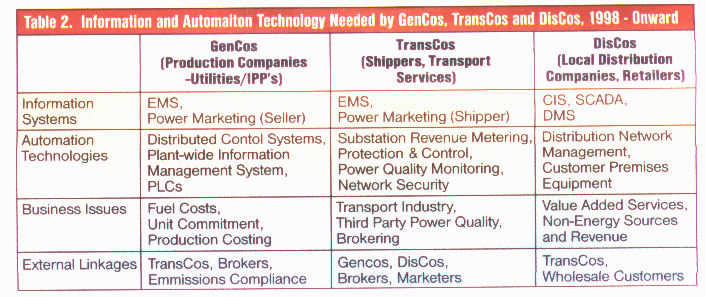
Systems integration firms and a combination of process and automation technology suppliers around the world stand ready to assist the electric utility industry with information technology solutions that can address the needs of both price-based and value- based suppliers. These same providers are preparing as well for the arrival of GenCos, TransCos and DisCos. Practically speaking, those three functions have been separated for the past hundred years anyway, at least on an operations level, if not on the a administrative and business levels. Table 2 looks at the information and automation technology likely to be needed by the three types of operating companies. |