TROUBLE CALL AND OUTAGE MANAGEMENT SYSTEMS Transmission & Distribution World August 1996 By Chuck Newton, Automation Editor
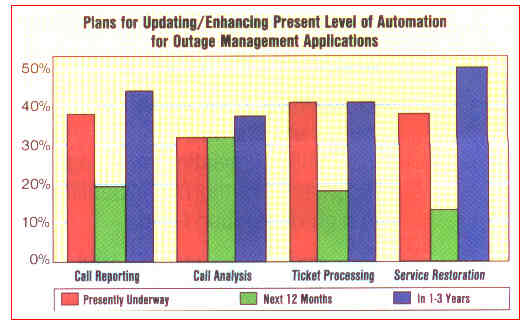
For the past three years or so, the terms trouble call management and outage management have taken on extra meaning and importance. The interest for many electric utilities is directly related to the recent increased focus on customer service and the development of specialized applications software. These topics are often discussed in light of the emergence and development of distribution network management systems and the extension of applications residing on distribution SCADA systems to include trouble call and outage management functions. Over the past several months, Newton-Evans Research has completed four related studies. One of the first concerns with systems design in this area is the philosophical question of "Who responds to incoming reports of electric service outages?" If this sounds a little unusual, it really is fundamental to the decisions taken by various utilities in their outage management design approach. Systems designs will vary based on whether all incoming calls are first handled by a switchboard (human operator or integrated voice response unit), and, if identified as a trouble call, whether they are then routed to either customer service reps or the operations side of the house. One recent survey of American utilities indicated that 71% rely on the operations group for trouble call handling while 27% rely on customer service center personnel. The analysis of current operating methods and procedures takes on added significance in light of the interest in the development of an integrated distribution management system. Why? Well, simply put, the way customer service functions are handled, including outage management, often serves as the basis for determining the linkages required between and among the various files associated with multiple departments. This is an opportune time to redesign the processes themselves, including the work flow related to trouble call management. If management of the customer services unit and the distribution operations units are not in sync, then sub-optimal coordination of customer outage and trouble call resolution will result. Another important factor to consider is how many customer service centers the utility operates. This is important because about 40% of large and mid-size American utilities and 60% of larger international utilities continue to operate multiple customer service centers. Many utilities around the world also operate multiple SCADA sytems. Often there is a one-for-one distribution SCADA system installed for every major customer service center, where these are both organized on a regional or geographic divisional basis. Two examples are Consolidated Edison Co. of New York, U.S., with its borough-by-borough divisions, and Hydro-Quebec, Montreal, Canada, with its multiple district customer centers. The utility industry's current progress with geographic distribution network databases provides yet another distinguishing feature for systems designers. In our recent studies, a growing percentage claim to have developed a geographic distribution database. The figure is now approaching the 25% range (about 30% for U.S. utilities and 20% for international utilities). These utilities have reported successful conversion of at least some part of their distribution network models. Most others are planning to have an AM/FM/GIS system for distribution networks in place by 1999. File linkage requirements between trouble call and other applications were especially strong for customer information systems, with AM/FM and SCADA interfaces following. More than 60% of respondents indicated a need for all three. Currently, efforts at improving ticket processing were cited more frequently than call reporting, call analysis or service restoration. Later this year, the automation development focus is likely to shift to call analysis and, by 1997, to service restoration and call reporting (Fig 1). Much of this work involved the move to paperless recording on computer screens for trouble call and outage events.
|