PROTECTIVE RELAY USAGE PATTERNS ARE CHANGING Transmission & Distribution World September 1996 By Chuck Newton, Automation Editor
During the late 1980s and into the early 1990s, a shift from reliance on electromechanical, single-function protective relays to microprocessor-based, multifunctional relays was developing. By about mid-1992, digital relays had made significant inroads in the world of electrical systems protection and control. Over the last four years, a major transition in specification and purchasing of protective relays occurred in North America as well as in the rest of the world. A comparison of major marketing research and product planning studies from 1992 and 1993 with studies undertaken in the third quarter of 1996 points up several signifcant changes. First, the majority of relays planned for purchase throughout North America are now digital rather than electro-mechanical, even for the more conservative utilities in the region. This preference extends to retrofit applications as well as for new installations. Secondly, replacement strategies include planned systemwide protection and control upgrades as well as reactive upgrades to digital units as older electro-mechanical relays fail. However, a significant minority of utilities plan to continue using and purchasing electro-mechanical relays for at least the next five years, especially for generator and substation applications. Such users claim that manufacturers can help them extend the life of their installed electro-mechanical relays by providing sufficient spares and by continuing to offer maintenance services. Transmission line protection at the EHV, HV and sub-transmission levels,
followed by distribution feeder protection, are the two categories where digital
relays have caught the attention of the relay engineering community. Why all the
interest in moving from the older, field-proven, electro-mechanical relay
designs to this brave new world of digital relays? Three key reasons, as ranked
by many of North America's leading relay engineers include:
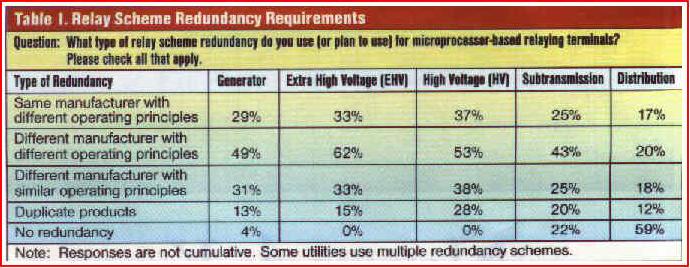
Relay scheme redundancy continues to be a key reason digital relays are chosen for generator protection, EHV and HV applications. According to the survey base (Table 1), relay engineers prefer to use relays from different manufacturers with different operating principals. In a majority of distribution feeder relay applications, no redundancy is provided.
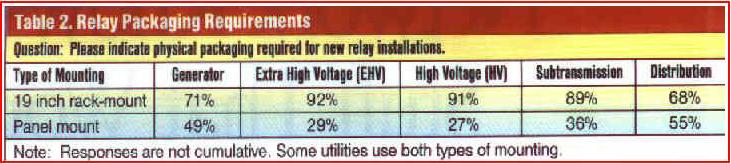
For new relays, physical packaging continues to be an issue, with 19-inch rack-mount favored in all application areas, but with strong indications of panel mounts for generator protection and for distribution applications. The three reasons relay packaging is an issue are that available space is tight, display viewing is desired and termination access is important (Table 2).
Relay data that is typically required for transmission to energy management and SCADA systems vary depending upon relay application. The exception is relay status, which is vital for all relays. Transmission line relays typically provide fault location and fault type, kilowatt-hour and kiloVAR information. Used in conjunction with high-end digital fault recorders, the ability of interconnected grids to locate outages and then track down sequence of events data will become increasingly important in North America and throughout the world. This type of data recovery approach has presumably enabled the WSCC and its member utilities to quickly pinpoint the location of outages as well as the type of fault that occurred this summer in that region. For distribution applications, relays are frequently required to transmit three-phase current data in addition to the above-mentioned categories. Substation relays provide three-phase voltage information. Relay communications pathing is mixed for many utilities, and again some variation is based on the specific protective relay applications. Most important is the ability of the relay to communicate with a substation RTU. However, engineers are increasingly indicating a need for relays to communicate with a substation computer via a LAN connection. For these reasons, both DNP 3.0 and MODBUS are indicated as the two principal relay protocols now being specified or named by relay engineers in our research. In fact, multiple protocols are being specified by today's relay engineers, according to this new study. |