TRENDS AND DEVELOPMENTS FOR U.S. SCADA SYSTEMS Transmission & Distribution World December 1997 By Chuck Newton, Automation Editor
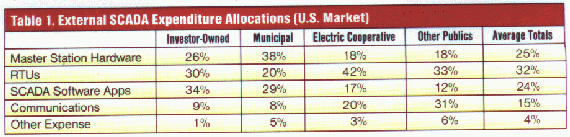
Did you know that there are at least a dozen separate industries or market segments in which supervisory control and data acquisition (SCADA) systems and remote terminal units (RTUs), typically associated with the electric utility industry, are used? While many of the basic applications are similar in function across industries, the applications associated with the electric utility industry tend to be the most demanding and require the most effort to develop and support. Electric utility SCADA systems tend to be more complex, use more sophisticated applications software, involve more I/O points and have a greater number of associated RTUs than comparable systems used in other industries. For these reasons and because of the utility market demand for electric utility-specific applications knowledge, there has not been higher supplier "cross-over" between and among SCADA system suppliers. Our December 1996-January 1997 study of more than 100 U.S. utilities points up this observation with dedicated suppliers such as ABB-SC, Advanced Control Systems (ACS), Cegelec-ESCA, Harris Controls, Ilex, Landis & Gyr, QEI and Valmet collectively representing about 90% of installed electric utility SCADA systems in the U.S. market. In the intervening periods between the Newton-Evans' studies of the American SCADA market, there has been little shift in industry-wide spending patterns, although the average contract values have decreased by about 5-10% per year for the past decade. Usage and spending patterns are clearly differentiated based on type and size of utility. See Table 1 for a view of how the SCADA budget for external spending is allocated.
Information Systems (IS) departments continue to play a somewhat muted role in influencing specifications and vendor selection for SCADA systems. Nearly half of the respondents from the current study claim that MIS has "no influence" on their SCADA-related activities. Of those who did note some MIS involvement, 70% said this amounted to only "some" involvement, not a great deal. Fewer than 20% of the utilities indicated that the IS group would "co-manage" or have "a great deal of involvement" in the next SCADA system's procurement. Eight SCADA specialist suppliers, led by ACS in mentions, received support from at least 25% of the utilities surveyed, as "likely to be considered" for future procurements. Within the investor-owned community, ABB-SC, Harris, Cegelec-ESCA, Siemens and Valmet were most frequently mentioned. Among municipals, ACS, Landis & Gyr and Harris led in mentions, followed by Ilex and QEI. Within electric cooperatives, ACS also led in mentions, followed by Valmet, Harris, QEI and Ilex. Three computer manufacturers dominated the list of manufacturers providing acceptable SCADA computing platforms: Digital Equipment lead among investor-owned SCADA sites, Hewlett-Packard among public power and IBM among rural electric cooperatives. SUN Microsystems continued to increase its position from earlier surveys. Led by operating data acquisition as the primary SCADA application, other principal applications likely to have been implemented on the current generation of SCADA systems include breaker controls, data archiving, capacitor controls and data trending. Planned new applications to be implemented in 1997-1998 include distribution feeder maps, distribution automation applications (such as balanced load flow, feeder voltage optimization and short circuit analysis), relational database access methods, automatic meter reading, extended sequence of events and capacitor controls. SCADA suppliers are looked to as the likely source for upgrading many of the 26 listed applications, but use of "third parties" will be on the increase in areas such as distribution feeder mapping, fault isolation, automated meter reading, network modeling and OASIS transaction capacity calculations. Utilities will rely on internal staff for dealing with some aspects of feeder mapping, relational database accessing methods, some distribution automation work and some capacitor control applications. When asked which intelligent electronic devices (IEDs) will likely be communicating with SCADA masters (via any method) by 1998, more than 50% of American utilities indicated that reclosers, protective relays and substation controllers would communicate with SCADA masters. In contrast, international utilities put relays at the top of their list, followed by substation controllers, then reclosers and digital fault recorders. All in all, despite the uncertainty of these times, hundreds of American utilities will forge ahead by adding to, replacing or upgrading their SCADA systems during the 1997-1998 time frame. Newton-Evans' outlook for the two-year period reveals substantial investment figures. Projections for system awards range from US$30-45 million. Upgrade and add-on work is estimated between US$62-94 million and maintenance, training and consulting contracts total US$15-25 million. |