| In the
last few years, talk of demand-side management (DSM) has
largely been replaced by concerns for an oversupply of
over-capacity situation in a competitive marketplace for
electricity. However, our 1997 studies have shown that there
is indeed some interest in DSM among the smaller-to-midsize
distribution utilities This interest may be mingled with
concern over the uncertainty that surrounds the operating
environment and the terms and conditions of future power
purchase contracts. Some distribution utilities will likely
compete in peak periods (tight markets) for variable power
allotments along with energy services companies (ESCOs), and
more importantly, with industrial and commercial customers
buying directly from electric power producers.
During these peak
periods, one of the most effective strategies for distribution
utilities (and maybe for the other bulk power buyers as well)
may be to implement a system of usage load controls, or
demand-side management capabilities. We have to keep in mind
that while deregulation (read "re-regulation") will mean lower
electricity prices to some end-users, the savings will
probably not be universal, nor will they be distributed
equally among all classes of electricity buyers/users.
Given the situation
now unfolding in the United States, I believe that demand-side
management and established load control systems will continue
to be desired by a sizable segment of the distribution utility
population. Additionally, these programs may be demanded by
the emerging ESCO market as an energy management service
offering.
 The load control and DSM approaches to
distribution utility planning will take hold in the United
States and elsewhere as deregulation and privatization efforts
are implemented throughout many parts of the world. In a
customer-oriented marketplace it makes sense to have one
element of a distribution utility's corporate strategy include
load management (LM) and DSM activities, if only as a "backup"
to staving off high peak load time price uncertainties and
contract delivery uncertainties. The load control and DSM approaches to
distribution utility planning will take hold in the United
States and elsewhere as deregulation and privatization efforts
are implemented throughout many parts of the world. In a
customer-oriented marketplace it makes sense to have one
element of a distribution utility's corporate strategy include
load management (LM) and DSM activities, if only as a "backup"
to staving off high peak load time price uncertainties and
contract delivery uncertainties.
In reviewing what
110 American utilities have reported to us so far this year,
some significant observations stand out.
More than half of
the utilities indicated some current use of LM/DSM systems, up
5% from our 1993 study. This includes six of 14 large
investor-owned utilities and 51 of 96 public and cooperative
utilities participating in the study. In March of this year,
17% of the group was evaluating the feasibility of
implementing LM/DSM. Only three of the utilities had
discontinued any LM/DSM, while 31 said they did not use and
had no plans to use LM/DSM. Some of the reasons for not using
LM/DSM included, "not cost-effective", "wholesale rate
structure gives no incentive to perform LM/DSM", "excess
production capacity" (by vertically integrated utilities)",
"reliability questions" and "overall cost concerns."
Interestingly, there is about a 50-50 split among user
utilities, between those who run their LM/DSM on a dedicated
master, versus those who run the applications from a SCADA
master, Just as in other control activities, investor-owned
utilities were far more likely to run LM/DSM applications on a
separate master than were their counterparts at smaller and
mid-size utilities. Two of the 14 LM/DSM objectives listed on
the 1997 survey form were particularly important to this group
of utilities. These were: "reduction of peak demand costs of
purchased energy" among distribution utilities and "reduction
of system peak" among producers anxious to minimize use of
their most expensive production units. Given the budget
information submitted by this representative sample of
utilities, some market comparisons can be made between the
1993 study and this new study. Based on the uncertainty in so
many areas affecting the electric power industry, LM/DSM
outlook fares no better than any other. In fact, we have had
to rein in our forecasts for the 1997-2000 time horizon. Our
current forecast is more conservative than our 1993 outlook,
reflecting the probable effects of a more competitive power
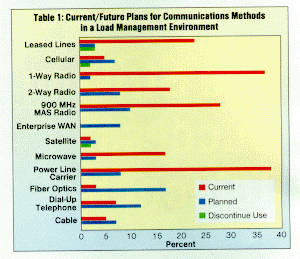
supply environment, as well as more reliance on use of low
cost power line carrier, and by 1999, some likely use of the
Internet to control load switches.
During the 1997-2000
period, Newton-Evans Research Co. anticipates yearly LM/DSM
spending by U.S.-regulated distribution utilities will hover
in the US$50 million - US$75 million range and as much as
US$150 million-US$225 million worldwide. This amount includes
funding for switches, consulting services, installation
services, software licensing and computer and communications
systems.
Many smaller-to-mid
size LM/DSM systems may be expanded during 1998-1999, once a
new generation of power contracts and their resultant exposure
risks, contract terms for upper limits and peak demand penalty
clauses are better understood by distribution utilities.
|