| Interest
in the Internet is spreading around the world and the electric
utility industry is no exception. A recent Newton-Evans
Research Co. study has found that more and more electric
utilities are signing onto the Internet to showcase their
services and to electronically connect with their customers.
The study suggests that utility use of the Internet will
expand in the future.
The study of data
communications trends among U.S. -based utility organizations
found that all of the 30 investor owned, public power and
electric cooperative utilities surveyed have Internet access.
Approximately 80% of the utilities surveyed indicated they
already have a home page on the Internet. All but one of the
remaining utilities indicate plans to implement a homepage by
the end of 1998. This finding indicates that the smaller
municipals and electric cooperatives are following the lead of
investor owned utilities, and in some cases, they are leading
the way to electronically link the company with its customers.
A majority of the
large utilities in Europe, the Asia-Pacific region, Latin
America and the Middle East/Mediterranean region have a Web
site, according to Newton-Evans' international research on
Internet use. Many of the sites are superb with extensive
offerings. Other sites offer limited information but are
expected to grow during the coming year.
A majority of the 30
U.S. utilities surveyed, that have or plan to have a Web site,
are using in-house development staff (Web masters). Ten are
using external contract sources, while one is using both
approaches. The respondents indicate that using internal
resources reduces Web site operating costs.
The utility Web
sites covered in the study address three distinct audiences
for Internet-related services: the consumer community, the
business community, and the utility and embryonic independent
system operator (ISO) community. All three audiences appear to
benefit from the growing availability of utility sponsored Web
sites with access to the following types of information
services:
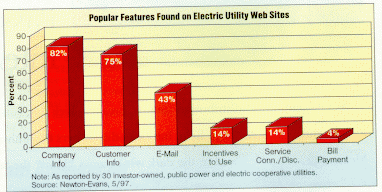
Customer-related
information such as energy use advice, energy services
availability, "virtual" customer support desks, billing
consumption data and requests for services are already
available or being tested on more than 250 domestic and
international utility Web pages visited by Newton-Evans'
staff. Company information such as annual report extracts,
corporate history, news releases, the history of electricity
and electricity infrastructure details. In the future,
additional customer-focused and company-focused information
will be included on these sites. More importantly, the
Internet will be used for OASIS postings, for electronic
bulletin board access for transmission access data and for
power contracting information.
Newton-Evans has two
principal concerns regarding the Internet: the security issues
that confront a "re-regulated" market and the
integrity/reliability/throughput characteristics of the
Internet. The electric utility industry must maintain its
private, secure, back-up networks (or sub-networks) to
preserve the reliability and security of mission critical,
real-time information flow, Secure networks at the utility
level, the NERC-ISO level and inter-regional levels will be a
requirement, not a luxury, as the industry moves closer to
open access, on-line power marketing and near total reliance
on electronic commerce.
For real-time
control and monitoring purposes, the Internet is no substitute
for a secure, private, high-speed data network. While the
Internet implies external information exchange, the term
"Intranet" defines a more restrictive, internal-only
information access and exchange for authorized utility
management and staff. Intranet seems to be an updated term for
what had been known as the enterprise-wide information
network.
Under the tutelage
and sponsorship utility Information systems departments, many
restricted-access, internal data files are being shared among
departments and business units through warehousing of multiple
use data - much of this data emanating from control
center-based systems and from customer information systems. To
prevent valuable utility-internal data from leaving the
organization, safeguards such as access restrictions and
firewalls are required features when establishing an Intranet.
The information
highway continues to develop at a rapid pace. The Internet's
role as a communications-centered information system is
destined to increase interaction among utilities and between
utilities and their customers.
|