| Substation-based equipment can acquire and
provide more information about the status of power delivery
and power quality - at a close range to the customer base -
than any other utility asset. Substation automation programs
should result in lower maintenance and operating costs and
provide a solid foundation toward automation of the
distribution network.
During the first six
months of 1997, Newton-Evans Research Co. completed a world
study of substation automation use and plans among nearly 250
utilities from more than 10 countries. This article summarizes
highlights from the international portion of the study.
Two-thirds of the 48
international utilities surveyed indicated that their utility
had substation automation strategy in place by the second
quarter of 1997. Relatively more utilities in the
Asia-Pacific, Mid east-Africa and European regions indicated
that they a substation automation strategy than utilities in
either North of South America.
Some 40,000 existing
transmission and distribution substations and more than 200
new substations planned to be completed by year-end 1998 are
represent in the international portion of the study. On a
regional perspective, European respondents indicated that a
reduction in operations staff was a more important benefit
than a reduction in time to find and fix problems. Asia
Pacific region respondents indicated that a reduction in
operations staff was a more important benefit than a reduction
in time to find and fix problems. Asia Pacific region
respondents indicated a reduction in equipment maintenance
cost as being an important benefit. Canadian and Mid
East-African utilities indicated interest in life extension
for primary equipment.
Every new substation
on the drawing boards of the surveyed utilities will have at
least limited automation. When it came to new substations, the
ability of automation to reduce the time spent on outage
analysis was still important, but reduced wiring costs were
also important. In fact, reduced wiring costs were the primary
benefits according to European and Asia-Pacific utilities.
European respondents
saw two other main benefits for automating new substations. In
addition to the wiring cost reduction, these officials ranked
a reduction in equipment maintenance costs and a reduction in
the number and type of protection and control devices as
equally important to reduced wiring costs in their planning
decisions.
On a summary basis,
utilities indicated by a wide margin that the most important
financial benefit of retrofitting existing substations was a
reduction in the time it took to find and solve problems. A
reduction in operating staff, together with an extended life
of primary substation equipment, were also noted as important
benefits.
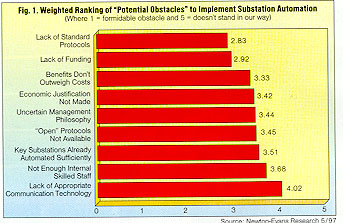
Among Canadian
respondents, limiting outage impact was by fat the most
important potential operating benefit of automating
substations. Among Europeans, the tightest systems control,
timely data and improved flexibility from an operations
standpoint were co-leaders.
Asia-Pacific
utilities indicated timeliness and flexibility as key, and
added relevant data conversion to their top rated benefits
list.
Some important
regional variations in listing potential obstacles should be
noted. In Canada, respondents felt that not having enough
skilled internal staff was as great or slightly greater an
obstacle than any of the above listed reasons. In the
Asia-Pacific region, uncertain management philosophy was the
key obstacle, with lack of funding also a big obstacle.
Insufficient protocol standards were the key obstacles to the
smaller groups of utilities in the Mid east and Latin America.
Respondents were
asked to indicate whether smart RTUs, separate microcomputers,
or programmable logic controllers were to be used to handle
primary substation information processing tasks, or whether
the job would be distributed over multiple platforms. Among
international utilities, just as reported by U.S. utilities in
this year's study and around the world in the 1994 study
series, the smart RTU was being relied upon extensively for
handling primary substation information processing tasks.
The world's
utilities are more optimistic about increased management
attention and funding availability for more substation
automation programs during the closing years of this decade.
From a financial and an operational viewpoint, substation
automation programs are proving to be a solid investment for
the world's utilities.
|