|
The worldwide market
for large (high-end) transformers is significant with sales in
excess of US$2 billion. In the United States, total sales of
power transformers reached nearly US$11 million in 1996.
However, the market for transmission and larger distribution
substation transformers has been flat at best and declining
slightly at worst in the mature electrical markets of North
America and Western Europe.
In fact, most
transformer manufactures will state that if it wasn't for
exports sales, the North American plants would be suffering.
Currently, only about 20% of the world demand for large power
transformers comes from the United States and Canada. In the
1970s and earlier, North America represented about 40% of
world demand.
The chart on this
page illustrates demand among various world markets for large
power transformers. Note the importance of the Asian Pacific
market and the growing importance of South and Central
America. In terms of units, more than 8000 transformers of at
least 2 MVA and up to more than 100 MVA were sold in 1996.
In the coming era of
open access, more and more importance will be placed on the
reliability of large power transformers because these units
will be requited to carry higher loads more frequently under
conditions of severe failure penalties.
In one recent Newton-Evan's survey, about 80% of the utility
spokespersons interviewed indicated their belief that in this
increasingly competitive climate, utilities would have to extend
transformer life rather than simply replace current installations. More
than half thought that the utilities would have to develop centralized
monitoring of transformer operating characteristics. 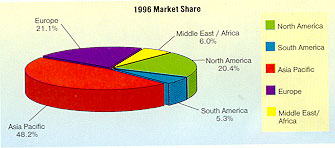
While most utility
operations officials say that power transformers should be
monitored for temperature, pressure voltage, and a few other
characteristics, many of the older, oil-filled transformers
installed in transmission and distribution substations are now
being monitored on-line for potentially dangerous dissolved
gases. These monitoring devices provide an early warning
system for potential catastrophic failures of critical
transformers, and are now installed in about 8000 sites around
the world.
Most utilities
perform some type of chemical or dissolved gas analysis
periodically on their important or "critical" transformers,
perhaps as frequently as quarterly or at least annually, for
about 60,000 of the more than 170,000 transformers installed
in utility- and industrial-operated substations in North
America.
As for the market
for transformer monitoring systems that can monitor variables
in addition to fault gases matures, there will be a new market
segment emerging for total transformer monitoring units, and
it is these units that will become key aspects of substation
automation programs over the next few years.
The same study found
that about half of utilities run their critical large power
transformers above thermal limits, if only on certain
occasions. About half believe that such practices are more
likely in the future.
When all of this is
viewed in light of the aging population of large power
transformers in North America and Europe, more and more
on-line monitoring devices will have to be installed as a
prudent measure to minimize the likelihood of catastrophic
failures in an open access environment.
|