| Newton-Evans recently completed our annual survey
of suppliers of equipment, systems and services to the utility
industry. The results of the survey, which involved more than
25 senior industry marketing and business planning executives
from around the world, reveals supplier perspectives for
automation (primarily T&D) spending by utilities. Why, you
might ask, are the concerns of T&D suppliers important to
you, working in the T&D field at a utility in North
America or Europe or Asia?
Well, first of all,
these observations parallel closely the issues raised by
utility executives in our most recent utility surveys. Most
importantly, uncertainty over deregulation (and/or
privatization) is a reality in today's utility work place in
many areas of the world. Uncertainty breeds inaction,
hesitancy to purchase T&D equipment, systems and services
except on a "must have" basis to serve load growth. Management
decisions regarding T&D automation are most often made on
the basis of knowledge about current and near-term to mid-term
operating environments.
In addition, when
management questions future T&D asset ownership, operation
and maintenance of field (and automation) assets, and finds
answers unavailable, it is unlikely that procurements will be
authorized. The deregulation concerns that are on the minds of
workers at utilities are also on the minds of suppliers.
Survey respondents were asked to rank nine issues as either
"critical," "somewhat important" or "not important" as related
to their T&D automation business outlook. The top concern
was "uncertainty over deregulation and/or privatization." This
concern seemed important to suppliers regardless of where they
were located.
"Thinning profit
margins" was the next highest concern of the respondents.
Eroding profit margins (or increasing operation losses) are
not only issues facing T&D equipment and system suppliers
but are a real possibility facing your own utility in the
not-so-distant future. If there is not much profit potential
in developing, manufacturing, or servicing the T&D systems
and equipment marketplace, suppliers will be forced to turn
their attention and R&D investment funds to other, more
promising, markets and may simply close up shop.
Two issues vied for
third place: the Asian financial crisis (at least for
companies with automation business interests in that region of
the world) and the rapid pace of technological innovation.
Even remote events such as the current Asian financial crisis
are likely to have an effect on your T&D planning, product
pricing and product availability. Regional crises may further
erode the supplier potential for profitable operations. Giants
such as General Electric, Siemens and ABB may have to rethink
their product and marketing strategies, T&D equipment and
systems development schedules and factory loading. They may
have to conduct other business risk assessments when major
events such as this monetary and financial crisis occur. In
turn, such events often result in a direct and dramatic shift
in your options.
The industry
business executives surveyed were also asked to provide their
estimates of market direction and degree for 1998. While the
forecast was positive overall—looking for worldwide growth on
the order of 6%--some regions look more promising than others
(Table 1). Latin America spending will likely increase the
most with North America and Asia Pacific following.
In summary, two
observations should be made. First, the suppliers seem to have
a more optimistic outlook on spending plans than the utility
managers recently surveyed, at least in North America.
Secondly, it is still dangerous to group transmission and
distribution spending plans together because they are most
often on different paths. While transmission automation
spending may remain conservative a while longer, distribution
spending should increase more rapidly.
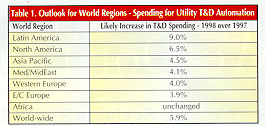
The chart above is
based on January 1998 surveys of 25 industry executives from
companies located in North America, Europe, Latin America, and
Asia Pacific.
|