
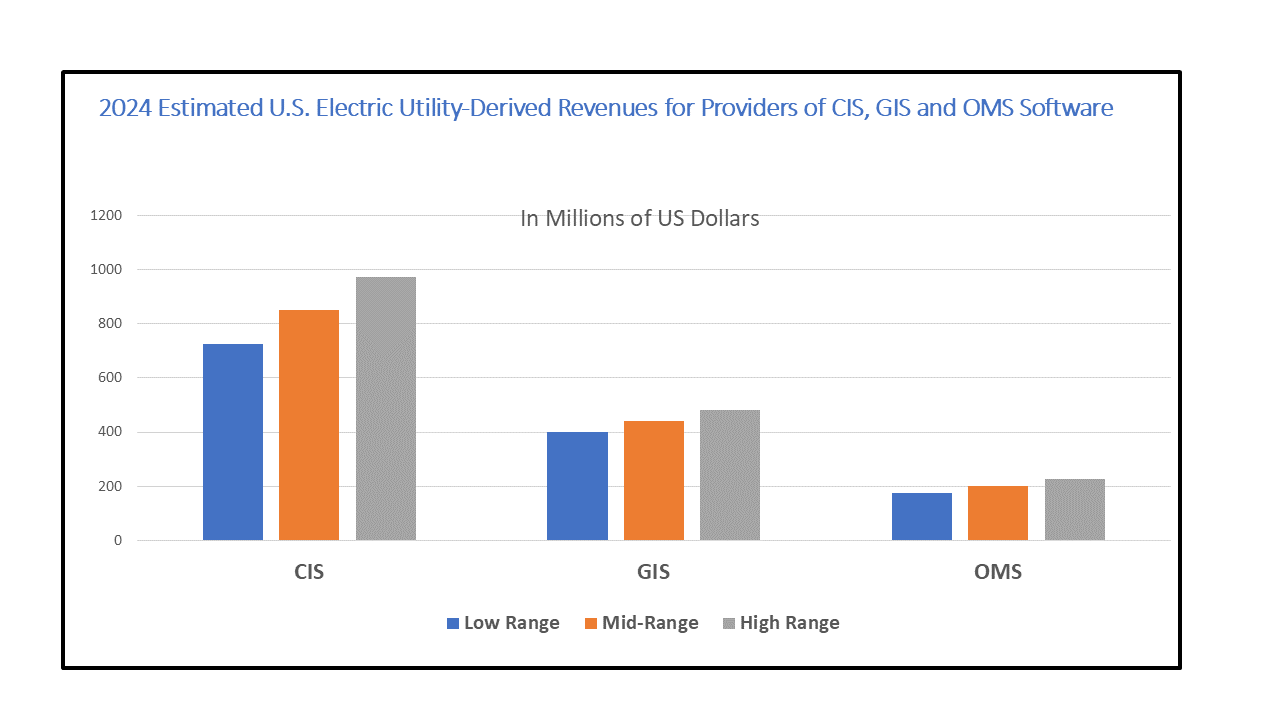
For November, we discuss Customer Information Systems, Geographic Information Systems and Outage Management Systems as our three topics in our 4-part OT/IT series of articles. At the end of the article is the Newton-Evans estimate of software licensing revenue derived from these three application systems.
Customer Information System (CIS) is defined as the computer data base and information system that contains all billing and personal data pertaining to utility customers including billing rates, historical utility consumption, associated charges and meter information. According to Newton-Evans’ studies, a CIS is the “heart” of utility enterprise information technology and systems, just as an EMS is the “heart” of an operational technology base for a transmission utility and ADMS is becoming the heart of any major distribution utility.
A more advanced form of CIS – a customer relationship management system or CRM, is a set of software applications that enable utilities to manage every aspect of their relationship with a customer. In a CRM, Customer information acquired from metering, marketing, customer service and support is captured and stored in a centralized database. The system may provide data-mining facilities that support an opportunity management system. It may also be integrated with other systems such as accounting and marketing for a truly enterprise-wide system with multiple end-users.
In addition to our estimate of “hard dollar” expenditures reaching about $455 million in 2021, (mid-point within the range estimate of $420-490 Million), “soft dollar” internal IT expenditures invested by U.S. utilities on CIS maintenance and upgrades likely exceeds $2.25 billion each year. Some portion of this $2.25 Billion may also be contracted out to third parties directly supporting the utility CIS. The authors have separated CIS business models into the following three tables: CIS providers to Tier One utilities; Custom CIS developers to utilities; and CIS providers to mid-size and smaller utilities.
In the domestic U.S. CIS market, there are some large multi-national CIS suppliers that maintain or are building a U.S. market presence. These include India’s Fluentgrid, New Zealand’s Gentrack, Belgium’s Itineris and Spain’s Indra (Minsait ACS) among a few others.
Sources: Newton-Evans Research Company, CIS Vendor Websites, Gartner Peer Insights
CIS suppliers to the nation’s larger utilities serving 250,000 or more include Hansen Technologies, Harris Computer, Oracle, SAP, SAS and about 6 others. Companies that specialize in custom or tailored CIS solutions include Accenture, Aclara, Convergys, Infosys, IBM and others. Some are developers for Oracle, SAP or SAS offerings.
A third group of CIS specialist firms work with mid-size and smaller utilities providing cost-effective AUS Infinity, InHance and Cogsdale), along with CSA Utilitrak, Milsoft, NISC Meridian and Vertex One.
Total revenue achieved by this group of CIS providers across the three CIS Segments is likely in the $750-$900 million range for 2024, possibly exceeding one billion dollars in by 2026.
Market Drivers:
- Some migration to SaaS platforms for CIS
- Segment growth due to need for replacements/upgrades to legacy CIS/CRM systems.
- Increasing linkage requirements between CIS and some OT-hybrid systems (OMS, GIS, MDMS et al).
Average Cost Range for Implementation of a CIS;
Wide range of costs for “packaged” solutions ($50,000 to low Millions). There is a qide range of costs for customization work: ($250,000 to multiple Million)
Geographic Information System (GIS)
A GIS ntegrates hardware, software, and data for capturing, managing, analyzing, and displaying all forms of geographically referenced information.
GIS allows users to view, understand, question, interpret, and visualize data in many ways that reveal relationships, patterns, and trends in the form of maps, globes, reports, and charts. The acronym GIS refers to the merging of cartography, statistical analysis, and database technology. For utilities, it most often means the geographical representation of the complete service area. For T&D operations, GIS provides significant advantages to visual awareness, operational support, outage location determination. Some forms of GIS are used for utility fleet routing (Caliper, for one example) while other forms are used for 3D mapping of utility physical assets like substations (Bentley, Trimble, ESRI GeoBIM, others).
Market participants across the nation include ESRI, Autodesk, Hexagon, GE Vernova {with its Smallworld, MapFrame and FieldSmart offerings) and Oracle with its Spatial and DB10g offerings. There are some important VARs active in this market that provide client tailoring of core solutions provided by the key software development firms. These VARs include companies like Schneider Electric, Caliper, Milsoft, WindMil, Trimble Benley, CADCorp, OGIS Precisely and others that work on a regional basis.
Dependent upon database size, number of seats, platform and other factors. Licensing costs may range from $40,000 upwards of $3-5 Million for large, multi-layered geospatial systems. Costs for GIS integration with OMS and/or EMS/SCADA is excluded from these observations.
- Increased linkage with external GIS usage patterns among utility C&I customers.
- Need exists for inclusion of non-utility-owned renewables assets in grid mapping.
- Expanded use of low-cost or free, open-sourced GIS offerings for use in (mostly) smaller utilities.
OUTAGE MANAGEMENT SYSTEMS
At the core of a modern Outage Management System, as the term is used in this report, is a detailed network model of the distribution system. The utility’s Geographic Information System (GIS) is usually the source of this network model. By combining the locations of outage calls from customers, a rules engine is used to predict the locations of outages. For instance, since the distribution system is primarily tree-like or radial in design, all calls in a particular area downstream of a fuse could be inferred to be caused by a single fuse or circuit breaker upstream of the calls. Newton-Evans’ estimates for vendor-realized OMS-derived licensing revenue now exceeds $200 million on a “stand-alone” basis – that is, when purchased unbundled from a DMS/SCADA or ADMS.
Major functions typically found in an OMS include:
- Identifying the location of fuse(s) or breaker(s) that operated to interrupt a circuit or portion of a circuit
- Translating customer call patterns into specific “p/roblem” locations requiring response by line crews.
- Prioritizing restoration efforts and managing resources based on defined criteria such as the size of outages, and the locations of critical facilities.
- Providing accurate information on the extent of outages and number of customers affected.
- Assisting with crew dispatching and tracking; management of crews assisting in restoration.
- On the horizon, MV underground cable fault location analysis for partial discharge issues will become part of an extended OMS capability. Mobile workforce management also becoming more closely linked with OMS.
- At least 11 OMS suppliers have a minimum of 3% market shares, making this a very crowded and competitive market segment.
- Market Drivers include:
- Regulatory rules changes affecting duration/extent of electric power outages.
- Customer-driven requests for outage status reporting, MTTR information.
- Emergency services preparations for initiating power resources are needed.
OMS market participants include (alphabetic order) AspenTech OSI, ETAP, GE Vernova, Hitachi Energy, Hexagon, Milsoft, Minsait ACS, Oracle, Schneider Electric, Siemens Energy, Survalent and a few other smaller firms.
Sources: Newton-Evans Research Company, DNV, CIS, GIS and OMS vendor websites
This chart provides a comparative view of the estimated software-licensing derived revenue for CIS, GIS and OMS licenses issued to U.S. electric utilities.
 summary reviews and highlights from completed studies