
Posted on

Newton-Evans Research Reports Planned for 2021


Newton-Evans is planning to publish the following reports during 2021:

First Quarter 2021

U.S. Market Overviews: Power and Distribution Transformer Series:  2021-2023

U.S.Market Overviews:  High Voltage Equipment Series:  2021-2023

Second Quarter 2021

World Market for Substation Automation:  2021-2023 – Four Volume Set of Reports

U.S. Market Overviews: Medium Voltage Equipment: 2021-2023

Third Quarter 2021

U.S. Market Overviews:  Substation Series:  2021-2023

U.S. Market Overviews: Control Systems Series: 2021-2023

Fourth Quarter 2021

World Market for EMS, DMS, SCADA and OMS: 2021-2023 –  Four Volume Set


Posted on

Network Transformers – Linchpins for Underground Electricity Distribution Networks

North American Study of Network Transformer Use and Plans in Progress through August 2020.

Preliminary Findings Suggest Increased Use of Network Transformers Likely as Underground Distribution

Increases in  Dense Urban Centers and on Large Commercial and Industrial Campuses

August 18, 2020.   Ellicott City, Maryland.  The Newton-Evans Research Company is conducting a major study of usage trends and plans for network transformers used to supply power to grid-type secondary distribution networks and systems in areas of high load density, typical of large urban areas, and are designed for use in vault type or subway type applications, in scores of cities and some suburban areas  and large C&I campus-like settings across the North American grid.

Network transformers may be oil-type or dry-type units, and of either single-phase or 3-phase design. Underground submersible units being purchased currently are likely to comply with IEEE standards requirements approved in 2016 (C.57.12-24) and for 3-phase units <2500kva (C.57.12-40) as approved in 2017.  Usage of network transformers is limited to underground networks found in major metropolitan areas served by IOUs, large municipal utilities and in a few high-density suburban areas served by distribution cooperatives

Product distribution channels used include purchasing direct from the manufacturer, distributors, and occasionally, manufacturer representatives or sales agents.  Major IOUs serving large cities having underground distribution networks tend to use blanket purchasing arrangements with selected manufacturers.

Most currently installed units across North America utilities are oil type units.  About three-quarters of respondents to date prefer to purchase network transformers paying a higher initial cost and minimal service requirements, while one-quarter prefer a lower initial cost with an ongoing service agreement.

Product safety has been ranked as the most important feature of network transformers among the initial group of respondents, followed closely by operating life expectancy.  Product efficiency of operation and prior field experience with equipment manufacturers were also important among this group.

Significant volume users of network transformers were unanimous in reporting that new underground, submersible transformers must meet current IEEE requirements and all network transformers are expected to comply with IEEE C57.12-40.2017.

When asked to indicate whether network transformers were being used in conjunction with other devices, network protectors and protective relays were especially prominent as noted by respondents.  A few also noted use of surge arresters on the high voltage side of the transformer and some have also reported including network transformers in their utility transformer asset management software.

For utility engineering and operations personnel who may wish to participate in the study, please send an email request to cnewton@newton-evans.com and a survey link will be forwarded.  A report of findings will be shared with participants.  All submissions are held in confidence. Only aggregated information is used in report preparation.  Generous stipends/donations are available. The field work will be completed in August, 2020.

– 30 –

Posted on

North American Study of Voltage Regulator Use and Plans Now Underway.

Preliminary Findings Suggest Increased Reliance on VRs Likely Given the Continuing Growth in Use of DERs and PBRs


August 4, 2020.   Ellicott City, Maryland.  The Newton-Evans Research Company is conducting a major study of usage, trends and plans for voltage regulators used to assist in maintaining voltage stability and reliability across the North American grid.

While the use of single-phase VRs can be found among all types and sizes of electric utilities across North America, three-phase units tend to be found primarily among larger investor-owned utilities, and among some G&T cooperatives.

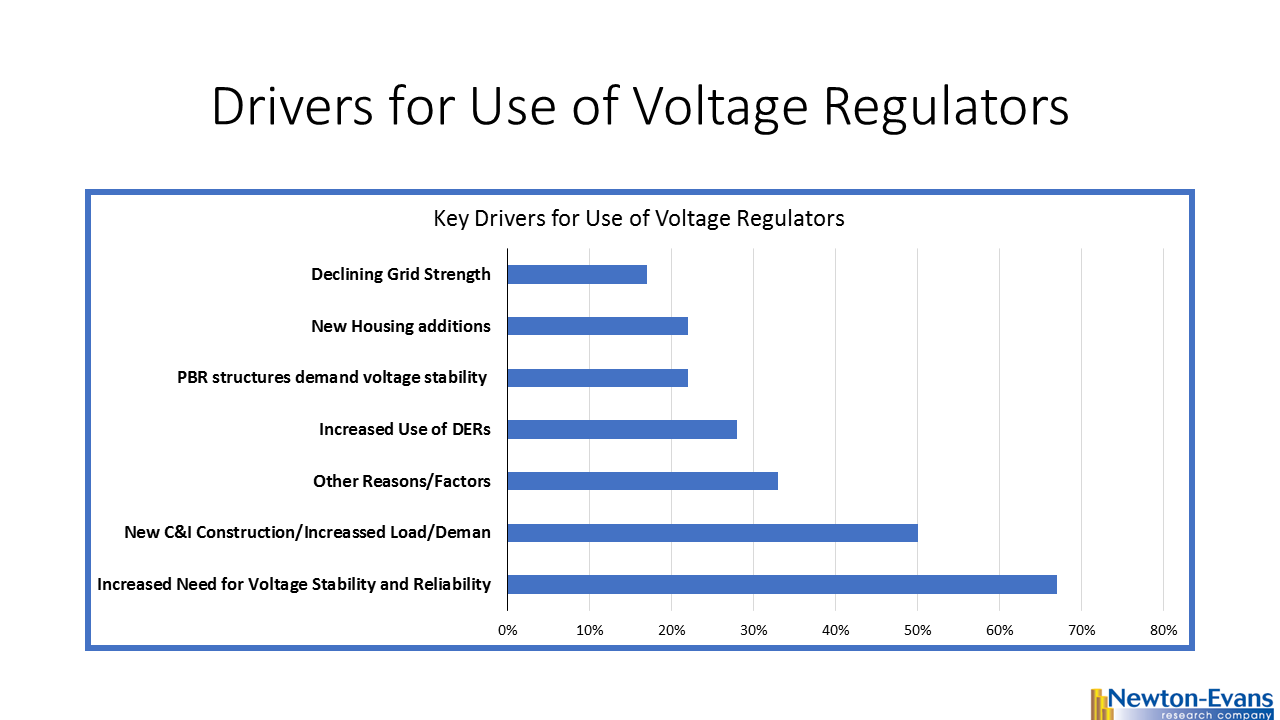
The key drivers for using VRs in the distribution grid today are led by the increased requirements for voltage stability and reliability, as reported in the responses from two-thirds of the initial 20 utility participants to date.  Importantly, C&I construction activities, linked with subsequent increases in load/demand, also have been ranked highly as a driver for increased use of VRs.  In addition, the increased implementation of DERs on the grid, a key factor in today’s grid voltage fluctuations, provide yet another key reason for using VRs to help provide grid stabilization.

Additional topics being studied include phase-to-ground voltages used in conjunction with VR; the use of VRs with other voltage improvement devices such as distribution feeder capacitors and substations capacitors; purchasing methods and preferences; installation methods, requirements for unit compliance with the latest IEEE requirements, wish lists for new VR product capabilities and a number of other pertinent topics.

For utility engineering and operations personnel who may wish to participate in the study, please send an email request to cnewton@newton-evans.com and a survey link will be forwarded.  Findings will be shared with participants.  All submissions are held in confidence. Only aggregated information is used in report preparation.

Posted on

Initial Thoughts on the Executive Order on Securing the United States Bulk Power System

On May 1, 2020, the President issued an Executive Order that forbids American electric utilities from purchasing (or utilizing) grid-related equipment obtained from countries viewed as adversaries.

There is not a clear definition of “adversary” provided in the executive order at this point in time.  It seems that such a listing must be made public for utilities to know what to do in the coming months.  Neither is there a clear definition of which products and equipment types are included, although common sense suggests that any “smart grid” equipment or device that can communicate externally would or should be closely evaluated.

However, this layman’s interpretation of the order puts the onus of having to identify the source country and component manufacturer for each component in the supply chain, and that is going to be a real challenge for some.  This is because there is an increasingly complex multi-layered array of capital equipment, devices, systems and software in use at hundreds of American electric utilities. The onus will fall to an even greater extent upon the manufacturers and integrators serving the electric utility community.

There is a reasonable requirement for electrical equipment manufacturers to be able to identify the source country of origin (COO) for every component of a smart device – even down to the foundry level in some instances.  This has been true for Milspec-related federal procurement for decades.

Importantly, domestic and international electrical equipment suppliers –both manufacturers and distributors – will now have to provide more depth to their equipment certificates that ensure traceability of origin, including tracing components from trusted sources located in approved countries.

It will come as no surprise that the initial list of “blacklisted” countries will very likely include China, North Korea, Iran and Russia, even though that list has not yet been officially made public.  Fortunately, there is very little use of finished “smart” goods from these countries in operation in the U.S. at this time.

Just as important- or perhaps more so – for software systems as for hard goods and components, it will be critical to identify the specific locations used for developers of source code for all smart grid software modules, programs, apps and packages.

What is quite clear to me is that, in the US, and among Western nations in general, electric utility standards and procurement officials must be prepared to ascertain the sources of already deployed smart devices throughout the electric power grid that could adversely affect electric grid operations at some point in time.  This is in addition to the thousands of smart grid projects now in the planning phases here at home and throughout the free world.

Among the plethora of smart grid devices now in use, the most important to vet will be digital relays – both loose relays and those embedded in generators, transformers, switchgear and other equipment.  Next in importance are the hundreds of thousands of communications-centric transmission and distribution level monitoring and control devices including dynamic line rating devices, line monitors, pole-top RTUs, smart controllers for capacitor banks, voltage regulators, automatic reclosers and sectionalizers.

Smart substation equipment (protective relays, electronic measurement devices, precision time measurement devices, power quality monitors, synchrophasors, et al) is now deployed in a majority of the nation’s 65,000 primary T&D substations.  At the consumer level, smart meters are at the top of the list of devices to be assessed, already deployed by the millions of units, whose component assemblies will likely need to be authenticated.  Digital fault recorders are installed in hundreds of critical manufacturing sites. Motor controls and associated relays are installed in thousands of manufacturing plants and in power generation facilities.

Moving into the sector of distributed energy resources, there are smart devices and attendant communications modules involved in, and embedded with, both wind and solar generation as well as in energy storage.  Wind turbine controls, smart inverters, small secondary substations whose final assembly may occur in the Western nations will have to verify sources of components, motherboards and microchips.

– Chuck Newton

Posted on

U.S. Electric Power Utility Capital Investment in Grid Modernization: Effects of COVID-19 Pandemic on Near-Term and Mid-Term Outlook

U.S. Electric Power Utility Capital Investment in Grid Modernization:  Effects of COVID-19 Pandemic on Near-Term and Mid-Term Outlook

Interim Report By Charles Newton, Newton-Evans Research Company

This article has been developed based on findings from surveys completed by officials from 22 U.S. electric utilities comprising about 10% of served end-use customers.  To date, the mix of participating utilities includes several IOUs, along with public power utilities and electric cooperatives.

The study is being undertaken to determine the effects of the COVID-19 pandemic on utility grid modernization plans involving capital expenditures.  Newton-Evans has requested the participation of major and mid-size American electric utilities in an attempt to gauge whether or not CAPEX investments will continue to be made as planned earlier, and whether grid modernization projects will continue as scheduled or will likely be deferred for some time.

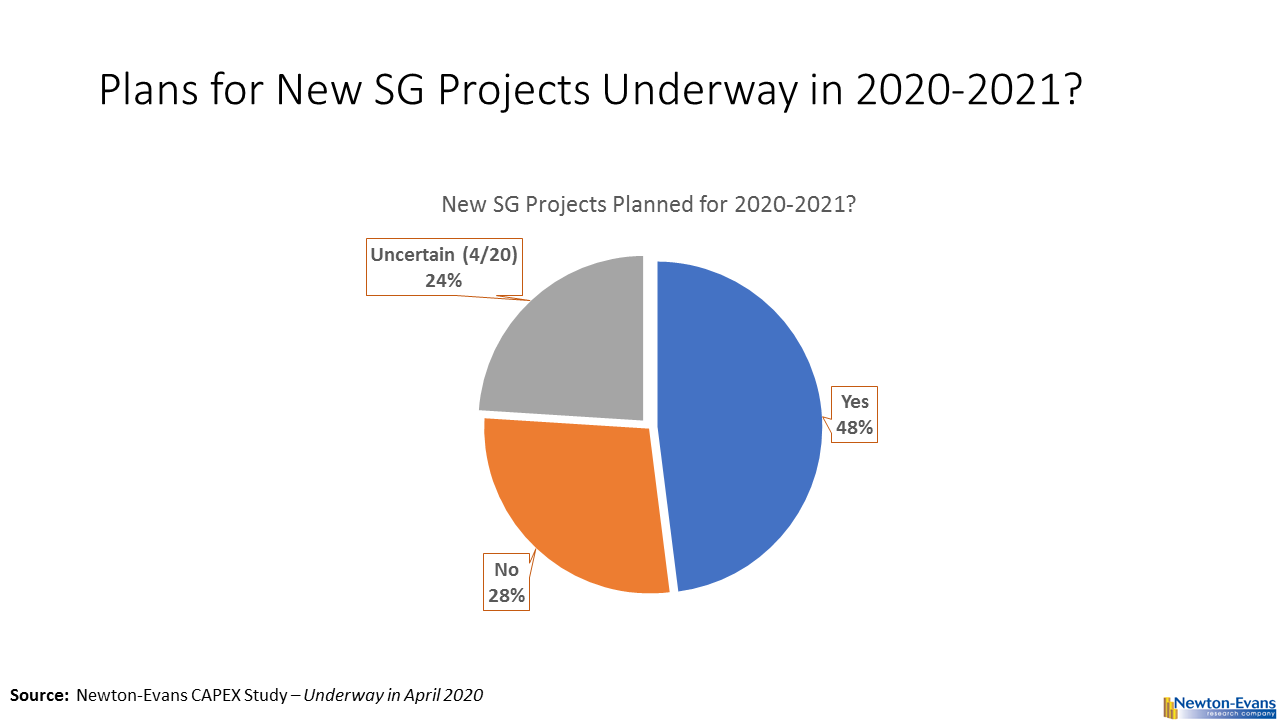
Figure 1 indicates that nearly one-half (48%) of the surveyed utilities continue to have plans to launch new smart grid projects either in 2020 or in 2021.

Figure 1.


Continue reading U.S. Electric Power Utility Capital Investment in Grid Modernization: Effects of COVID-19 Pandemic on Near-Term and Mid-Term Outlook

Posted on

CAPEX Outlook Survey for America’s Electric Power Utilities

If you have insights into your utility’s plans for its near-term CAPEX planning affecting grid modernization projects, we request your help. . Newton-Evans will value your participation in our current study of the capital spending outlook for the nation’s electric utilities in light of the current pandemic.  Newton-Evans will retain your observations in confidence, and will provide you with a complimentary 40-page report of findings gathered from among electric power industry officials located throughout the United States.  The secure online survey is located here: https://www.surveymonkey.com/r/ElectricUtilCAPEXsurvey

Some reasons to participate include:

  • Help industry manufacturers, T&D consultants and systems integration firms prepare to meet the nation’s electric utility demand for equipment and systems during late 2020 and 2021.
  • Provide fellow utility planners to better understand specific grid modernization activities that IOUs, public power utilities and cooperatives are preparing to undertake.
  • Keep up with industry trends by having your own copy of the highly regarded Newton-Evans’ CAPEX report to share with management in mid-May.

A special “thank you” gift is is also available for participants at the end of the 12-question (largely multiple choice) survey.  To date, we have well-thought-out responses in hand from major IOUs, public utilities and electric co-ops.  Looking forward to your survey participation, we thank you kindly for sharing your insights.  We are closing off survey data collection work on Friday, May 15, 2020.
 

Posted on

Wide Variations in Networking Technologies Used for Substation Communications Noted

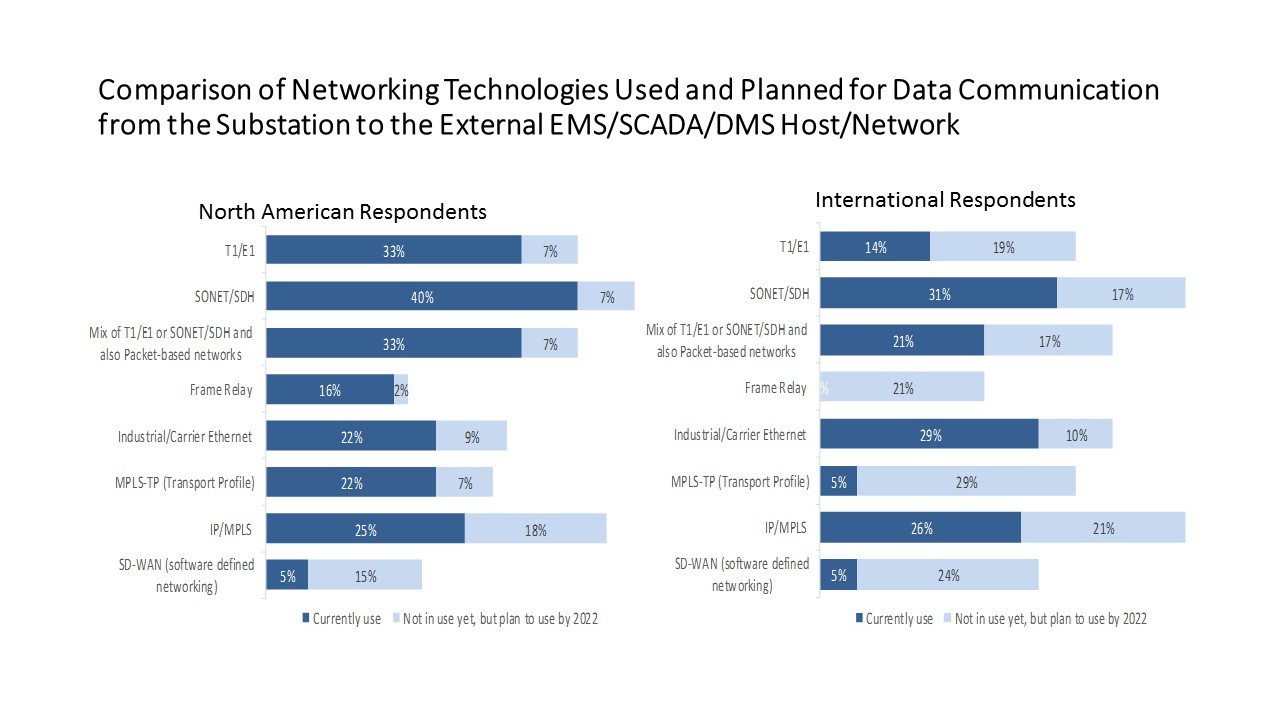
November 8, 2019.  Ellicott City, Maryland.  With nearly 100 officials from 30 countries participating in the 2019 Newton-Evans study of trends in protection and control practices, there were some wide variations noted in the use of networking technologies across the world.

Among 55 North American utility respondents, the most prevalent networking technologies in use during 2019 included SONET/SDH (40%), T1/E1 (33%) and a mix of T1/E1, SONET and packet-based (33%). This seems to imply that SONET is the leading technology among the sample. However, the two networking technologies to watch out for in the next 4 years are IP/MPLS and SDN; 18% plan to use IP/MPLS and 15% plan to use SDN by 2022.

The most prevalent networking technologies used in 2019 among the 42 international utility survey participants included SONET/SDH (31%), Industrial Carrier Ethernet (29%) and IP/MPLS (26%). Based on the survey sample, the leading technologies planned for development by 2020 include MPLS-TP (29%) and SD-WAN (24%).

The Worldwide Study of the Protective Relay Marketplace in Electric Utilities: 2019-2022 measures current market sizes and contains projections on a world region basis for the next few years. More than 35 topics are covered in the utility survey portion of this study with participation from nearly 100 utility P&C officials from countries around the world.  The complete four-volume study of protection and control practices and trends is available from Newton-Evans Research Company.  Details are available at https://www.newton-evans.com/product/the-worldwide-study-of-the-protective-relay-marketplace-in-electric-utilities-2019-2022/ .

Posted on

Full Plate of Research Projects Underway and Planned at Newton-Evans

As of early April, much of the 2013 T&D research work already completed or now underway for clients has once again centered on fundamentals required for a more resilient power grid— that is, on “infrastructure building blocks” rather than on pure automation or IT.

While many observers continue to overlook the critical role of “widgets” — basic T&D grid components – – – that have themselves benefited from technical advances over the past decade, our research programs have included a number of studies of these components.  During the first quarter of 2013, we have come to understand that more reliable and greener components available in the newest generation of core grid products are indeed making headway in the North American Grid and throughout the world.

Currently, Newton-Evans staff is fully engaged in client studies researching the emerging roles being played by such basic grid components as power fuses, capacitor bank switches, and even the various improvements in transformer oils being used in the millions of power and distribution transformer installations in North America.  We are about to begin a private study of high voltage circuit breaker trends.

We have not overlooked “smart grid” developments, of course, being the earliest industry marketing research firm to study T&D control systems . . . beginning in 1981.  We have recently released the four volume 2013-2015 edition of the World Market Outlook for EMS, SCADA, DMS and OMS Systems.  For another private client we have already completed a detailed year-by-year history and eight year outlook for distribution automation in North America.

Another first quarter client study provided a major power utility client with the ability to measure the opinions, attitudes and experiences of other electric utility operations officials regarding the pros and cons of alternative data communications infrastructure choices for operational data acquisition. These report findings enabled our client to make an educated decision about how to proceed with its own communications infrastructure upgrades.

The findings presented in the project report were based on a survey sent out to large electric utilities around the world. Utility officials involved in communications network planning or oversight from more than 15 countries responded to the survey. While not all participating utilities operated control systems that are configured with multiple control centers, survey participation and informative feedback was welcomed from everyone.

Illustrative diagrams were included throughout the survey to guide respondents into thinking about four specific network communications scenarios being considered by the client utility. After being presented with the diagrams and descriptions, survey respondents were asked a series of questions including, “What scenario do you think will offer the best opportunity to accomplish the following:”

  • transition easily to an IP data infrastructure with better cost control and reduced latency
  • transition easily to a better data acquisition infrastructure using synchrophasors (PMUs)
  • easily update data points over the network & synchronize the updates with other systems

In early June, one of our clients will be hosting an exclusive afternoon reception and discussions of advanced cyber security and related compliance topics, with speakers from NIST and ENERNEX among others.  Newton-Evans will soon be sending out invitations to selected utility officials from the mid-Atlantic area.  Qualified senior utility officials, who may be interested in learning more about defense-in-depth file transfer techniques between various operational systems and multiple enterprise systems, can contact us for an invitation to attend this small group event which will be held in suburban D.C.  The seating for this event is limited; there is no cost for attendees (other than transportation).

This event promises to be another great way to learn more about the implications of the new 2013 cyber security executive order for critical infrastructure, as well as receiving updates to NERC compliance topics, and how advanced cyber technology developments will transfer from one usage sector to the electric power industry to secure file transfers between operational control systems and IT systems.

During the summer months, Newton-Evans will be “going global” once again with its fifth edition of the CAPEX/OPEX outlook among the world’s electric power utility community.  Concurrently, we expect to be underway with a major update to our historical compilations of distribution automation developments and trends.

Newton-Evans’ CEO, Chuck Newton, has been selected by Energy Central to serve as the Operations Track Chair for this autumn’s KNOWLEDGE 2013 Conference, scheduled for November 4-6, 2013 at the exclusive Broadmoor Hotel and Resort in Colorado.  We are looking for a few additional senior level Operations/Smart Grid people to serve as program committee members.  The KNOWLEDGE Conference is known for its attractiveness to C-Level executives and other senior managers who are afforded the opportunity to have open discussions and dialogue with peers on IT and CIS topics in a relaxed setting.  We hope to make the Operations track a vital new component of this exclusive conference.

Finally, during the first quarter, Newton-Evans contributed articles to the following publications:

Intelligent Utility (March 13, 2013 edition) “Current, Planned Global Deployment of Analytics Capabilities”

Utility Horizons Quarterly (April, 2013 edition) “Usage Patterns and Trends in Electric Utility Automation”

Transmission & Distributions WORLD (May 2013 edition) “Special Supplement Communications: “Assessment and Outlook for Telecommunications Networks and Protocols in the World’s Electric Power Utilities”

In addition, our latest global control systems studies received coverage on a number of financial news sites around the world as well as in the following industry publications:

Transmission and Distribution World – Online – Feb 20, 2013
“Global Spending for Power Delivery Control Systems for 2012-2015 Likely to Exceed $5.5 Billion” http://tdworld.com/smart_utility/newton-evans-delivery-study-0213/#ixzz2LT9GejmD

Renew Grid – February 19, 2013
“North American Utilities Lagging On Standards And Best Practices”
http://www.renew-grid.com/e107_plugins/content/content.php?content.9586#.USUiB1f_qsk

Smart Grid News – February 15, 2013
“Study reveals U.S. utilities falling behind in adoption of essential best practices”
http://www.smartgridnews.com/artman/publish/Technologies_Standards/Study-reveals-U-S-utilities-falling-behind-in-adoption-of-essential-best-practices-5517.html/?fpt#.USUhWlf_qsk

PowerGrid International, January, 2013
Newton-Evans:  EMS, SCADA, DMS, OMS Likely to See Much Growth Through 2015″
Print Magazine article (page 20)


Posted on

Global Spending for Power Delivery Control Systems for 2012-2015 Likely to Exceed $5.5 Billion . . . If Economic Outlook Strengthens, Market Could Reach $6.5 Billion

Standards Compliance for Many Systems Components Important Internationally while Surprisingly High Level of Interest in NERC CIP Compliance Reported From Outside of North America


February 12, 2013.  Ellicott City, Maryland.  The Newton-Evans Research Company has released its 2013 edition of a four volume study of EMS, SCADA, DMS and OMS usage patterns in the world’s electric power utilities.  This release marks the tenth such research program in this series completed since 1984.

Newton-Evans staff conducted surveys and interviews with more than 150 utilities in 37 countries.  These included many of the TOP 100 utilities in the world.  Among the observations gleaned from interviews and surveys with these utilities, along with views from control systems integrators and power delivery consultants are these:

Rationale for Increased Spending on Control Systems:  A number of factors were cited by participants as the basis to support the increased levels of systems augmentation, upgrades and replacements over the next 36 months including the need for new applications to improve operator visualization and situational awareness; adding redundancy to communications pathing; improving cyber defenses; complying with new regulatory mandates; and in some instances, a desire to combine two or more systems onto common platforms.

Differences in International and North American perspectives and approaches to Standards for control systems:  The role of international standards is more important to utilities outside of North America than to domestic utilities.  While IEC standards compliance dominates systems procurements and communications approaches internationally, in North America the roles of IEEE, ANSI, NEMA and de facto standards play a much more important role. Forty percent of international respondents indicated having a requirement for OPC (Open Platform Communications) compared with only 27% of North American replies.  Similarly SOA (Service Oriented Architecture) was viewed as being much more important internationally than was reported by North American respondents. Two-thirds of international utilities and 19% of North American utilities reported interest in using CIM standards for model maintenance related to distribution circuit design transfers from GIS (Geographical Information Systems) to DMS.

Similar Levels of Concern with Cyber Security: Eighty percent of North American utility officials and 82% of international utilities cited a need for cyber security features to be designed as an integral part of their control systems, not provided as an “add-on.”   Interestingly, many international utilities are modeling their cyber security mandates for power delivery control systems on North America’s NERC CIPs.  Across the world, several utilities also called for control systems integrators to do more to make NERC (and other) compliance and regulatory reporting easier and more automated.

Third Party Control Center Services:  Consulting services are being used and more likely to be relied upon to assist with expanding NERC CIP compliance issues, for the conduct of vulnerability assessments and for consulting on smart grid topics.  In addition, several comments were directed toward the increased reliance on third party services to assist utilities as they cope with workforce retirements in their operational control centers.

Role of Operational Analytics:  Noticeable differences in current and planned usage of operational analytics were found for asset analytics, DMS analytics (load and voltage balancing et al) and customer analytics.  Each of these are now being used (or soon will be) more widely internationally than in North American utilities.  OMS analytics (e.g., fault location) are of similar levels of usage and plans among both groups.

The four volume study includes separate reports on (1) North America with details by type of utility, (2) International community with detailed findings by world region; (3) Profiles of leading systems integrators and (4) World regional market outlook for each type of power delivery control systems through 2015.  The complete set of reports is available for $7,500.00, and individual reports are also available for online ordering.

Further information on this new series entitled The World Market Study of SCADA, Energy Management Systems, Distribution Management Systems and Outage Management Systems in Electric Utilities:  2013-2015 is available from Newton-Evans Research Company, 10176 Baltimore National Pike, Suite 204, Ellicott City, Maryland 21042. Phone: 410-465-7316 or visit us at www.newton-evans.com  to order this series or any of more than 100 related reports. Chuck Newton can be reached at cnewton@newton-evans.com.

Posted on

Release of North American 2013-2015 EMS, SCADA, DMS and OMS Report – Now Available for Secure Online Purchase and Download!

EMS, SCADA, DMS and OMS Systems to be Significantly Upgraded or Replaced to Meet New Regulations and to Provide Improved Situational Awareness and Visualization Tools for Systems Operators

Role of Operational Analytics for Outage Management Growing Rapidly in Attempts to Improve Reliability and Minimize Outage Duration and Frequency

January 25, 2013.  Ellicott City, Maryland.  The Newton-Evans Research Company has released highlights of findings from its newly published study of EMS, SCADA, DMS and OMS usage patterns in North American electric power utilities, one of four component reports of the company’s 2013 global market assessment series on power delivery operational control systems.

Among the observations gleaned from interviews and surveys with more than 110 participants from a wide range of participating U.S. and Canadian electric utilities, are the following:

  • Plans call for upgrades or retrofits to EMS (energy management systems) and SCADA (supervisory control and data acquisition) systems among a large percentage of these utilities.  Related industry expenditures will likely increase by more than 25% over the next 24 months.
  • Plans for procurements of new DMS (distribution management systems) and OMS (Outage management systems) are significant, with more than one quarter planning to purchase a new or replacement DMS and nearly one-in-five planning OMS procurements.
  • Eighty percent of utility officials cited a need for cyber security features to be designed as an integral part of their control systems, not provided as an “add-on.”  Most officials also called for control systems integrators to do more to make NERC compliance and regulatory reporting easier and more automated.
  • Third party services are being used and relied upon to assist with NERC CIP compliance issues, for the conduct of vulnerability assessments and for consulting on smart grid topics.
  • DNP 3 continues to be the most prevalent operational data communications protocol throughout North American electric power utilities.  Plans call for continuing the use of DNP 3 for the foreseeable future, among the majority of these utilities.   Increased use of IEC 61850 for intra-substation communications has been reported in newly constructed transmission substations.

The North American report is one of four volumes of study completed for the company’s fourteenth bi-annual series of EMS, SCADA and DMS studies published by Newton-Evans Research since 1984.

Further information on this new series entitled The World Market Study of SCADA, Energy Management Systems and Distribution Management Systems in Electric Utilities:  2013-2015 is available from Newton-Evans Research Company, 10176 Baltimore National Pike, Suite 204, Ellicott City, Maryland 21042. Phone: 410-465-7316 or visit us at www.newton-evans.com  or to order any of more than 100 related reports.  For readers interested in purchasing this new series please call or email the company for special introductory pricing. Chuck Newton can be reached at cnewton@newton-evans.com.