
Growth in real market demand for electrical equipment remains quite strong, but is lower in mid-2026 than total year-over year market dollar value increases would suggest. This is largely due to goods manufacturing cost pressures, caused by rising spot market prices for key commodities used in the production of electrical equipment. Key among these components are copper, electrical steel and aluminum. These commodities are under significant price pressures and production capacity limits, and right now, while GOES steel prices have leveled off over the past six months, copper and aluminum prices have continued their upward spiral, and are among the principal reasons for increasing electrical equipment manufacturing costs, resulting in higher capital equipment prices being paid by utilities and industrial/commercial buyers.
Equipment prices (especially for power and distribution transformers, for HV/MV switchgear and for capital HV transmission equipment) have doubled in the last five years, even as real demand has grown as well in spite of higher prices. However, overall equipment demand has grown almost as fast as have component cost increases. These same commodity price increases have affected equipment production costs and together with increased demand (primarily from utilities undertaking grid modernization efforts, and C&I buyers of all types and sizes) have together resulted in increased and a stretch out of order placement-to-delivery times for a range of MV equipment as well as for HV equipment along with power and distribution transformers.
What seems to be different as of the mid-2026 market composition versus that of just five years ago is that a higher percentage of electrical infrastructure equipment is now being purchased by end-user industrials and commercial enterprises than had earlier been the situation. Chief among these relatively newer buyers are data center developers and large renewables project owners as well as hundreds of American manufacturing plants being expended or on shored. Also, the re-invigoration of the nation’s electric power grid is well underway, in an attempt to make electricity supply more abundant, more secure, more sustainable, and more reliable. Together these efforts will result in electricity grid infrastructure becoming more resilient to the effects of climate challenges and surges in the peaks and valleys of electricity consumption in the coming years.
Much of the increase in demand for capital electrical equipment is coming from three sectors of large energy users.
- First is the continuing growth of renewables, despite the mistaken erosion of interest in, and significant cutbacks of, research funding on the part of the current administration and its Department of Energy.
- Secondly is the huge increase in the number and size of data centers, especially those supporting AI developments.
- Thirdly is the reshoring of manufacturing industries, with numerous large industrial campus developments underway at this time.
- Each of these is responsible for placing capital electrical equipment orders earlier than required, sometimes 2-5 years in advance of the projected need for the equipment to be installed and operating at a plant site.
- Each of these factors impact and disrupt the historical cyclical equipment procurement activities of electric utilities of all types and sizes.
By staying the course toward availability, reliability and resilience, electric power utilities will necessarily form alliances with non-utility providers of electric power. Concurrently, I believe we will see an increases in some new large campus-like industrial and large commercial sites developed that will be at least partially self-powered, using resources ranging from gas turbines, to small modular nuclear reactors to on-site utility-scale renewable solar farms and wind parks. A newer and more sustainable form of auto-production and co-generation is being developed by, and for use among, manufacturers, data centers and utility-scale renewables sites.
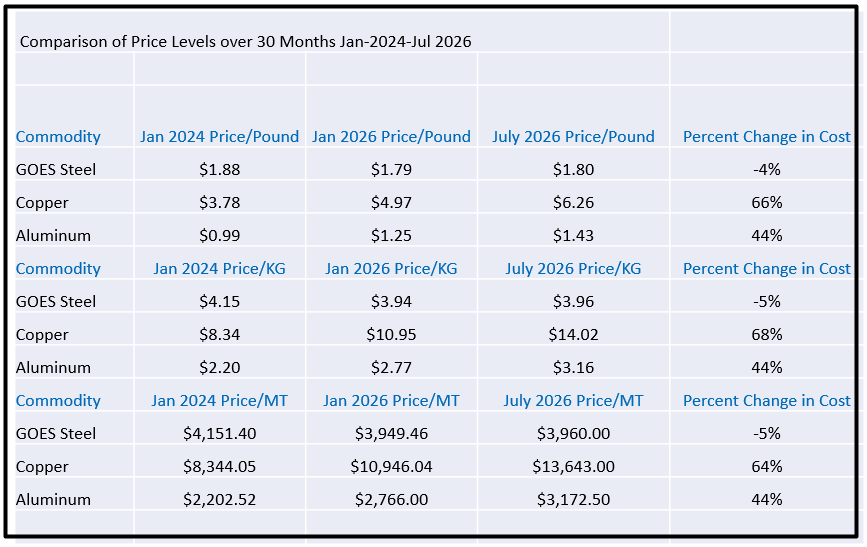
When we evaluate current mid-year costs for key components of electrical equipment, we must look into the cost changes that have occurred over the past 30 months. The following table was developed using commercial market information sources as of July 30, 2026. Note that the cost/unit of GOES steel in the U.S. market has actually fallen from its high-water mark incurred in 2024 until January of this year. This has resulted in a five percent drop in price/metric ton over this time interval. GOES has now remained at this somewhat lower price level for an additional six months – through July, 2026. However, note the continuation of rather steep cost increases for units of copper (+64%) and aluminum (+44%) over the past 30 months, whether measured in units of pounds, kilograms or and especially in metric tons (MTs).
Much of the information reviewed for preparation of this article discussed the heretofore relative stability of aluminum prices as compared to the volatility of copper prices. However, it seems that in recent years, aluminum costs have surged as well, including a jump of some 44% over the last 30 months. The increases just from January through July this year are also significant for both copper and aluminum, and show no signs of significantly slowing down.
In reviewing cost components for large power transformers, copper (used for windings) comprises about 30-45% of the component costs for large power transformers. For distribution transformers, aluminum windings account for about 25-35% share of material costs. An excellent tutorial is available from Maddox Transformers that discusses selection of copper versus aluminum windings. Here is the link: https://www.maddox.com/resources/articles/aluminum-vs-copper-in-distribution-transformers .
Switchgear manufacturing costs are also significantly impacted by the fluctuations in the market prices for copper and/or for aluminum. Internet sources have indicated that when used for critical applications and at higher voltage switchgear, copper as a key component can account for as much as 40-45% of total material costs.
Look for our next article to be published in early August that will review the latest electrical equipment price trend information provided by the Federal Reserve.
 summary reviews and highlights from completed studies