It seems to me that after a couple of years spent delving into the evolving situation regarding the impact of data centers on utilities and on transformer and other T&D equipment needs, there are a number of obstacles facing utilities that will also resonate with plans being made by data center owners and investors. The ongoing development of AI will lead to more numerous and more robust (hyper-scale) data centers being planned and constructed over the next five years.
The recent surge in demand for electric power has resonated in each of the seven Newton-Evans’ 2026-2028 series of Market Overviews of the U.S. Electric Power Industry, whether the series covers transformers, high voltage equipment, medium voltage equipment, substation automation, OT/IT, distribution automation or protection and control (the latter two are still in production). Each topical area has seen revenue and unit growth substantially above the increases seen in the 16 prior years of the publication of these series covering more than 85 individual components of the electric power delivery industry.
However, the electricity markets in developed nations have built out and operate currently reliable supporting electric power infrastructure to meet recent demand levels and designed to support a smooth, few percent increase per year in energy usage patterns. In many countries wherein only modest growth in power consumption is occurring, the available supply of electric power may not match up well with the growing power demands of data centers. In economic terms, the demand and supply curves are not in sync at this time, at least not at first glance, nor do they appear to line up any time soon. As a result, interesting work-arounds are being developed.
A range of options is available to meet the expected increases in power demand, and in the U.S., many utilities will need to increase the available supply of electricity through plant expansions, refurbishment or bring out of retirement some large fossil-fueled plants.
New power plants likely to be built in the near term to meet this rather sudden (in utility terms) huge increase in demand from all sources will be largely natural-gas fueled as these plants can be constructed and operating in a shorter time frame and at lower costs than can some larger renewables or other fossil-fueled projects. Recently, the Electric Power Research Institute (EPRI) stated in its Powering Intelligence 2026 report https://powering-intelligence.epri.com/executive-summary.html that data centers may account for as much as 9%-17% of power generation in the U.S. by 2030. This is substantially higher than EPRI’s forecast made in mid-2024. Boston Consulting Group (BCG) has indicated power demand levels of well over 198GW by 2030 may be reached. https://www.bcg.com/publications/2026/solving-the-us-data-center-power-crunch .

Availability of electric power supply is only one part of the power equation needed to meet the upsurge in demand coming from AI developments and data centers. By looking at alternatives to today’s data center hubs, there are areas within the U.S. with more than sufficient power to meet current load requirements.
Permitting processes will have to be speeded up at the federal, regional, state and local levels while regulatory action must be taken to reduce obstacles to HV transmission development. During the 2020-2025 years, only about 400 new HV line miles have been annually added to the grid. Additional transmission assets must be developed. Transformer and other T&D equipment manufacturing capacity will need to be increased significantly. We have tracked transformer manufacturing capacity additions for some time and the chart showing these additions is found here: https://www.newton-evans.com/march-2026-assessment-of-the-u-s-power-transformer-industry/ Training of a workforce that can support electrical equipment manufacturing is required, as is the need for developing thousands of capable data center operations personnel.
The data center-allied consortia recognize a near-term market need for their offerings and rightly want to seize on this opportunity. When searching for plausible sites, companies are looking at secondary and tertiary regional locations – primarily heartland areas of the nation blessed with an abundance of power generation capacity required to meet the power demands of new data center developments.
Today’s primary data center hubs around the world may be reaching capacity regarding electric power delivery capabilities and may have limited available infrastructure, so alternate site selection assessments are playing key roles for data center developers. Examples of secondary hubs in the U.S. include Chicago, Atlanta, Dallas and Phoenix, while Las Vegas, Reno and Columbus are considered examples of tertiary hubs at this time.
Today’s major U.S. data center owners/operators include subsidiaries of Amazon, Microsoft, Google and Meta along with Digital Realty and Equinox. Important locations (hubs) for very large data centers include Northern Virginia, home of the largest data center aggregation in the world, along with hubs in California and Texas and several other states.
As of August 2026, there are about 4,767 data centers operating in the United States alone according to Datacentersmap.com. At least 860 new U.S.-sited data centers are being constructed at this time. Before these sites can become operational, large power transformers and high-voltage equipment must be purchased, manufactured, shipped, installed, tested and operational on the utility/energy provider side. A substation may have to be enlarged or a new substation built to serve the proposed data center. Even with this growth, there are an additional 3,900 announced plans for future data center development per Inc.’s website https://www.inc.com/georgia-fearn/nearly-five-data-centers-are-announced-for-every-one-being-built/91386819 .

The medium-voltage and low-voltage equipment used within the data center facility also has to be specified, manufactured, purchased, installed and tested. Supply chain issues confront the utility-required equipment as well as the facility power equipment availability as manufacturer pipelines are somewhat clogged with the sheer volume of incoming orders, along with material sourcing issues, and in some cases, labor availability issues that can slow down production cycles and affect delivery times.
Effect of Tariffs
As a good percentage of both LPTs and distribution transformers are currently manufactured in either Canada or Mexico there are duties and some tariffs currently in effect as of August 2026. These mean higher end-user prices will be paid for imports of electrical equipment. The duties on copper, aluminum and steel have been reduced from 50% to 25% at the current time. The rapid increases in AI-fueled demand for very large and hyper-scale data centers will also significantly impact other electronic devices with a requirement for increased cooling and heating systems needed for new generations of semiconductor developments.
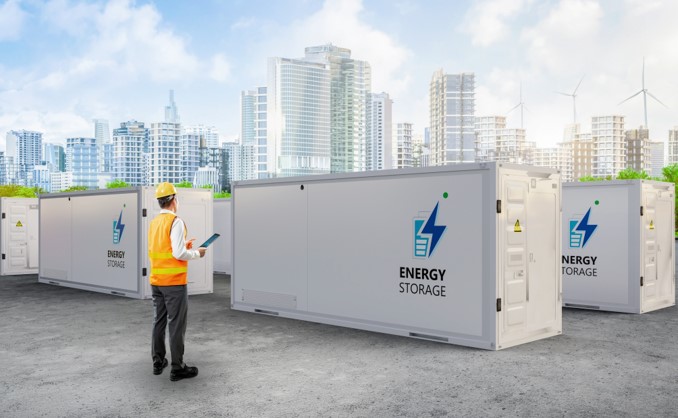
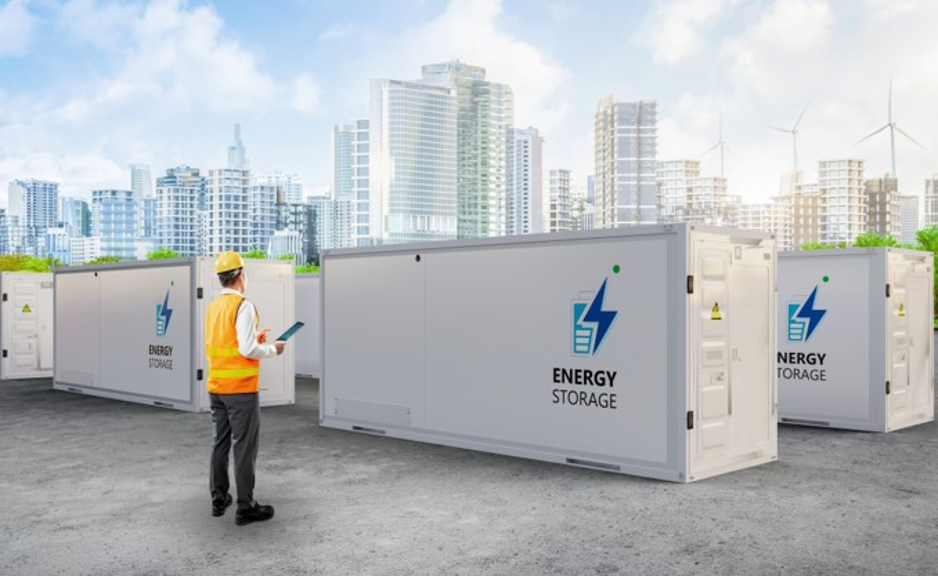
It seems to me that a good option to meet the near-term reliable power needs of data center planners is to include construction and operation of on-site renewable energy sources with battery energy storage systems in addition to their grid-connected primary (or secondary) source of utility-delivered electricity. It should only be two-four years until small modular nuclear reactors will be commercially available as a realistic option for hyper-scale data centers -sort of a hybrid micro-grid to supplement utility-supplied power.
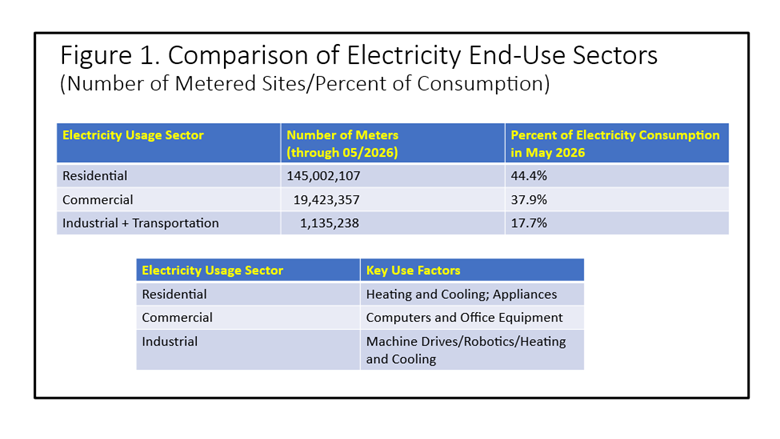
Looking across the American industrial base, we note that manufacturers and other industrial firms account for only 1,135,000 meters, serving about 450,000 industrial firms in the U.S. There are more than 19,423,000 commercial site meters and the number of residential consumers has recently surpassed 145 million meters as of May 2026.
However, when it comes to consumption of electricity, residential use accounted for 44.4%U.S. of total usage in May 2026, while commercial use stood at 37.9% and industrial and transport use accounts for a significant 17.7% of the total. It is foreseeable that the percentage of power consumed by industrials will increase rapidly to account for perhaps 25-30% of the total domestic US electricity consumption by 2030. This will be due not only to the rapid growth of data centers, but likely to some degree of additional discrete and process manufacturing facilities being re-shored as well as new factories coming online. See Figure 1 derived from the US Department of Energy’s Energy Information Agency https://www.eia.gov/electricity/data/browser/ .
In closing, it appears we will continue to be in for a roller coaster of a ride for the next several years, between the energy industry in transition, the need for more power capacity, and the explosive growth of not only data centers, now accompanied by a resurgence for high power requirements from a wave of new semiconductor fabrication plants, a likely strong expansion in mining industries, the reshoring of industrial firms, and a possible increase in several power hungry hydrogen production facilities now being designed for delivery during the next five years. As well, interconnection requirements for a legion of new and planned utility-scale renewables sites will add to the mix.
 summary reviews and highlights from completed studies