
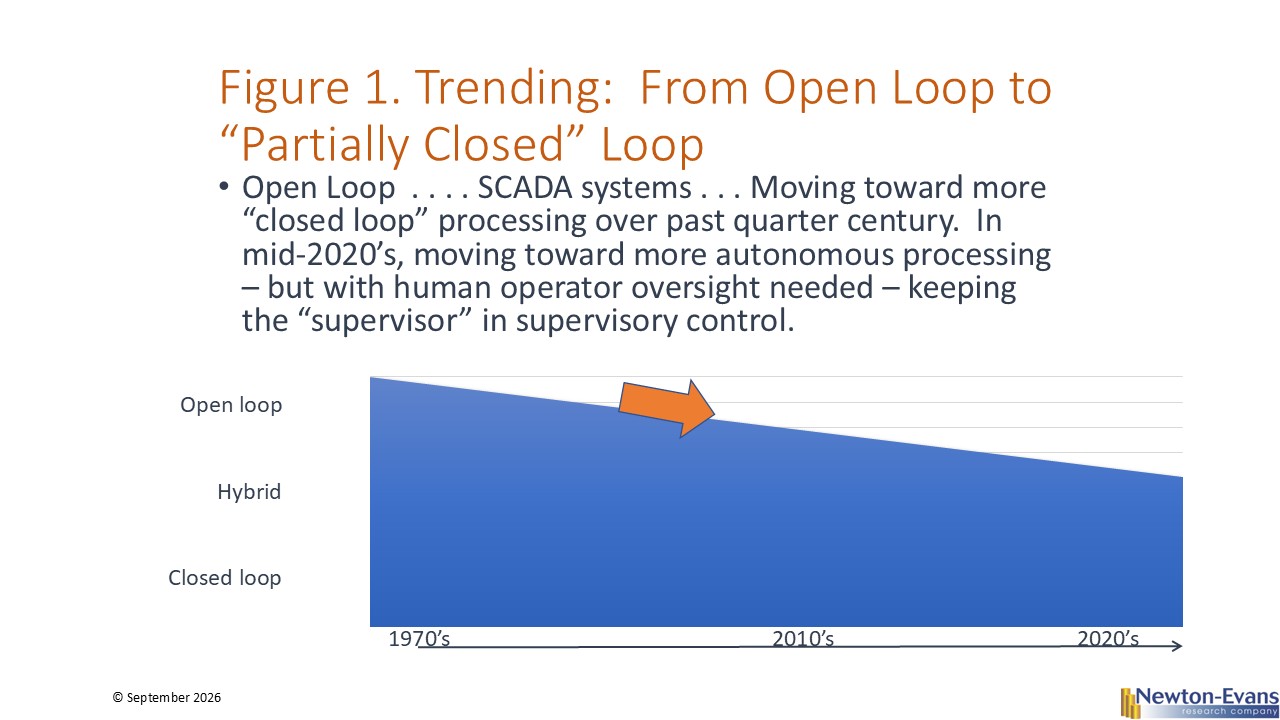
Supervisory Control and Data Acquisition (SCADA) is one of 12 OT/IT topics covered in our just-released series of OT/IT market overview reports for 2026-2028. SCADA is a type of industrial control system (ICS). Industrial control systems are computer-controlled systems that monitor and control industrial processes that exist in the physical world. SCADA systems historically distinguish themselves from other ICS systems by being large scale processes that can include multiple sites, and may cover large distances. In addition, electric power distribution SCADA along with water and gas distribution systems and energy pipeline operations remain as more-or-less “open loop” type of control systems, with human operators monitoring and supervising the actions of the control computer as it acquires data continuously from power substations and other remote locations, including third party operated distributed energy resource sites in an electric utility network. See Figure 1.
Newton-Evans believes that there is a significant opportunity for providers of SCADA-related systems and application software to help manage the operations of commercial and utility-scale renewable power resources and BESS installations-now totaling more than 1,000 utility-scale BESS installations. There are multiple SCADA specialists serving the renewables and energy storage market in the U.S. and Canada. Several others based in Europe and the Middle East serve international renewables markets.
The U.S. Department of the Interior’s USGS agency reports that there are about 75,000 large (utility-scale -1MW+) wind turbines in operation in the United States as of mid-2026. These thousands of wind turbines are installed at about 1,620 sites or farms. The country is currently adding about 2,200-3,200 utility- scale wind turbines each year.
According to the U.S. Department of Energy’s EIA (Energy Information Administration), there are more than 6,611 utility scale solar plants/farms now operating (as of April 2026) in the United States. Most of these facilities represent from 1 to 5 megawatts of generation capacity. There have been several larger solar plants coming onstream in the last several years, led by New Mexico-based SunZia.
By mid-2026, utility-scale BESS installations have continued to increase, and are now operating at more than 1,000 U.S. sites. In addition, there are now 66 utility-scale geothermal units operating in the US – mostly in California and Nevada.
Each of these 9,000-plus utility-scale renewables/energy storage sites now operational in the U.S. requires a SCADA-like system to acquire operating information and to coordinate grid planning activities. For enterprises operating multiple facilities, capabilities exist to coordinate multiple SCADA installations (or site automation/control systems) under the control of a larger company-wide (i.e., renewables asset owners) or utility-wide SCADA system.
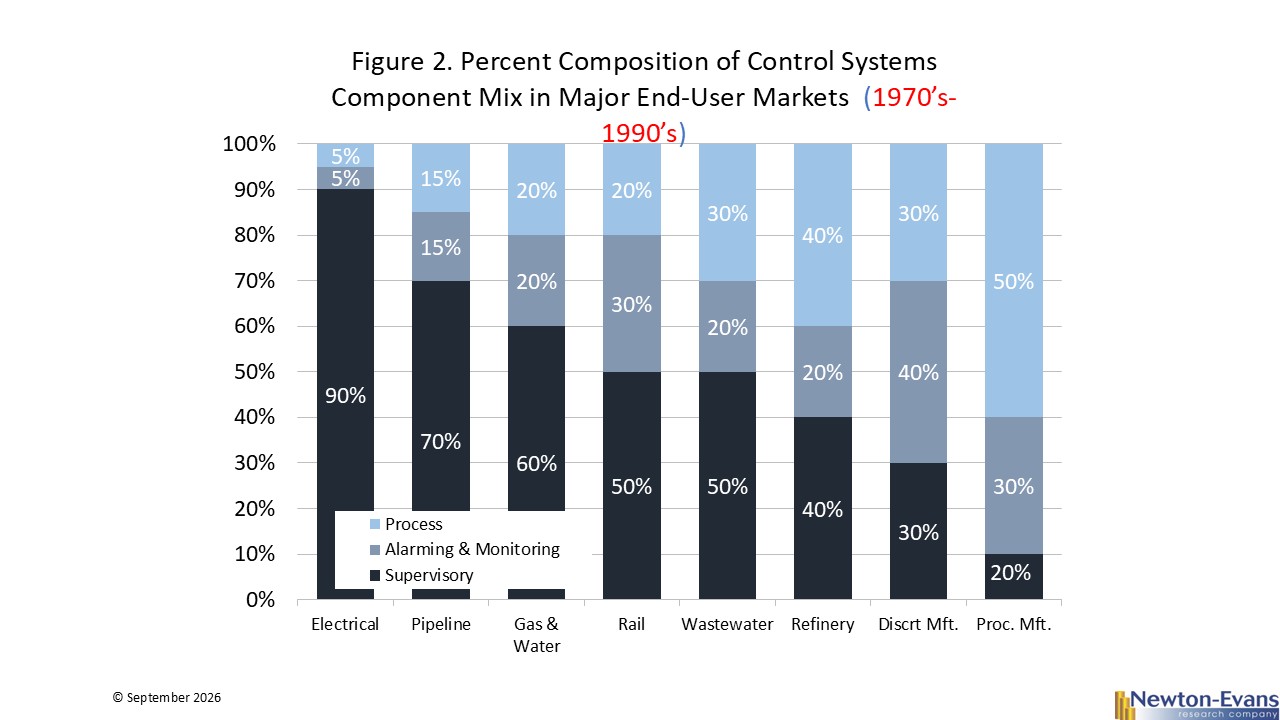
Following on with the changes in control systems designs for critical infrastructure, here is my view of how things looked in the 1970s through early 1990s for eight critical infrastructure segments of control systems use. My first experience with SCADA technology was involvement with piloting supervisory control and data acquisition systems in the military way back in 1967.
By the mid-late 1980’s and into the 1990’s, significant technology improvements had been developed for both computer hardware and software development. As a result of these innovations in operating systems and applications software programming capabilities, there was a corresponding change in control systems design.
The development of the minicomputer and the vertical industry specialization of firms including Digital Equipment, Data General, Hewlett-Packard, Prime and others paved the way for new operating systems including Unix, Linux (adopted early on by Advanced Control Systems), to others already basing systems on Windows 95.
Application development was enabled by the creation of Java (by Sun Microsystems) together with advances in operating systems and software led to more interest in control systems in general, and closed loop systems became widely adopted early on in some of these market segments, especially in the manufacturing industry, process manufacturing in particular. The development of the internet and expansion of digital networks and telecommunications developments were influential in expanding the roles of multi-site control systems, especially for scada-like systems in which remote site data acquisition was a requirement.
See Figure 2.
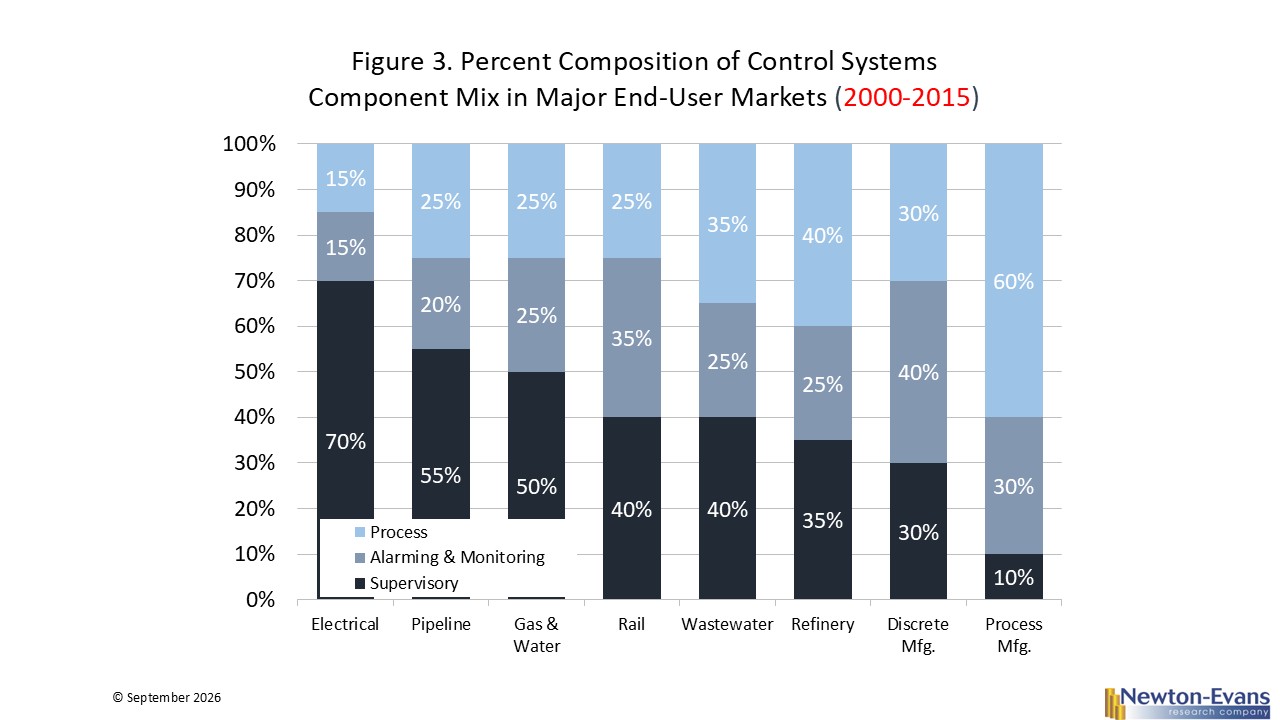
By the turn of the 21st century there were additional technological breakthroughs that had immediate effects on control systems redesign. Broadband internet, faster and more widespread use of the Internet, new iterations of Windows, Unix and Linux, cloud computing and concern for system cyber-security, especially after the events of September 2001, and the development of NERC CIPs for providing a sense of cyber security for each critical infrastructure sector (including the eight control-systems-using sectors in these charts). See Figure 3.
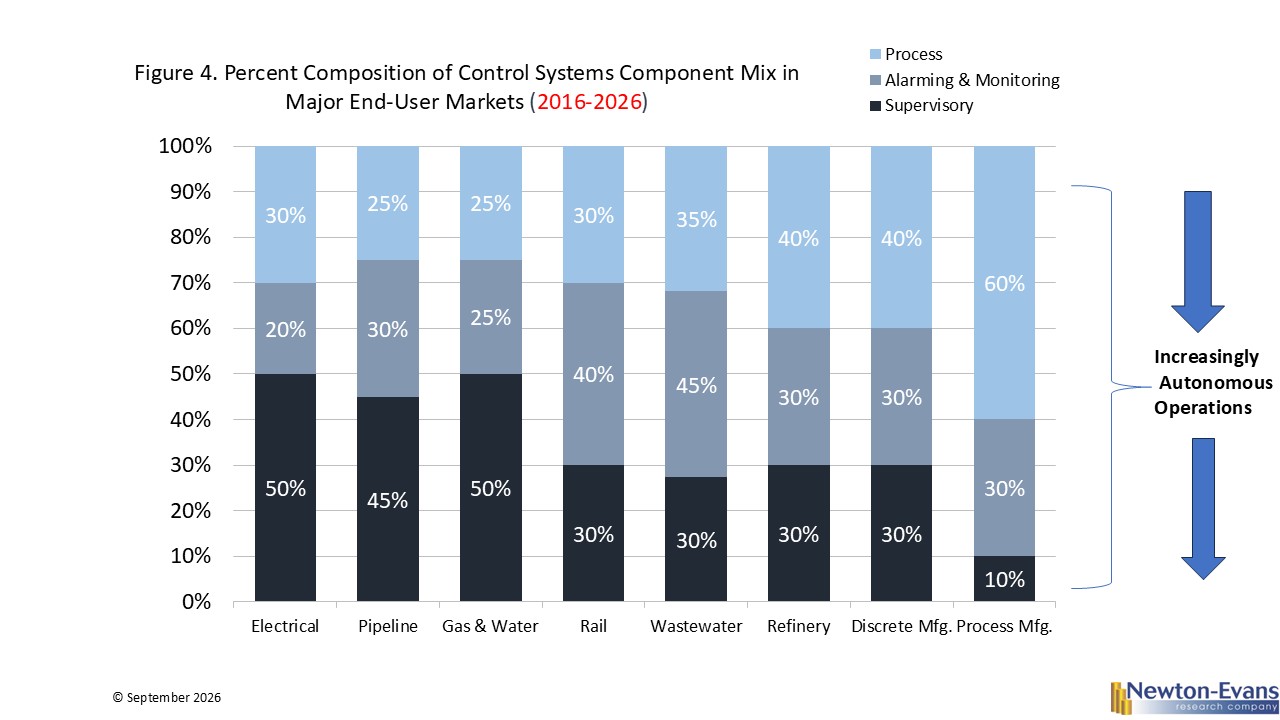
Over the last decade, even more technology developments have taken place. One of the most important of these is applications linkages from primary control systems to ancillary supporting systems. These have led to better integration of information from formerly disparate systems operated from outside of the secure perimeter of the operations control center. Thus, the term Advanced has been placed ahead of EMS and DMS to denote the integration of formerly stand-alone apps and systems. The second major development has been the widespread deployment of 4G networks about 15-20 years ago, and then just ten years later, 5G networks became operational across North America. With the increased reliance on integrated sub=systems with underlying or core platforms, the role of control systems operations personnel has once again undergone a change. This time, more autonomy in systems operations is evident across all user segments. However, with the concerns recently being voiced over the future developments of AI, it is clear to me that we must retain the best and brightest operations personnel to be the decision maker for critical situations in which human insight, experience and knowledge will trump AI decision-making, at least for the foreseeable future. For this reason, we see a high percentage of supervisory control remaining in at least three critical infrastructure segments of control systems usage, electric power, gas and water distribution, and energy pipeline operations. See Figure 4.
THe September 2026 release of all OT/IT report summaries marks the fifth volume in our seven volume series of 2026-2028 reports totaling reports on more than 85 primarily T&D equipment, systems and services topics.
The complete list of OT/IT topics covered in this year’s series follow: Report ordering information can be found here: https://www.newton-evans.com/product/overview-of-the-2026-2028-u-s-electric-utility-market-for-ot-it-systems/
OT/IT 01 – Energy Management Systems;
OT/IT 02 – Distribution SCADA
OT/IT 03 – Geographic Information Systems (GIS)
OT/IT 04 – Customer Information Systems (CIS)
OT/IT 05 – Outage Management Systems (OMS)
OT/IT 06 – Meter data management (MDM)
OT/IT 07 – Mobile Workforce Management (MWM)
OT/IT 08 – Advanced Distribution Management (ADMS)
OT/IT 09 – Energy Market Management System (EMMS)
OT/IT 10 – Control System Security
OT/IT 11 – Generation Management System (GMS)
OT/IT 12 – Distributed Energy Resource Management
 summary reviews and highlights from completed studies