Posted on

Review of Electric Power Industry Producer Price Trends and a NERC ES&D-derived Summary of Power Transmission Project Status

Growth in real market demand is significantly lower than total year-over year market value increases would suggest.  This is largely due to inflationary pressures, caused by rising prices for key commodities used in the production of electrical equipment.  Key among these components are copper, electrical steel and aluminum.  These commodities are under significant price pressures and production capacity limits, and are among the principal reasons for continually rising electrical equipment manufacturing costs.

Equipment prices (especially for power and distribution transformers, for switchgear and for capital HV transmission equipment) have doubled in the last five years, even as real demand has grown as well, but not as fast as inflationary pressures.  These same inflationary pressures affected the production costs and increased prices for MV equipment as well as for HV equipment.

What seems to be different in today’s market composition versus that of a decade ago is that a higher percentage of electrical infrastructure equipment is now being purchased by end-user industrials and commercial enterprises than had earlier been the situation.  Chief among these buyers are data center developers and large renewables project owners as well as the reshoring of American manufacturing plants.  Also, the re-invigoration of the nation’s electric power grid is well underway, in an attempt to make electricity supply more secure, sustainable, more reliable, as well as becoming more resilient to the effects of climate change and climate challenges.

Much of the increase in demand for capital electrical equipment is coming from three sectors of large energy users.

  • First is the continuing growth of renewables, despite the mistaken erosion of interest and significant cutbacks of research funding on the part of the current administration and its Department of Energy. 
  • Secondly is the huge increase in the number and size of data centers supporting AI developments.
  • Thirdly is the reshoring of manufacturing industries, with numerous large industrial campus developments underway at this time.
    • Each of these are responsible for placing capital electrical equipment orders earlier than required, sometimes 2-5 years in advance of the projected need for the equipment to be installed and operating at a plant site.
    • Each of these factors impact and disrupt the historical cyclical equipment procurement activities of electric utilities of all types and sizes.

The electric power segment of the overall energy industry is indeed continuing to proceed with its transition from a fossil-fuel based power generation basis to a more sustainable and greener approach to providing reliable and resilient electric energy.

By staying the course toward reliability and resilience, electric power utilities will necessarily form alliances with non-utility providers of electric power.  Concurrently, I believe we will see some new large campus-like industrial sites developed that will be self-powered, using resources ranging from gas turbines, to small modular nuclear reactors to on-site utility-scale renewable solar farms and wind parks.  A newer and sustainable form of autoproduction and co-generation is being developed by and for use among manufacturers, data centers and utility-scale renewables sites.

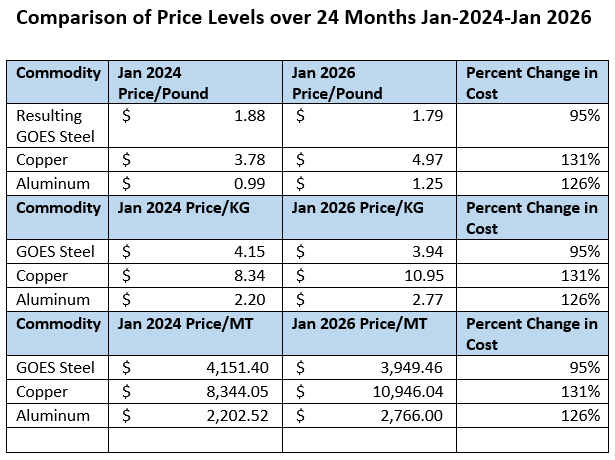
When we evaluate current year costs for key components of electrical equipment, we must look into the cost changes that have occurred over the past 24 months.  The following table was developed at Newton-Evans using commercial market information sources.  Note that the cost/unit of GOES steel had actually fallen from its high-water mark incurred in 2024 until this January, resulting in a five percent drop in price/unit over this time interval However, note the rather steep cost increases for units of copper (+31%) and aluminum (26%), whether measured in units of pounds, kilograms or metric tons (MTs).
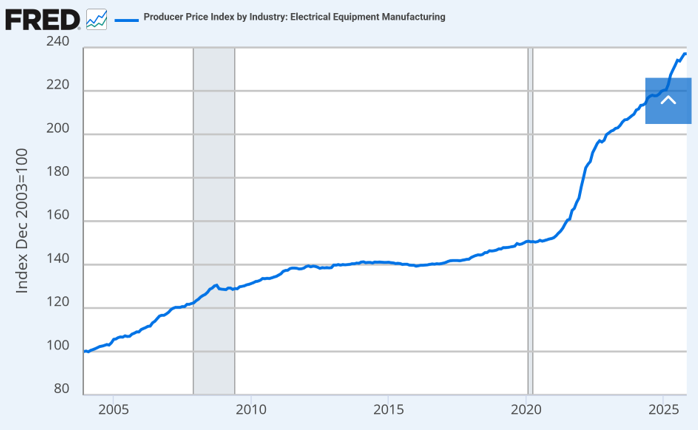
One of the principal resources I have used and relied on over the years has been the economic information produced by the Federal Reserve Bank of St. Louis.  The information on producer prices is published for dozens of commodities, and for many of these, the data is updated on a monthly basis.  This vast array of economic research is known as FRED – for federal reserve economic data.  Now in its 35th year, FRED is a major reliable source of business-related economic information vital to industry and commerce in the USA and internationally.

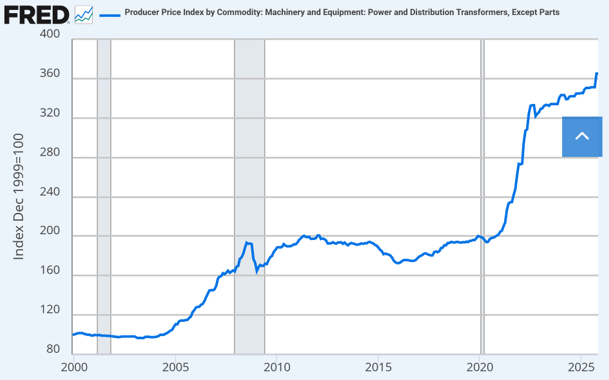
We are looking at FRED data in this article to help understand the huge increases in producer prices (manufacturing-related costs) that have affected the electrical equipment manufacturing industry.  In this first chart, one can view the rather steep rise in producer prices that have occurred over 20 years.  Note the sharp increases in the producer price curve beginning in the COVID era.
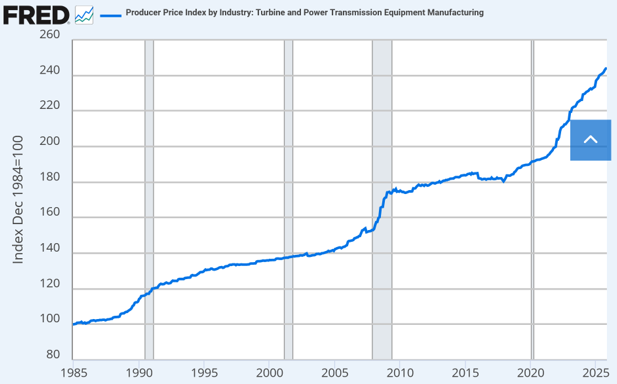
The second chart shows the steep rise in transformer producer prices that have been incurred over the past five years, nearly doubling on this index rising from 200 to more than 360 on the scale.  Note that while it took 20 years for costs to double (from 100 in the base year of 2000) to a level of about 200 in 2020, it will likely take fewer than six years for transformer production costs to again double.
The final chart shows more of the same type of producer price rises, but includes power transmission equipment and turbines in this array.
Earlier this month (January 2026) The North American Electric Reliability Corporation (NERC) published its annual landmark study of transmission projects from across the United States.  More than 1000 projects were documented and described in its annual report can view the status of U.S. transmission projects as of year-end 2025 reader.

There were about 62 project cancellations or delays due to a variety of reasons including economic considerations, load growth issues permitting issues and a few other considerations.  The following chart illustrates the rationale provided for transmission project cancellations or significant delays.

The number of project cancellations and delays that occurred in 2025 was significantly lower (at 62 total) than the 142 such instances reported in the 2024 ES&D study.  Our next topic will focus on the recent developments in the large power transformer segment of the industry.
Posted on

Part Two: A Look at Major Substation Component Equipment – Excerpts from the 2024-2026 Market Overview Series on Substation Automation

The 2024-2026 edition of Market Overview for Substation Automation includes 14 topical reports on modern substation components.  This month’s article presents some highlights from 7 more of these market overview reports. In May, we provided another seven summaries of modern substation components.  Read the article that follows below this article for that information.

More information on the entire 14-report series of substation automation components can be found here: https://www.newton-evans.com/product/overview-of-the-2024-2026-u-s-transmission-and-distribution-equipment-market-substation-automation-series/.  The complete 2024-2026 series is priced at $1,450.00, with individual 3-5 page report summaries available for $195 per report. Each report provides component definitions, revenue estimates of key suppliers, market share assessments, outlook through 2026, and revenue split between sales to utilities and commercial-industrial buyers. 

Sequence of Events Recorders: A sequence of events recorder (SER) is an intelligent standalone microprocessor-based system, which monitors external inputs and records the time and sequence of the changes occurring with any substation activities. Sequence of events recorders usually have an external time source such as a GPS or radio clock configured with Precision Time Protocol (PTP). When wired inputs change state, the time and state of each change is recorded.

SERs enable rapid root cause analysis after multiple events have occurred due to the secure recording of the sequence of events in the order of occurrence. SERs are therefore utilized as a diagnostic tool to minimize plant downtime. SERs are often interfaced with a SCADA system, distributed control system (DCS),or programmable logic controller (PLC). (Per Wikipedia).

Our shorter definition is: a sequence of events recorder is a microprocessor module within the electric power substation that logs time-stamped events. The SER functions can also be performed by other smart substation devices such as multi-function meters and recorders. 

The total utility substation market for dedicated, stand-alone SOE/SER units is in decline due to the inclusion of SOE/SER functionality in other smart substation devices and systems. However, the decline among utility users is being offset by the application of SOE/SER devices among non-utility DER asset owners and operators, hence our outlook is for low-to-moderate growth over the mid-term years.  See report SA08 for detailed information.

Power Quality Recorders: A power quality recorder (PQR) is a microprocessor module that most often is located within the substation that provides and enables regulatory power quality application, measurement, comparison, and profiling of power quality parameters at the individual electrical system interfaces: (e.g. generation, transmission, sub-transmission and distribution system levels). Source: Siemens Corporation.  Substation-based PQ recorder sales have plateaued in recent years as single functions (like recording) tend to become one function of a multi-functional “system-like” instrument.  Non-utility DER assets will likely procure power quality monitors to track power quality being produced by their generation assets prior to uploading to transmission lines.  It is difficult to separate out specific units that ONLY perform power quality recording, so the authors are attempting to allocate costs back to the specific PQ function being studied.  See report SA 09 for detailed information.

Reclosers: An Automatic Circuit Recloser (ACR) is a medium voltage circuit breaker equipped with a mechanism that can automatically close the breaker after it has been opened due to a fault. The market size estimates below include 1phase and 3phase hydraulic units, which category continues to represent as much as 17%-24% of the total recloser business in the U.S. Key factors influencing demand include:

  • Aging and obsolescence of installed base of older reclosers
    • Regulatory decisions on reliability improvements mandated
    • DMS installations and growth in DA activities will likely spur additional ACR installations
    • Utilities represent the bulk of the recloser market – 90%+ of total demand. Substations using recloser technology typically will have four units installed.
    • Customer density and feeder length both affect system protection choices (reclosers versus fuses or sectionalizers).
    • Ease of installation, maintenance-free operation, visual break and SCADA connectivity

See report SA10 for detailed information.

Substation Communications devices include Ethernet switches, hardened routers, teleprotection comms equipment, serial device servers and media converters. Key U.S. market participants in this multi-hundred million dollar market include CISCO, SEL, Siemens, Belden, GE Vernova, ABB and Hitachi Energy, along with many other suppliers of these devices.  See SA12 for details on this market.

Voltage Regulators: A voltage regulator (VR) is an electrical device designed to automatically maintain (regulate) a constant voltage level. VRs may use an electromechanical mechanism, or passive or active electronic components. Depending on the design, it may be used to regulate one or more AC or DC voltages. This overview provides information only on substation-based single and three phase VR units. The larger portion (60-70%) of the total VR market is for single phase units placed along MV feeder paths. In both applications, VRs are often paired with power capacitors

Electric utilities also use mechanical automated units (AVRs) to adjust voltage levels as loads fluctuate on each feeder in an MV distribution network. MV AVRs are basically transformers with multiple taps used to change the turns ratio and thereby alter output voltage. A voltage regulator may be a simple “feed-forward” design or may include negative feedback control loops. It may use an electromechanical mechanism, or electronic components. Depending on the design, it may be used to regulate one or more AC or DC voltages.

In an electric power distribution system, voltage regulators may be installed at a substation (1p/3p) or along distribution lines (1p) so that all customers receive steady voltage independent of how much power is drawn from the line. The DA portion of the VR market is primarily for automated control of single-phase units installed along MV distribution lines.  See report SA13 for detailed information on the substation voltage regulator market.

Substation Timing Synchronization Devices/Clocks: Special clocks used for precise timing indications for improving grid reliability, gaining a better understanding of the power system operation, predicting and preventing systems-wide faults, and testing and verifying operation of protective devices. (Source: http://www.arbiter.com/news/technology.php?id=4)

Similar to the findings obtained from equipment manufacturers in a major Newton-Evans study of timing synchronization, IRIG-B was the most frequently mentioned timing reference used by

U.S. utilities as recently as 2014, as cited by 87% of a survey sample comprised of 30 US electric power utilities. NTP (37%) and direct GPS signals (30%) were mentioned as the next most important references. IRIG-B continues to be widely used in mid-2024.

In that same referenced Newton-Evans study, 21% indicated that their utility would be specifying Precision Timing Protocol (PTP) Standard IEEE 1588 within five years for use as the substation timing references. One utility had already begun standardizing on the PTP standard. Importantly, as American utilities migrate to IEC 61850, time synchronization becomes ever more critical to reliable operations.  Much of the increase in demand for timing synchronization devices is a result of the proliferation of synchrophasor measurement units across North America.  The North American Synchrophasor Initiative (NASPI) provides a great deal of information on their website here https://www.naspi.org/ .

More than 80% of US utilities have recently indicated that they rely on a stand-alone clock for embedded GPS. The utility industry’s migration to Ethernet and IP-based telecommunications to/from substations will likely include a changeover from “legacy” approaches (typified by IRIG- B) to IEEE-1588 to enable more precise network monitoring and sequence of events recording.  See report SA14 for details.

Substation Automation Integration Specialists are firms (or corporate business units) that can assist with or provide a full or partially automated substation on a turnkey basis. Such firms include dedicated businesses such as listed in the SA platforms report SA03 (NovaTech, SEL Automation Services, Subnet Solutions, Eaton-Cybectec), or can be business units of larger companies engaged in the electric power automation business as EMS/SCADA suppliers, RTU manufacturers or protection and control specialists.

Three “tiers” of substation integration providers are included in our assessment:

  • Specialist substation automation integration services
    • SCADA /P&C industry participants with substation devices (RTUs, FEPs, Relays, IEDs, platforms) offering substation integration expertise
    • T&D Engineering Services firms with substation integration expertise

See report SA11 for information that describes the substation automation integration specialist companies in each tier along with revenue estimates for each tier.

We hope you enjoy reading this summary of market information on substation components.  In July, we will provide readers with part one of a two-part series describing high voltage substation equipment as used in the United States.

Posted on

The U.S. Market for Power Transformers in Perspective: April 2025 Edition

Newton-Evans Research has been assessing the increase in demand for power transformers of all size ranges since the COVID pandemic. Many observers have focused on the growth of the data center and artificial intelligence market as being the principal driver for this increase in demand. Additionally, there are equally important – but somewhat less impactful – market drivers that are also increasing the demand for power transformers.

The Trump administration’s dual focus on expanding mining operations and reshoring of manufacturing, the Biden administration’s prior push on increasing U.S.-based semiconductor fabrication operations and its earlier focus on clean hydrogen production, are each adding to the increase in demand for power transformers. Add to this the typical utility-driven demand to replace hundreds of aged-out large power transformers annually and one can see the demand for medium and large power transformers being likely to continue over the short-term and medium-term economic cycles – likely through 2030.

The recent administration decision to apply tariffs to imported finished goods of all types and the duties planned to be applied to commodities and key components of electrical equipment could certainly put a damper on at least part of the planned increase in demand for large power transformers.
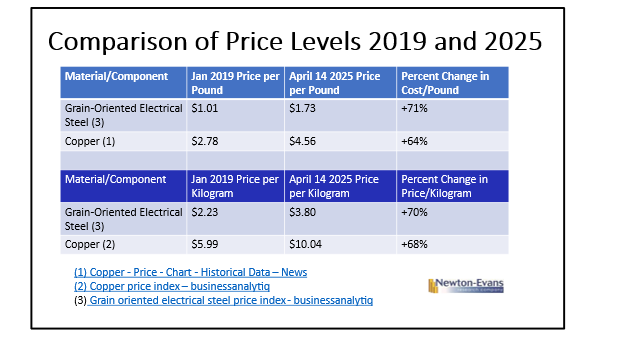
Commodity price increases, especially for electrical steel and for copper, coupled with the surge in demand from utilities and the C&I community, have necessitated that such costs be passed along to the buyer. See Table 1 for a look at the significant price increases for these two key components from January, 2019 to April, 2025.

FIGURE 1.

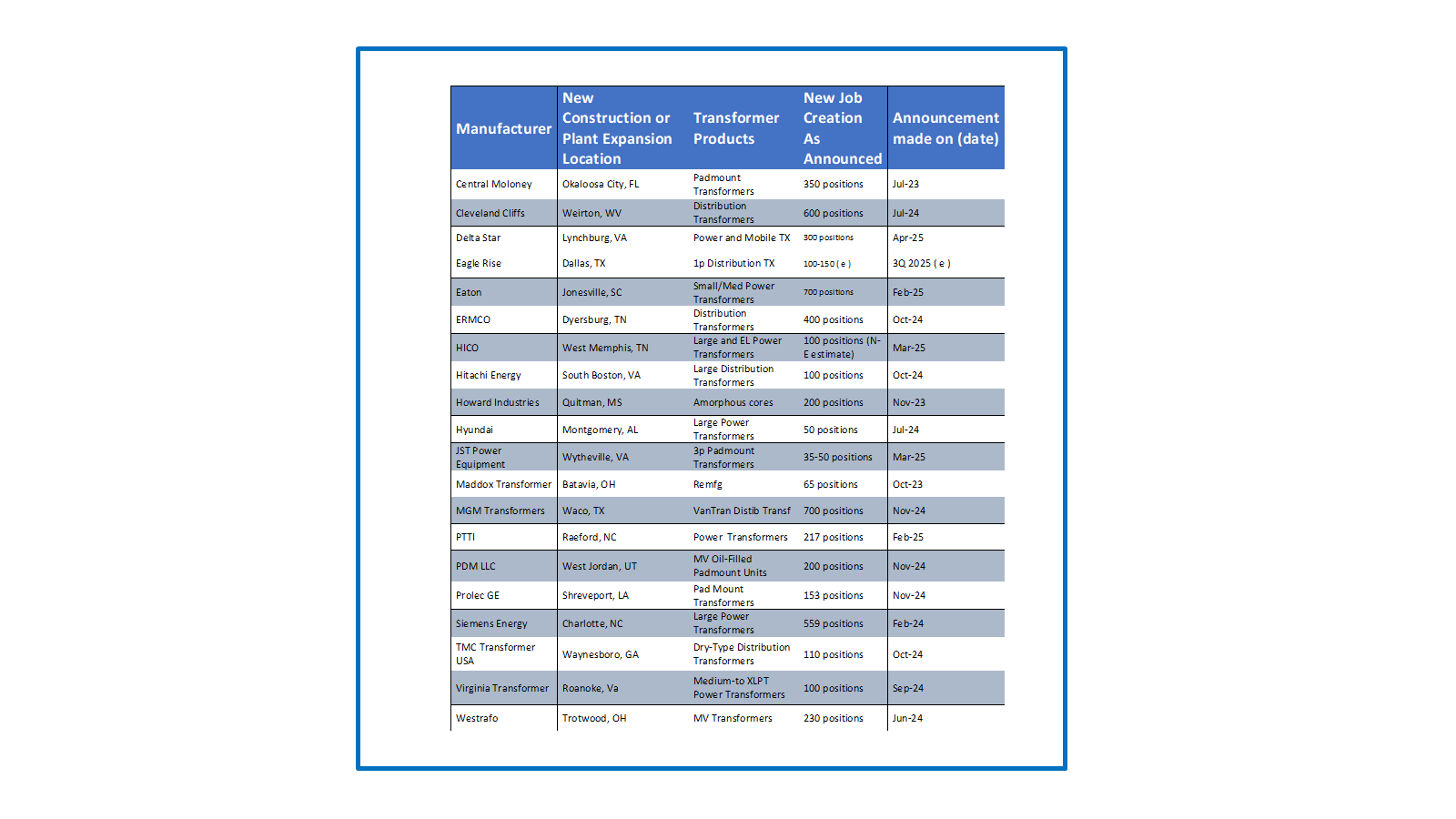
So, the question before us is this: How do we shorten the lead time between order placement and scheduled delivery of a medium to large power transformer? Certainly, development of additional manufacturing facilities and expansion of existing factories is going to help. Figure 2 lists the known plans among transformer manufacturers to expand existing manufacturing facilities or to construct new facilities in the United States over the next 12-36 months. This new capacity will help shorten the currently extensive lead times between order placement and delivery of power transformers. There are 20 transformer manufacturers on our list of known sites planned for expansion or new facility construction spread over 11 states across the U.S. Seven of the listed suppliers are expanding power transformer production capacity. Nearly 3,000 manufacturing and support positions are being added among this group (which is likely not all-encompassing).

FIGURE 2.

If the IEEE PES, NEMA and others could form a task force to standardize on design and performance characteristics to a reasonable extent for large power transformers, that would also help shorten unit production times. A recent article from Wood-Mackenzie focused on the efforts of U.S. mining companies now seeking to mine extensively for copper, given the high level of demand for power and distribution transformers. (3)

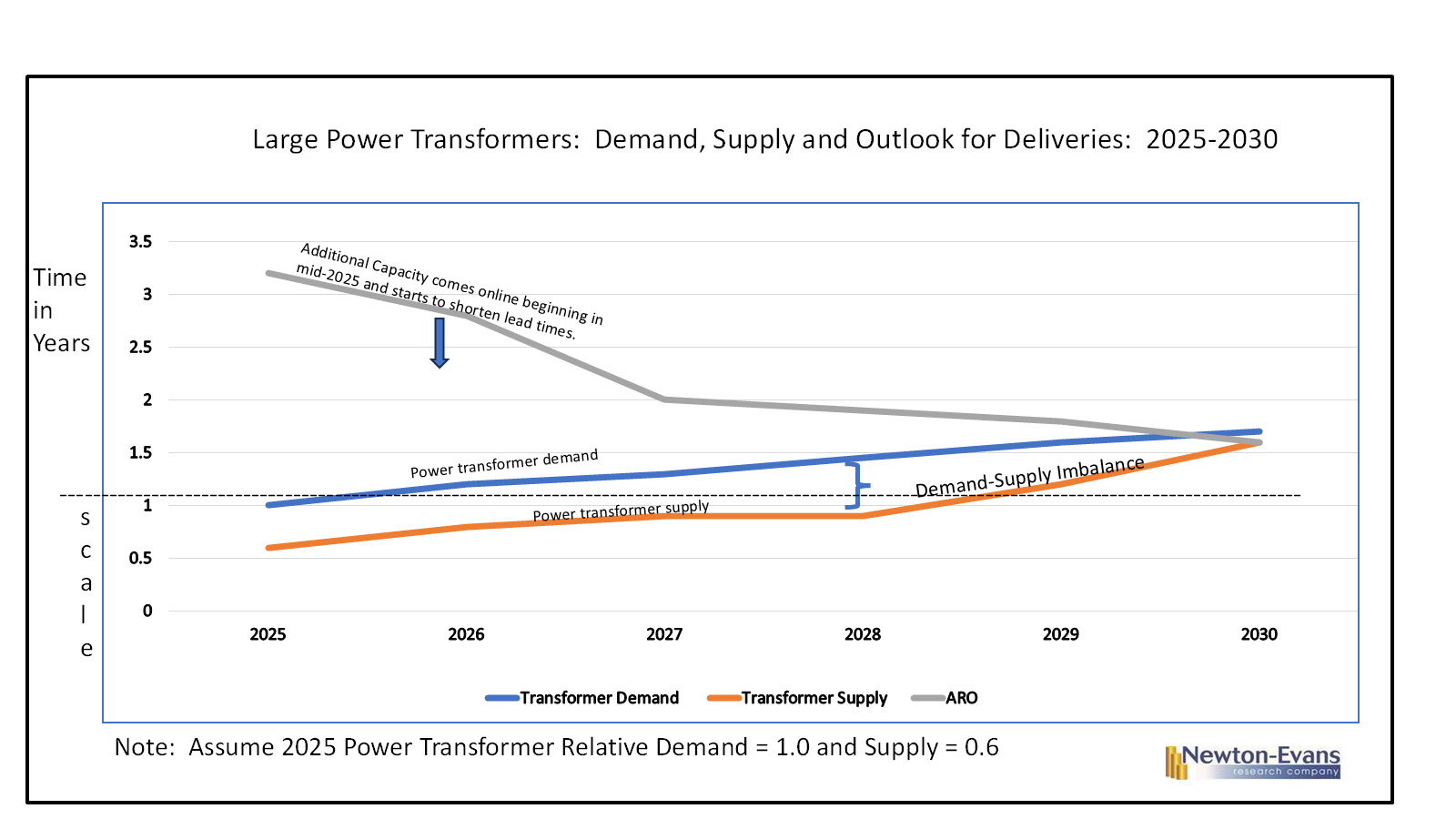
In Figure 3 below, I have attempted to scale perceived unit demand and supply capacity through 2030. Note that relative current imbalance between power transformer supply (orange line) and demand (blue line). The third line (grey line) indicates the view that the increased unit production capacity will have a positive effect on closing the multi-year gap between power transformer order placement and shipment of completed units.
FIGURE 3.

Next month, we will address the distribution transformer industry segment and look at what will likely shape up as a somewhat similar supply-demand imbalance curve, and the time lags affecting deliveries. We will separate pole-mount and pad-mount data as best as we can.

In the meantime, our Market Overview series on Power and Distribution Transformers provides up-to-date coverage on 14 transformer-related topics. Purchasers of this series will be provided with a complimentary update in the third quarter 2025. More information can be found at https://www.newton-evans.com/product/overview-of-the-2024-2026-u-s-transmission-and-distribution-equipment-market-transformer-series/ ,

Posted on

Newton-Evans Research Company Introduces Comprehensive and Cost-Effective Market Overview Package for the Electric Power Industry

The Newton-Evans Research Company is pleased to announce a new, cost-efficient purchasing option for its extensive series of electric power T&D (Transmission and Distribution) equipment, systems, and services market overviews.
Now Available: All 86 Report Summaries for $7,500
This special package includes every summary from our seven major report groupings, as well as an exclusive June 2025 Market Update. The update will analyze the impact of newly imposed or revised U.S. tariffs on T&D equipment and includes an updated spending outlook through 2027.

What’s Included:
Each market overview provides:
• A technical description of the specific product, system, or service
• A list of key market participants
• Market size and share estimates
• A market outlook through 2026
• Sample pricing data (for most topics)
Report Categories (2024–2026 Updates):

Our 86 individual topic reports span seven major categories:

  1. High Voltage Equipment
  2. Medium Voltage Equipment
  3. Power and Distribution Transformers
  4. Control Systems
  5. Distribution Automation
  6. Substation Automation
  7. Protection & Control
    Each category includes between 8 and 18 individual research topics.
    For category details and topic descriptions, please visit our Reports page: www.newton-evans.com/our-reports
    This is the only series of its kind—a vital resource for professionals who need to know the key players, current trends, and future projections in the electric power sector.

Posted on

A Look at the U.S. Medium Voltage Electric Power Equipment Services Market

The total MV services market is very large – possibly in excess of $15 billion. This larger view of the MV services market encompasses multiple segments such as field and in-plant equipment maintenance and refurbishment; construction-related services for distribution substations and MV under-grounding activities; training classes for utility/C&I engineering and operations staffs; site analysis and permitting for distribution utilities and renewables projects; and MV equipment testing services, including commercial test labs and field service diagnostics and testing firms. In addition, vegetation management and telecommunications services are both very large power utility-related businesses in their own right, with significant portions of segment revenue obtained from medium-voltage projects, and these topics will be covered in articles later in 2024.

U.S. Medium Voltage Equipment Services
The U.S. MV equipment services market itself is very large (>$4 billion is our estimated minimum market size) in total, comprised of at least three major sub-segments and is served by hundreds of national, regional and local-area electrical equipment service providers.

While much of MV equipment services growth for third party firms seems likely to be in the 3-5% range, there are a few areas that may see larger increases in revenues, including the upper MV ranges of switchgear, along with gas-insulated units and underground equipment. As well, transformer maintenance, repairs and retrofits are commanding more attention and relying on third party services as new transformer prices, product availability and long lead times affect grid reliability.

Numerous MV Maintenance Market Participants
In multiple research studies conducted over several decades, Newton-Evans Research has found more than 275 U.S.-based companies and organizations provide one or more types of MV equipment-related services to electric utilities and to C&I customers. Each of these was earning related revenues of at least $10 million in annual revenue, with about 45-50 firms in the group earning in excess of $20 million annually from the provision of MV-related services. There is a growing group of domestic firms earning in excess of $250 million in MV services revenue. Another large segment of commercial providers offers services in addition to equipment maintenance, repair and refurbishment. These include utility staff training services, equipment testing services and some portion of construction related (design/build) services.

When it comes to MV equipment services, two product categories account for the lion’s share of segment revenue. These are switchgear/circuit breaker and distribution transformer equipment services.  Let’s take a closer look at these.

MV Switchgear Services Revenue Assumptions based on Third Party Service Firm Website Information
Switchgear services (maintenance, repair, refurbishment and re-manufacturing) are often grouped with similar Circuit Breaker services and together account for several hundred million dollars of utility and C&I expenditures. There are national, regional and local area third-party T&D services firms that provide various levels of equipment services for utilities and the C&I communities. Some of the national names prominent in the switchgear services, maintenance and repair/refurbishment market include Shermco, CBS Services and Saber Power Services.

While many services firms are in the “small business” category and earn less than $10 million annually, there are several others that earn in excess of $100 Million from a variety of T&D equipment service offerings.

Distribution and Power Transformers
While Newton-Evans estimates as much as $900 million is spent annually on electric power transformer services and replacement parts, the majority of this amount goes for power transformers. Nonetheless, there are several firms that specialize in service and repairs for pole-top and pad-mount distribution transformers. Among the large firms that service, repair and refurbish transformers of all sizes and offer nationwide services, include companies such as IPS, Sunbelt Solomon, RESA and others. A number of smaller firms specialize in maintenance, repairs for distribution transformers at a regional level, including Northeast Power, UTB Transformers and Valley Transformers, Inc.

Twenty years ago, a Newton-Evans survey found that many utilities did not bother with repairs to, nor did they consider third party maintenance, of pole-mount distribution transformers. Unit replacement was easier and faster than was rework and repair. At that time, manufacturing capacity for pole-mount units was sufficient to meet domestic U.S. demand, and lead-times were quite short, compared with today’s market. Most electric power utilities had been able to procure and store scores or hundreds of spare pole-top units for emergencies or time-based replacement up until the COVID years.

All Other MV Equipment Services: The third arm of MV equipment services we consider to be comprised of “all other” equipment of significant cost – that is, costing multiple thousands of dollars. Based on a small sample utility survey conducted during late 2023, it appears that relatively low-cost equipment including reclosers, sectionalizers, fuse links, distribution line monitors, fault current limiters, surge arresters and MV capacitors were very likely to be replaced rather than repaired.

Our next article on MV Services will focus on construction-related services for distribution substations and MV undergrounding activities; training classes for utility/C&I engineering and operations staffs; site analysis and permitting for distribution utilities and renewables projects; and MV equipment testing services, including commercial test labs and field service diagnostics and testing firms.

Keep in mind if you need to have an understanding of the U.S. medium voltage equipment market, our report series of two to four page U.S. market overviews, covering 17 MV equipment types, may be helpful to you. The link for for further information and to place an online order is here:
https://www.newton-evans.com/product/overview-of-the-2024-2026-u-s-transmission-and-distribution-equipment-market-medium-voltage-series/

Posted on

Voltage Regulators –Guardians for Maintaining High Quality Power Distribution


Voltage Regulators –Guardians for High Quality Power Distribution  –   In an electric power distribution system, voltage regulators may be installed at a substation (1p/3p) or along distribution lines/feeders (1p) so that all customers receive steady voltage independent of how much power is drawn from the line. The distribution automation portion of the VR market is primarily for automated control of single-phase units installed along MV distribution lines.  In both distribution feeder and substation applications, VRs are often paired with power capacitors.

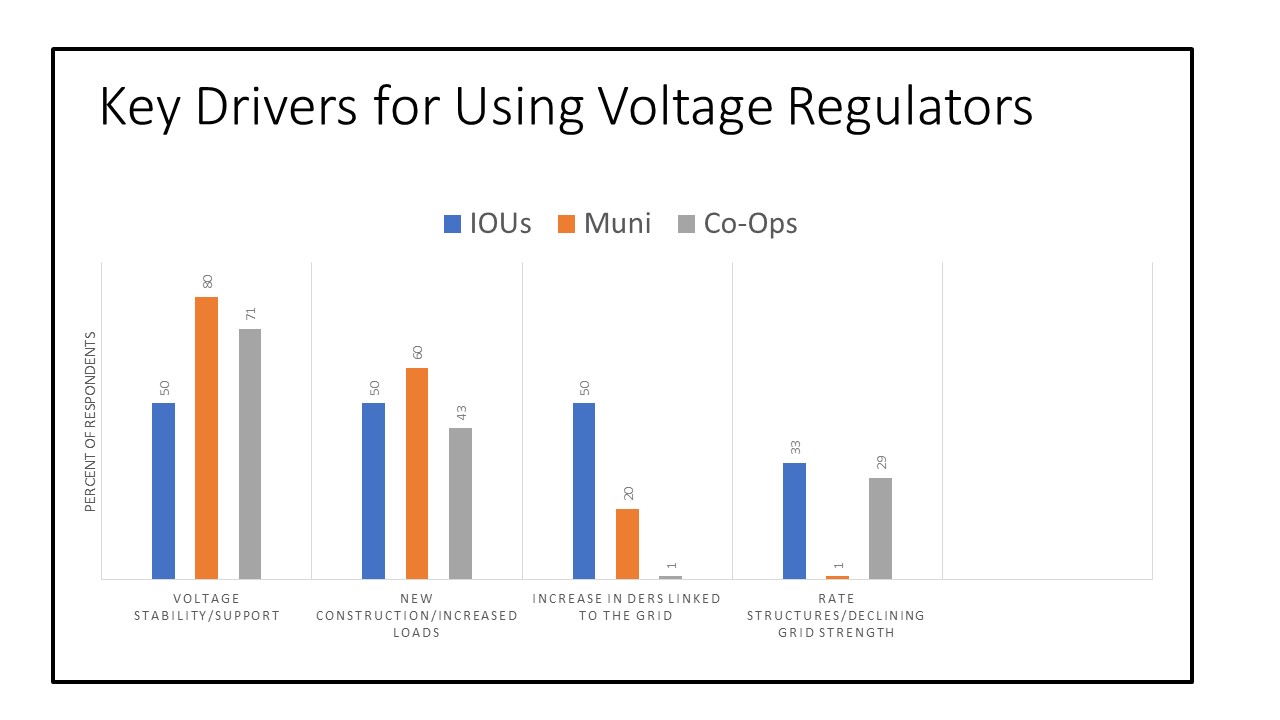
Currently the single most important factor behind the growth in use of single-phase VRs is the increase in installations of distributed energy resources (DERs) and the impact that these grid-connected resources are having on grid voltage stability.  Because of the variable or intermittent nature of DERs, there is a need to control voltage fluctuations, hence the push to utilize more VRs by utilities that are actively involved with DERs in their service territories. New construction of C&I sites, residential developments in the suburbs as well as feeder length in large rural areas are also key factors affecting the increase in use of VRs.  Certain regulatory actions in place or planned will continue to influence the need for VRs.  See the chart just below for a look at key drivers for using VRs among IOUs, Public Utilities and electric power cooperatives.

Click on chart to enlarge! Keep in mind that the nation’s electric power delivery/distribution system was designed for one-way (or uni-directional) power flow, and with the development of DERs, we are confronted with a need to accommodate two-way (bi-directional) power flows.  This changes the feeder voltage profile making voltage regulation more challenging, with DERs tending to cause local voltage rise along a distribution feeder.  The expansion of variable renewable generation resources owned by industrial/commercial companies will mean growth in the non-utility/C&I portion of the VR market.  VRs will continue to be used to control voltage levels from these intermittent resources.

 Market Size Summary:

Some suppliers have suggested to Newton-Evans that growth of 10-15% per year is on the horizon.  A lot will depend upon continuing economic recovery and the promulgation of DER-friendly policies and regulations being planned over the coming years.  Currently, there are three principal manufacturers of automated voltage regulators serving the domestic U.S. market.  These are General Electric, Eaton Corporation and Siemens.  Together the “Big Three” control about 75-80% of the combined VR market.  Howard Industries is next, followed by Schneider Electric, Delta Star and Basler Electric with each having a few dozen important utility customers and together comprise the remaining 20-25% of the VR equipment manufacturing market.

Market Drivers:

Currently the single most important market driver for using VRs is the increasingly important role of distributed energy resources (DERs) and the impact that these resources are having on grid voltage stability.  Because of the variable nature of DERs, there is a need to control voltage fluctuations, hence the push to utilize more VRs by utilities that are actively involved with DER in their service territories. New construction of C&I sites and residential developments in the suburbs are also key factors affecting the growth in use of VRs.  Feeder length among suburban, exurban and rural areas and some regulatory actions also impact the need for VRs.  Perhaps offsetting some of the demand from DER sites will be a new generation of smart inverters that may be able to provide voltage stability from DER sites to the grid interconnection point, perhaps nullifying the need for a separate VR on-site.  The publication of IEEE 1547-2018 provides for performance criteria for DERs including such functionality as Volt-Var control which can also be used to help regulate the distribution system.

Operational Driver:

While the use of single-phase VRs can be found among many hundreds of IOUs, public utilities and cooperatives, the use of three phase VRs is less widely used among munis and co-ops.  Many of these utilities have switched to using single-phase units where, in the past, they may have used a three-phase unit.  There are also about 10-15% of utilities that do not use VRs, but rely on on-load tap changers (OLTCs) with substation transformers – most within urban corridors with relatively short distribution feeders.  You may want to return here for more articles on grid modernization over the coming weeks and months.

Posted on

Newton-Evans Research Publishes 15 Market Snapshot Reports on High Voltage Power Equipment and Transmission Substations

March 22, 2021.  Ellicott City, Maryland.  The Newton-Evans Research Company has announced publication of a set of 15 U.S. high voltage equipment and substation market two-to-four-page summaries.  The new series of market overview reports (executive market summaries) includes supplier listings, representative products, and estimated market size for each topic, including vendor market share estimates and market outlook through 2023.   Electric utilities accounted for about 86% of HV-related equipment and transmission substation spending overall.

  • Commercial and industrial end-users accounted for more than $300 Million on substation construction projects in 2020, according to Newton-Evans’ estimates. Much of this amount was for construction of renewable energy gathering substations.
  • Substation construction represents the largest single investment area among all bulk power system components.
  • HV gas-insulated substations and gas-insulated switchgear represent a growing segment of bulk power-related investments. Growth is likely to accelerate once non-SF6 gas alternatives are more widely available for higher voltage equipment.
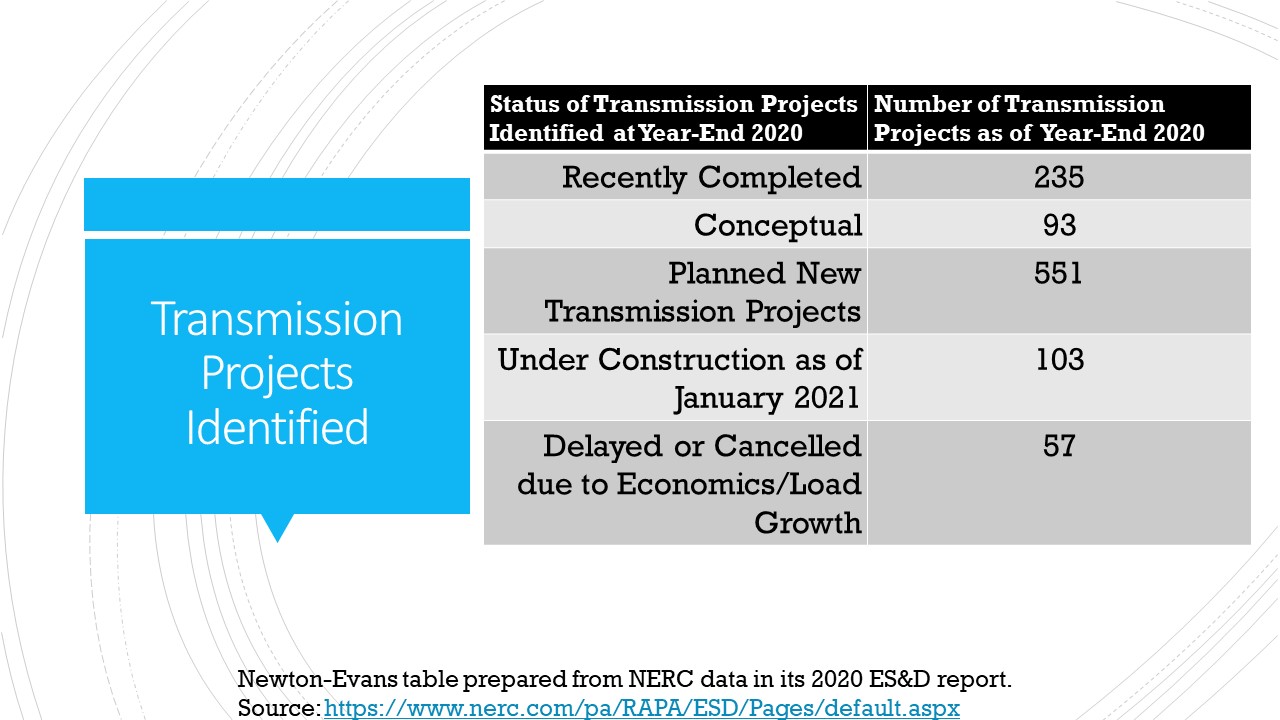
  • NERC projections suggest that as many as 14,000 HV line miles will be constructed over the 2021-2030 period. Importantly, more than one half of the expected expansion will be at 200kV or higher.  This will mean a need for about 250-300 new/up-rated transmission substations.
  • IOUs, G&Ts and federal agencies were most closely identified as having HV substation construction plans. Distribution cooperatives, municipal operations and industrial sites were more likely to plan MV substation construction projects.  Following is a look at identified transmission projects.


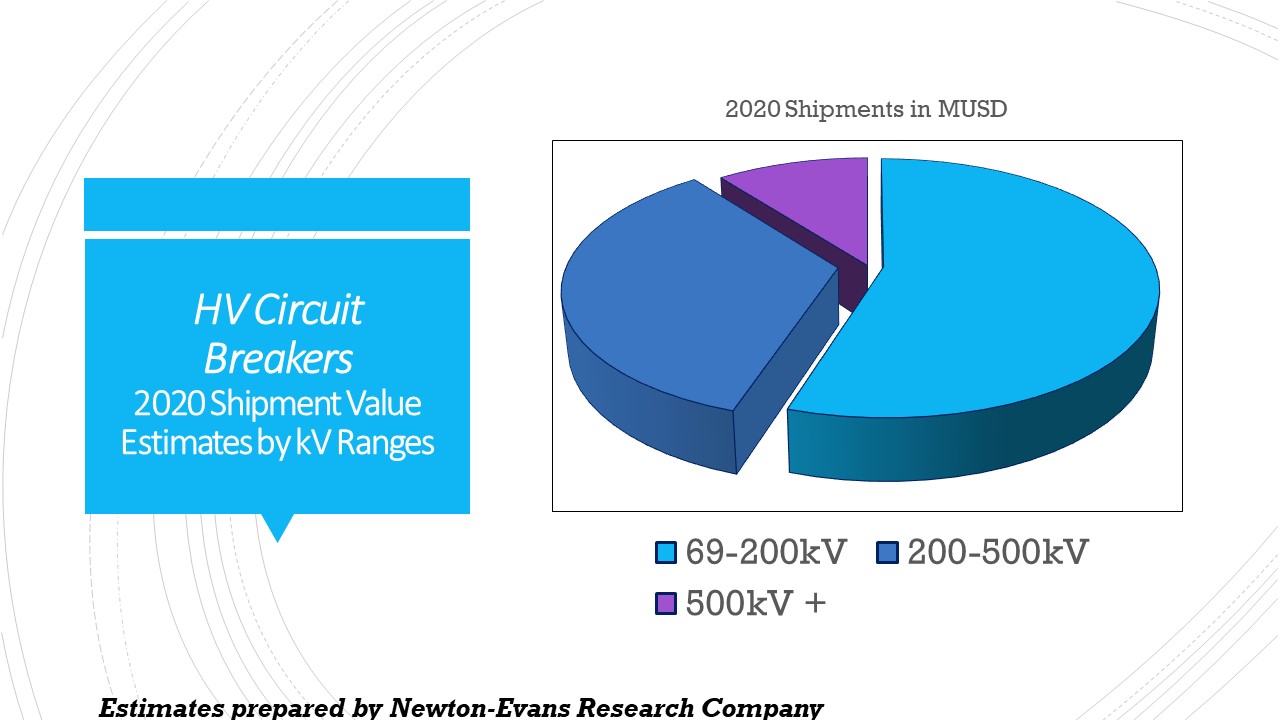
  • HV circuit breaker shipments likely exceeded $900 Million in 2020, with more than one half of the total investment made for 69kV-200kV range of breakers.


Further information on the 2021-2023 series of U.S. High Voltage Equipment market overviews is available on the Newton-Evans Research Company website:  https://www.newton-evans.com/our-reports/ for a brochure or to place an order for this new series or many other available T&D-related market reports.  This series is available via online purchase and immediate download.  Individual HV topical reports are priced at $150 per report, and the entire 15-report series is priced at $1,250.00.  Newton-Evans Research Company, P.O. Box 6512, Ellicott City, Maryland 21042. Phone: 410-465-7316.

Posted on

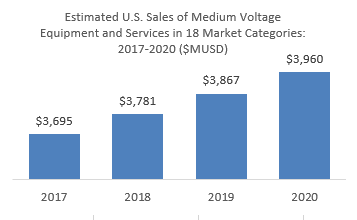
Estimated U.S. Sales of Medium Voltage Equipment, Components and Related Services Accounted for about $3.6 Billion in 2017 – Likely to Reach $3.9 Billion in 2020

The Newton-Evans Research Company has announced the publication of a series of 18 electric power distribution market two-page snapshot market summaries. The new series of market overview reports (executive market summaries) includes supplier listings, representative products, and estimated market size for each topic, vendor market share estimates and market outlook and growth factors through 2020. Electric utilities accounted for nearly two-thirds of purchases of the medium voltage product categories in this series, with industrial and commercial usage accounting for about one third of the value of MV equipment shipments. A majority of the included grid infrastructure equipment and products continue to be manufactured and/or assembled in the United States.

Continue reading Estimated U.S. Sales of Medium Voltage Equipment, Components and Related Services Accounted for about $3.6 Billion in 2017 – Likely to Reach $3.9 Billion in 2020

Posted on

Proposed Import Tariffs: A BAD IDEA for the U.S. Electric Power Industry

by Chuck Newton

We all know that the current administration wants to “make America great again,” but using tariffs to prop up our homeland infrastructure is not the right approach to take at this time.

The U.S. electric power industry can ill afford the extra costs that would be incurred with the placement of 10-25% tariffs on iron, steel, and aluminum, which are core building blocks of our nation’s electrical infrastructure with a good percentage of finished electrical apparatus, equipment and ancillary products manufactured with imported steel and aluminum. Continue reading Proposed Import Tariffs: A BAD IDEA for the U.S. Electric Power Industry

Posted on

U.S. Sales of Medium Voltage Equipment, Components and Related Services Accounted for More than $11 Billion in 2013, Forecast to Reach $13 Billion by 2016.

May 19, 2014. Ellicott City, Maryland. The Newton-Evans Research Company has announced the publication of a series of 18 electric power distribution market two-page snapshot market summaries. The new series of market overview reports (executive market summaries) includes supplier listings, representative products, and estimated market size for each topic, vendor market share estimates and market outlook and growth factors through 2016. Electric utilities accounted for nearly two-thirds of purchases of the medium voltage product categories in this series, with industrial and commercial segments accounting for about one third of the value of MV equipment shipments. A majority of the included equipment and products continue to be manufactured and/or assembled in the United States.

The Medium Voltage equipment market overview series is priced at $1,500 for all 18 market summary reports, or at $150.00 for individual report summaries. Each snapshot report include product definitions, estimates of 2013 U.S. market size, supplier market shares and the outlook through 2016 for these categories: MV01 – Air Insulated Metal Clad Switchgear; MV02 – MV Motor Controllers; MV03 – MV Gas Insulated Switchgear; MV04 – Automatic Circuit Reclosers; MV05 – Outdoor Distribution Circuit Breakers (5-38kv); MV06 – Load Interrupter Switchgear; MV07 – Overhead Disconnect Switches (15-38kv); MV08 – Sectionalizers; MV09 – Fused Cutouts; MV10 – Pad Mounted Switchgear; MV11 – Submersible Switchgear; MV12 – Bus Duct and Bus Bar ; MV13 – Substation Class Pad Mounted Capacitors; MV14 – Current/Instrument Transformers; MV15 – Fault Current Limiters; MV16 – Fault Current Indicators and Faulted Circuit Indicators; MV17 – Current Limiting Fuses and Fuse Links; and MV18 – Surge Arresters.

Other U.S. T&D market snapshot series to be updated during the next three months include power transformers (11 market segment snapshots), protective relays (8 market segment snapshots) and substation automation components (13 market segment snapshots). The next market overview series to be released covers 12 component topics related to distribution automation. The DA series is planned for publication in June, 2014.
Further information on each series of U.S. T&D market snapshots is available from Newton-Evans Research Company, 10176 Baltimore National Pike, Suite 204, Ellicott City, Maryland 21042. Phone: 410-465-7316 or visit www.newton-evans.com for a brochure or to place an order for any of the related report series or more than 85 individual T&D report summaries online. For subscriptions to all of the currently available report series, please call or email us for special introductory pricing offers. For more information send an inquiry to info@newton-evans.com

Posted on

Overview of the U.S. Market for Fuses and Fusing Products Among Mid-sized Electric Utilities

This past summer Newton-Evans Research conducted a market survey of mid-sized electric utilities in the U.S. on the topic of fuses and fusing products. A total of 38 replies were received from utility operations officials. This respondent group included: 4 Investor Owned utilities, 21 Public Power utilities, and 13 Cooperatives. These 38 utilities serve a combined total of 8.2 million end user customers, or about 6% of the 144.5 million U.S. electricity end users.

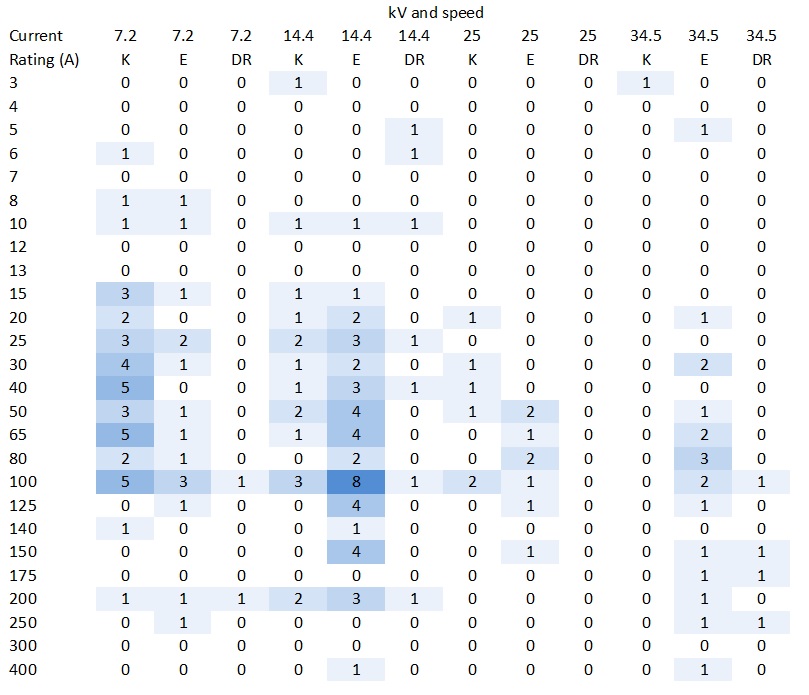
Among several of the survey questions, utility engineers were asked to select the five voltage, current and speed power fuse combinations that were most used. Thirty-two respondents answered this question. Some respondents selected less than five combinations, and some selected more than five combinations. Twenty-seven respondents use 100 amp power fuses at either 7.2kV, 14.4kV, 25kV or 34.5kV. The table below provides a complete count of each combination selected on the survey.

Voltage, current and speed power fuse combinations used most: number of mentions
VCSusedMost
*Note: respondents were allowed to pick multiple options.

Utility officials were also asked about their typical annual budgets for fusing products, as well as which manufacturers are used as a percent of their overall fuse purchases.

This new 37 page market report is based on a survey of mid-size utilities regarding usage levels and brand preferences for fuse links, power fuses, and current limiting fuses. The report looks at the most common amp ratings, key manufacturers, budgets and annual usage levels of fuse links, power fuses and current limiting fuses among the sample, and offers projections to the entire U.S. market. The power fuse section also looks at indoor versus outdoor applications and refillable versus one time use units. Voltage and current combinations are charted by usage levels for current limiting fuses. The fuse products report is priced at $675.00.

See our reports page to place an order.

Posted on

Power Fuse Applications in the U.S. Electric Utility Industry

Earlier this year, Newton-Evans received 38 responses to a four page survey on the topic of power fuses, current limiting fuses and fuse links. Topics on the survey included number of power fuses, current limiting fuses and fuse links purchase annually; what brands are used; which current levels, voltage levels and speed ratings (K, E and DR) are used the most; what % of fuses are re-fillable vs. one-time use; and what % are used for indoor vs. outdoor applications.

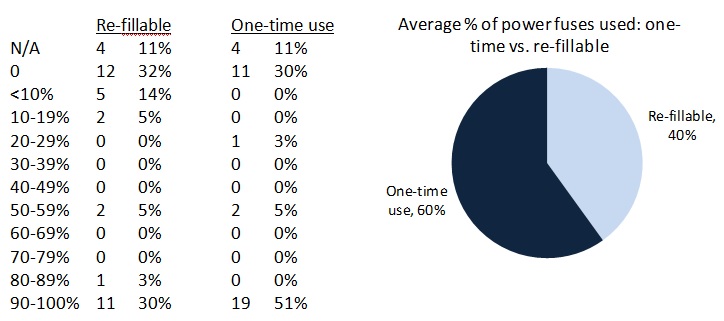
What percent of power fuses being purchased are re-fillable power fuses (i.e. SM4, SM5) versus one time use (replaceable) power fuses (i.e. SMD20/SMU20, SMD40/SMU40)?

Newton-Evans Research found that most utilities either buy nearly all re-fillable power fuses or nearly all one time use power fuses. Among the sample, an average of 40% of power fuses are re-fillable, and an average of 60% are for one-time use. A frequency distribution of individual responses shows that the 2 largest portions are either 0% or 90-100% for either type.

What % of Power Fuses Are Refillable Vs. One-time Use?
powerFuses_refillV1time_tblchrt

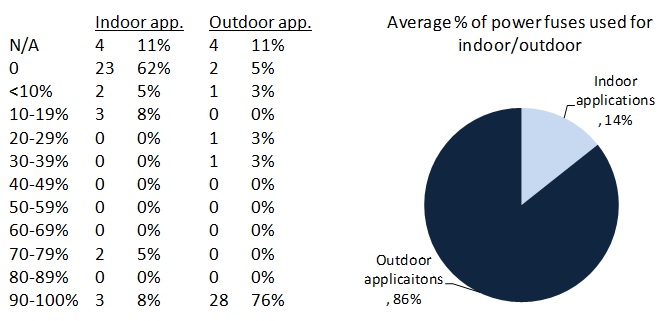
What percent of power fuses are used for indoor applications (i.e. SM4Z, SM20) versus outdoor applications (i.e. SMD20, SMD40)

Overall findings from the surveyed utilities indicated that about 86% of power fuses are purchased for outdoor applications, and the remaining 14% for indoor applications. However, note that five survey respondents indicated that 70% or more of their power fuses were in fact for indoor applications.

What % of Power Fuses Are For Indoor Use Vs. Outdoor Use?
powerFuses_indoorVoutdoor_tblchrt

To download a sample .pdf of this report or to order online, see our reports page.