Posted on

EMMOS Conference Sep. 21-23

Just a reminder for those planning to attend the 22nd annual EMMOS (Energy Management and Market Operations Systems) user group conference on September 21-23 at the Marriott Renaissance Hotel in Carmel, Indiana can make hotel reservations at a discounted rate until August 27th.

This year’s conference agenda will feature topical speakers and roundtable sessions, technical training classes and a vendor exhibition.

Featured conference and training topics at the 2015 gathering of North American and international control and market systems operations management and staff include:

  • Cyber Security Perspectives in Light of CIPS V5
  • Overview of MISO Market and System Reliability Operations
  • North American Developments in DMS and DA Usage
  • Visualization
  • Situational Awareness
  • Communications Standards
  • Renewables Integration and Management
  • Network Security Applications
  • Next Generation Systems
  • The Future of Energy – Smart Grid and Beyond, and several additional control systems related topics.

The 2015 conference will include tours of the Midwest ISO (MISO) control center on Tuesday afternoon and Wednesday morning. The vendor exhibition will include a cocktail and hors d’oeuvres reception on Monday evening.

The annual EMMOS conference attendees include electric power operations officials involved with transmission, distribution and generation, as well as IT managers, planning engineers, consultants, ISO staffs, and related systems personnel involved with control systems and substation modernization, distribution automation, outage management and geographic information systems.

Further information on the upcoming 2015 EMMOS conference, including registration information and hotel booking arrangements can be found on the EMMOS website at www.emmos.org. Exhibitor opportunity information is available from Ms. Erika Ferguson at EFerguson@osisoft.com

Posted on

The Role of ADMS/SCADA in Building a Resilient & Reliable Distribution Grid: Part 1

This is part one of a four part series on ADMS and Distribution Automation. Part one discusses Advanced DA, differences between Distribution SCADA and ADMS, market participants, usage patterns, challenges, priorities, and comments from users.

What utilities have said
Based on a mid-2014 study of the market for Distribution Automation (along with multiple earlier studies), increasing numbers of large utilities have indicated the following:

  • Integrated systems are becoming more desirable
  • Entrenched suppliers of large control systems (EMS primarily) have an “in” but often cannot provide the required component systems for an integrated approach to DMS-OMS-GIS.
  • Many mid-size utilities consider their DSCADA systems (primarily the ACS, OSI and Telvent communities) as suitable platforms for DMS/DA.
  • A high proportion of all respondents do not yet see a need for a separate DMS. This is especially true among the mid-tier utilities.
  • DMS systems can be (and most often are) implemented in a single control center that cuts across state lines in the United States.
  • Typically, operating companies under a large holding corporation operate their own DMS or DSCADA installations.

10 attributes of advanced DA
Here are the 10 attributes of an advanced distribution automation capability based on Intelligrid’s definition:

  1. Real-time Distribution Operation Model and Analysis (DOMA)
  2. Fault Location, Isolation and Service Restoration (FLISR/FDIR)
  3. Voltage/var Control (VVC/VVO)
  4. Distribution Contingency Analysis (DCA)
  5. Multi-level Feeder Reconfiguration (MFR)
  6. Relay Protection Re-coordination (RPRC)
  7. Pre-arming of Remedial Action Schemes (PRAS)
  8. Coordination of Emergency Actions (CEmA)
  9. Coordination of Restorative Actions (CRA)
  10. Intelligent Alarm Processing (IAP)

While ADMS platforms are increasingly used by Tier One utilities, many other utilities continue to rely on their DSCADA system to manage a growing portfolio of ADA functions.

Use of DMS as of Mid-2014 (Participants in Newton-Evans’ Study)

  • Just over 40% of all respondents indicated use of a DMS as of June 2014.
  • IOUs were more likely to indicate having a DMS installation than were respondents from other utility types.
  • All of the surveyed utilities have a DSCADA capability and are likely to be applying SCADA control over basic DA functions such as capacitor bank control and recloser control.

ADMS and DSCADA market participants
The total North American DMS market is made up of ADMS and DSCADA, with some overlapping providers and some different market participants in each category. Among this North America sample of large utilities, GE and ABB/Ventyx led in mentions of current ADMS installations. OSI is also a major supplier of DSCADA and ADMS installations, but their clients tend to be mid-size utilities. All of the mentions for both GE and ABB/Ventyx were made by IOU respondents.

Posted on

North American Market for Single Phase Reclosers

During the first quarter of 2015 Newton-Evans Research Company studied the North American market for single phase reclosers. This survey based report addressed questions pertaining to purchasing volume by type (kV rating and insulation type), protection for 1-phase laterals, brands used, types of connections for recloser communications, importance of various recloser features, and other topics.

Newton-Evans found that out of 46 electric utilities who responded to the survey, 72% currently use single phase reclosers on their system and 4% plan to use them in the future. The total number of installed single phase reclosers among the survey sample included about 18,000 units, with the vast majority of those being oil insulated (as opposed to other insulation types like solid dielectric.)

Some key findings from this report suggest the following:
(1) Electric utilities predominantly use fuse protection on single phase taps rather than use a single phase recloser.
(2) While the bulk of survey respondents indicated a greater installed base of oil insulated single phase reclosers, on an average annual basis some utilities indicated they purchase many more solid dielectric reclosers than oil insulated.
(3) Nearly one-half of the respondents said that over 70% of future recloser purchases will be for new units and not for replacements.

Question: Over the next 3 years, please estimate the percentage % of 1-phase reclosers your utility will install on 1-phase laterals vs. feeder main applications.

Only a minority of new purchases of 1-phase reclosers will be installed on single phase laterals, although four utilities plan to use more than one-half of their 15kv purchases to protect single phase laterals. Three utilities plan the same (50%+) for 26kV units, none replied with any indication of any plans to use single phase reclosers of 38kV laterals.

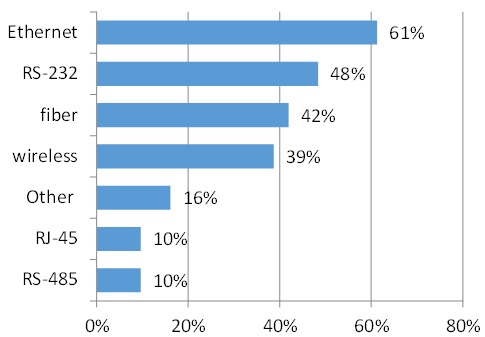
Question: What types of connections are required for recloser communications?
Ethernet ranked as the type of connection required for DA communications, with rs-232, fiber and wireless connections also very important to this group.
RecloserComms1

Question: How are the 15kV 1-phase laterals on your system protected?
For 15kV laterals, most utilities indicated the vast majority of laterals are protected, but are protected by and large, via the use of fuses. Few 1-phase laterals are protected by reclosers and even fewer by electronic sectionalizers.

Question: What are your preferred protocol for recloser communications?
Clearly, the US utilities are still tightly aligned with DNP 3 as the most critical DA protocol, and the protocol that all manufacturers of DA devices do provide.

For more information about the market for reclosers or other research topics, give us a call: 1 800 222 2856.

Posted on

Excerpts from Newton-Evans’ North American Distribution Automation Market Assessment & Outlook: 2015-2017

header1-field

Below are some excerpts from this recent survey of 75 North American electric transmission & distribution companies.

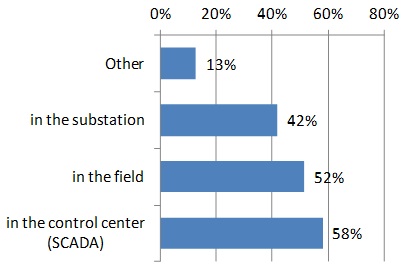
Where are the controls located for FDIR/FLISR on your distribution system?
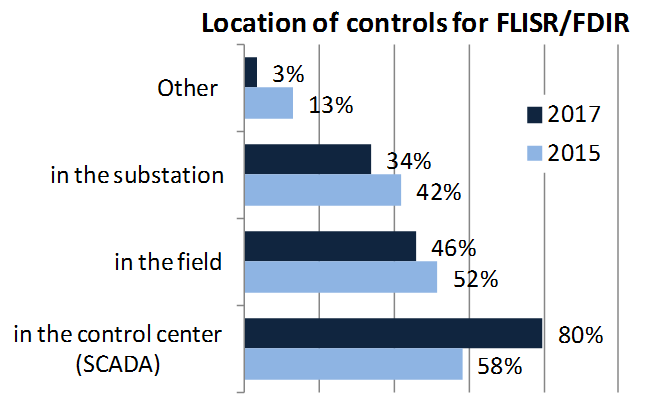
As had been observed and reported din earlier Newton-Evans studies of distribution automation, respondents continue to provide a mix of replies to this question. Among the 42% of utility officials indicating some implementation of FDIR/FLISR on their distribution system, many have controls implemented at two or three locations. Among the 31 utilities identified as current FDIR/FLISR user utilities, controls were listed as being located at the control center (58%), in the substation (45%) and in the field (52%).

Location of controls for 31 respondents who have feeder automation and/or FLISR
DA1June1

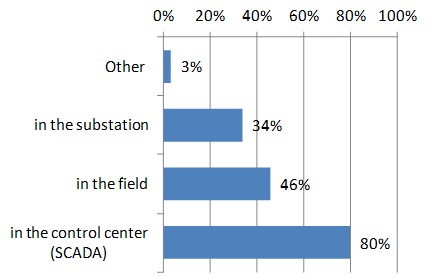
In the future, where do you anticipate the controls to be located for FDIR/FLISR?
Interestingly, control placement for FDIR/FLISR in the future is anticipated to be primarily in the control center, as cited by 67% of all respondents. Nearly 40% indicated future control location in the field, while 29% cited plans for substation-based controls. Eighteen percent of all respondents indicated no plans (at year-end 2014) for feeder automation.

Importantly, regardless of type or size of responding utility, the majority of participating utilities plan to use the control center based systems to manage field equipment.

Location of controls for 59 respondents who have plans for feeder automation and/or FLISR
DA2June1

Continue reading Excerpts from Newton-Evans’ North American Distribution Automation Market Assessment & Outlook: 2015-2017

Posted on

Substation Automation 2015-2017 Market Overview Series Now Available

Newton-Evans Research has just finished updating a series of U.S. market overview briefs on fourteen different substation automation market topics, including: Remote Terminal Units, Programmable Logic controllers, Substation Automation Platforms, Multifunction Meters and Recorders, Inter-Utility Revenue Meters, Digital Relays, Digital Fault Recorders, Sequence of Events Recorders, Power Quality Recorders, Substation Reclosers, Substation Automation Integration Specialists, Substation Communications, Substation Voltage Regulators, and Substation Precision Timing Clocks.

Each report provides a list of major market participants and their year-end 2014 revenues and market shares, as well as estimates of product pricing and a U.S. market forecast through 2017. See the sample brochure for more detail.

This series of reports is available for purchase on our reports page

Posted on

First Quarter 2015 Projects Underway at Newton-Evans Research:

Study for CIGRE WG D2.38 – Operational Readiness for Cyber Threats. The Newton-Evans staff is conducting an international survey of electric utility IT and OT organizations to learn about the current status of preparations and readiness to minimize the impact of cyber threats. Utilities that participate with us in this “pro bono” study for CIGRE will be entitled to share in the findings and recommendations from the survey and from the guidance to be set forth in a 2016 CIGRE technical brochure.

2015-2017 Substation Automation U.S. Market Overview Series: Newton-Evans is in the process of releasing a new series of market synopses concerning 14 components of electric power substation modernization in the United States. Fourteen report summaries are available individually or as a complete series. Taken together the fourteen components reported in the series accounted for an estimated $1.7 Billion in 2014 shipments to U.S. utility and industrial customers. Growing at an average rate of about six percent, Newton-Evans expects 2017 shipment values to reach nearly $2 Billion.

Included in the series are these individual topics: SA01 – Remote Terminal Units; SA02 – Programmable Logic controllers; SA03 – Substation Automation Platforms; SA04 – Multifunction Meters and Recorders; SA05 – Inter-Utility Revenue Meters; SA06 – Digital Relays; SA07 – Digital Fault Recorders; SA08 – Sequence of Events Recorders; SA09 – Power Quality Recorders; SA10 – Substation Reclosers; SA11 – Substation Automation Integration Specialists; SA12 – Substation Communications; SA13 – Substation Voltage Regulators; SA14- Substation Precision Timing Clocks. The report summaries are available individually at $150 per report, or the group of 14 report summaries is available for only $975.00.

2015-2017 Protective Relay U.S. Market Overview Series: Newton-Evans is now underway with work to update the 2012 series on protection and control. A total of ten market summaries will become available on April 10. The P&C series will include the following topical summaries:
PR01 – Feeder Relays; PR02 – Transmission (Distance, Overcurrent, Line Differential) Relays; PR03 – Generator Relays’ PR04 – Bus and Busbar Relays; PR05 Transformer Protection Relays; PR06 – Motor Control Relays; PR07 – Electro-Mechanical Relays; PR08 – Drop-In Control Houses; PR09 – Synchrophasors (PDUs/PDCs); PR10 – Teleprotection. The report summaries will be available individually at $150 per report, or the group of 10 report summaries will be available for $875.00.

Worldwide Study of the Protective Relay Marketplace In Electric Utilities (2015-2017). Newton-Evans staff is preparing to undertake a major update to the four volume flagship study of protective relay use in utilities around the world. We need to hear back from interested parties as to whether this study should be scheduled for a spring kick-off or whether we should defer work on this massive study until autumn 2015. Early commitments will mean lower subscription prices and earlier reports availability. Please provide your thoughts and information requirements on the study’s timing and desired content to us.

Commissioned Studies:  Privately funded studies this first quarter include North American assessment of the recloser market; cyber security topics; ADMS market overview; software module pricing for AMI-OMS related systems; new compilation of North American EHV/HV and MV substations, transmission and distribution line mileage totals. (By state and by type and size of utility).

Posted on

New Utility Insights on Adoption of Advanced Distribution Automation Applications

Findings from the Newton-Evans Research Company study completed in February 2015 indicate that a substantial number of electric utilities are using distribution automation technologies such as FDIR/FLISR and VVC/VVO/CVR, but the number of operating feeders currently configured with these features is still relatively low. These observations are based on a survey of 75 electric T&D utilities in the U.S. and Canada providing electric power service to 32 million customers (approximately 20% of North America’s electricity end users, according to Newton-Evans estimates.)

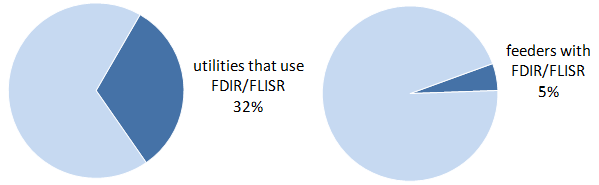
Percentage of all feeders that have Fault Detection Isolation Restoration (FDIR) or Fault Location Isolation Service Restoration (FLISR) Capabilities
On a summary basis, nearly one-third of the responding utilities (32%) cited their operation of one or more primary distribution feeders configured with FDIR/FLISR capabilities. However, the overall installed base of feeders with FDIR/FLISR capabilities was quite small, standing at about five percent of the total number of feeders operated by these utilities. According to the survey sample, six percent of 13-15kV feeders and seven percent of 22-26kV feeders are configured to provide FDIR/FLISR functionality.

FLISRpie1

Percentage of feeders that support integrated Volt/VAR control (VVC), Volt Var Optimization (VVO), or Conservation Voltage Reduction (CVR)
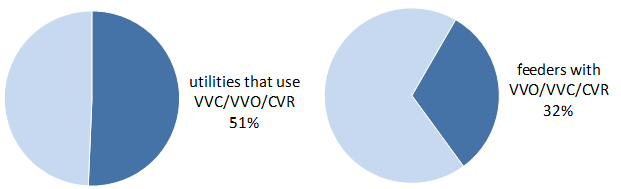
Just over half of all respondents reported having at least some feeders supporting Integrated Volt/Var Control, Volt/Var Optimization (VVC/VVO) or Conservation Voltage Reduction (CVR). The 75 respondents indicated an installed base of 34,122 feeders across 4 voltage levels: 4kV (5,094 feeders), 13kV/15kV (22,831 feeders), 22kV/26kV (4,214 feeders), and 33kV/38kV (1,983 feeders). Overall, respondents indicated that 32% of all feeders currently support VVC, VVO or CVR, but out of 4,214 feeders at the 22/24kV level about 59% support these capabilities.

VVOpie1

Percentage of utilities integrating VVC, VVO or CVR by year end 2017
Overall, 68% of the utilities replying to this question indicated that at least some feeders will support integrated IVV control/VVO and/or CVR by year-end 2017.

Decision factors for implementing VVC/VVO
Respondents indicated that “cost savings effected by reducing the need for infrastructure enhancements” was the single most-cited driver for volt-Var optimization (VVO) implementation, as reported by 38% of respondents. Additional cost savings brought about by “reducing the need for additional generation” was second in importance, at 33%. About 1 in 5 respondents also cited “regulatory compliance” as a significant driver for implementing VVO.

Other reasons mentioned for implementing include peak shaving to reduce demand costs, reducing losses, and maintaining power factor. A few utilities mentioned that VVO is either not a requirement for them or that they do not want to implement additional technology simply to raise revenue.

To see a table of contents and pricing information for the “North American Distribution Automation Market Assessment and Outlook: 2015-2017” visit our reports page

Posted on

Utility Plans Call for Continuation of Substantial Investment in North American Distribution Grid Automation Programs

Findings Corroborate Earlier Newton-Evans Studies Regarding “Mixed” Placement of Controls of Field Devices

The Newton-Evans Research Company today released key findings from its newly published study of electric utility plans for distribution automation. Entitled “North American Distribution Automation Market Assessment and Outlook: 2015-2017” the 89-page report includes coverage of more than 35 DA-related issues.

Progress Being Made with Distribution Automation Programs:
North American utilities are making good progress in developing and implementing new DA applications and telecommunications network upgrades. The overall DA market among North American utilities is approaching one billion dollars and will continue to grow each year for the foreseeable future.

DA Controls Placement:
The placement of DA controls for field devices remains mixed. While some see controls being distributed to field locations, others are placing controls on substation automation platforms, while an even larger group is using control center systems-based approaches (centered on SCADA-DMS systems).

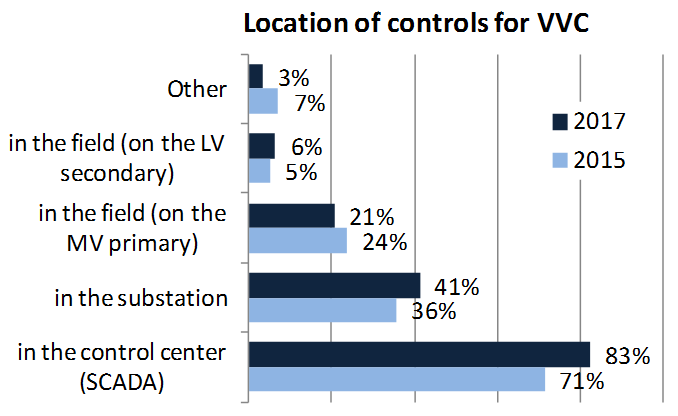
The outlook for controls placement in the future shows that utilities are bringing more controls for fault detection, isolation and service restoration (FDIR/FLISR) and for volt/var control (VVC) into the control center as shown in these charts.

FLISRcontrols VVCcontrols

Automatic Fault Sensing:
Devices providing information such as hot line status and fault indications are becoming a mainstay in many utility DA programs. IOUs and Canadian utilities were more likely to be using automatic fault sensing devices than were their counterparts at electric cooperatives or public power utilities. Usage patterns and plans for AFS devices were strongest among the respondent subgroup of very large utilities (those serving more than 500,000 customers). Of the subgroup using AFS devices, about one-third actively utilize the status of such devices in their DA schemes.

Integration of Communications and Controls for Distributed Generation into DA System Architecture:
By year-end 2014, only about 16% of utilities indicated some use of DA-related communications/controls while another 14% plan to integrate these for DG purposes by year-end 2017. In a related question, well over one third of the respondents indicated that they have a trial deployment to manage distributed energy resources within the DA system either underway or planned.

More than 30 additional topics are covered in the 2015-2017 Newton-Evans DA report. Seventy five major and mid-size utilities were surveyed and interviewed to gather the information for the report. This group provides a substantial sample, accounting for 20% of served customers and 19% of primary feeders across North America.

A supplemental North American DA market outlook synopsis for the years 2015 through 2020 will be released in March. The outlook supplement will provide DA market outlook information based on type, size and regional location of utilities.

Additional information on the North American Distribution Automation Market Assessment and Outlook: 2015-2017 report is available from Newton-Evans Research Company, 10176 Baltimore National Pike, Suite 204, Ellicott City, Maryland 21042. Phone 1-410-465-7316 or write to info@newton-evans.com

Posted on

Save 25% Off Currently Available Reports

Through January 31, 2015, Newton-Evans Research is offering a 25% discount on all currently available 2014 and earlier reports. Click on the “Order Here” button and use the discount code “2014sale” at checkout to take advantage of this limited time offer, or give us a call at 410-465-7316 and mention this announcement when placing your order with us over the phone.

Get the “Overview of the 2014-2016 U.S. Transmission and Distribution Equipment Market – HV Equipment Series” for only $731.25 – a savings of over $240. Or purchase the entire four-volume report series, “The Worldwide Market for Substation Automation and Integration programs in Electric Utilities: 2014-2016” for only $5,212.50 – a savings of $1,737.50 for a comprehensive package of market intelligence.

See our Reports Page for a complete listing of report topics and prices.

Posted on

Use of FDIR, Integrated Volt/Var Control, and Sensors on Distribution Feeders

The following information was excerpted from a Newton-Evans survey conducted in September 2010. A total of 47 utility officials from the U.S., Canada, Europe and Asia-Pacific regions responded to the survey participation request. For the majority of U.S.-based respondents, there was a good mix of utility representation by size and by type of utility.

Approximately what percentage of your feeders (existing & new) will include FDIR, Integrated Volt/VAR Control, or Medium Voltage/Low Voltage Sensors?

Importantly, utility responses indicate that the percentages of feeders to include any of the three applications will continue to increase over the 2010-2011 and 2011-2012 periods.

Integrated volt and VAR control was the most likely application to have been implemented to date. However, the budget percentages allocated for FDIR are expected to more than double over the 2010-2012 periods (from 7% to 15%). The already substantial portion allocated for IVVC will likely grow from 19% to 28%.

Posted on

Distribution Automation: Communications for Feeder Automation

The following information was excerpted from a Newton-Evans survey conducted in September 2010. A total of 47 utility officials from the U.S., Canada, Europe and Asia-Pacific regions responded to the survey participation request. For the majority of U.S.-based respondents, there was a good mix of utility representation by size and by type of utility.

Do you plan to migrate (or have you already migrated) the existing feeder automation communications network to a newer wireless technology that allows for functionality like higher bandwidth, IP enabled radios and WiMAX?
Fifty-six percent of respondents had no plans to undertake any migration to newer wireless technology approaches. Sixteen percent of survey respondents had already migrated their existing feeder automation communications network to a newer wireless technology, while 30% were planning to do so.

If you are adding wireless technologies for feeder automation communications, which wireless technology are you planning to migrate to?
Three specific technologies were listed on the survey form (WiMAX, LTE and 4G) along with “other.” Forty-one percent cited WiMAX, 18% mentioned 4G and 6% listed LTE. More than three quarters of the group listed other wireless technologies as shown below.

Other Mentions

  • NetCom 900MHz packet radio
  • IP radio system
  • 700mHz Arcadian
  • CDMA 450 Mhz
  • Owned licensed spectrum
  • not sure; investigating
  • RFP stage
  • Low bandwidth/IP enabled IDEN
  • Higher speed 900 mHz supporting IP
  • Under investigation; not decided yet
  • unlicensed spread spectrum
  • Wimax, 802.11 technology, 900 mHz spread spectrum
Posted on

Distribution Automation Apps That Will Share Network Space

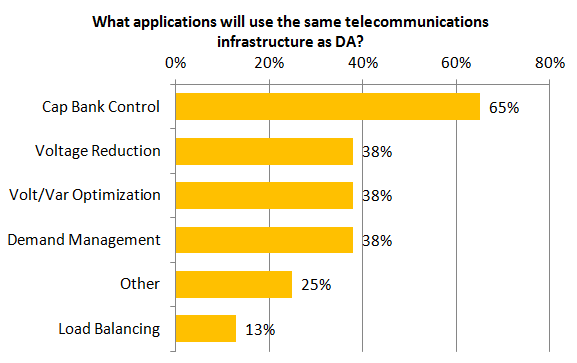
In 2007, a Newton-Evans survey of electric utilities in North America showed that 65% of the sample planned to have capacitor bank control on the same telecommunications infrastructure as distribution automation. Thirty-eight percent said that Volt/Var optimization, demand management or voltage reduction applications will share the same telecoms as DA, and 13% indicated load balancing will also use the same infrastructure. One quarter of the respondents to this survey cited “other” applications such as AMI, fault location, and station alarms.  We are revisiting this question and obtaining status and plans related to many more DA topics and issues during the fourth quarter of 2014.

DAsharedApps

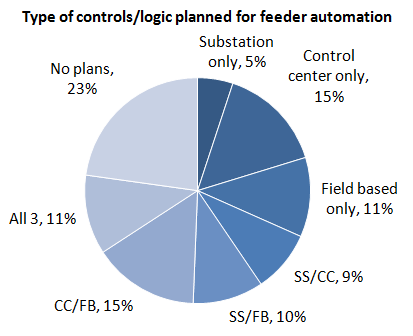
In designing a Distribution Automation system, controls and/or logic can be control center based, substation based, or field based. The 2007 Newton-Evans survey asked electric utilities, “Which type of controls are you planning for feeder automation?”

DAcontrols

Since completion of the 2007 study, Newton-Evans has conducted several proprietary studies on DA topics, both from a field equipment perspective as well as from a DMS perspective.  Our current study is now being readied for North American-wide utility participation in a comprehensive survey format.    During mid-2014, Newton-Evans also published its series of nine comprehensive DA market segment overviews on key market components including DA/DMS systems, control devices for reclosers and capacitors, voltage regulators, fault current indicators, pole-top RTUs, line mount monitoring devices, DA communications options and DA engineering and consulting services.

For more information on Newton-Evans DA research (including the new study of the North American market for DA, planned for late January 2015 availability) see our reports page and the article below.

Posted on

Newton-Evans Research Company plans to revisit the topic of Distribution Automation

DA Brochure Image

Newton-Evans Research Company plans to revisit the topic of Distribution Automation (DA) by researching the market for DA field devices, communications methods, engineering service and Distribution Management Systems (DMS) applications software used in the control center, the substation, and on lines and poles. We will invite hundreds of North American electric transmission & distribution utilities to participate in a survey of Distribution Automation hardware, software and communications infrastructure.

The results of this survey will be combined with Newton-Evans’ discussions with DA vendors and manufacturers and published in a report titled “Distribution Automation 2015-2020: North American Utility Perspectives, Market Outlook and Analysis.” This report – available in January of 2015 – will be a comprehensive market overview of the automation aspects of electric distribution networks and supporting infrastructure. The scope of this research project will also include estimates of growth in the communications infrastructure needed to support this increased deployment of DA hardware and software.

Research Methodology
The study will include several weeks of survey-based research with major and mid-size utilities, requesting their insights regarding DA plans through 2020. This study will also include secondary research to learn about documented plans for DA among North American utilities.

The final report, “Distribution Automation 2015-2020: North American Utility Perspectives, Market Outlook and Analysis” will measure current market sizes, provide estimates and outlooks of demand for distribution automation equipment through 2020, and showcase a selection of major product vendors and service providers in the DA marketplace.

(Download a .pdf brochure here)

Continue reading Newton-Evans Research Company plans to revisit the topic of Distribution Automation

Posted on

2014 Autumn Electric Power Conference Season Well Underway

For the electric power industry, late summer through mid-autumn brings a number of conferences to the forefront each year or at least every two years.

This year is no exception. From the international CIGRE Conference held in Paris every two years, to the annual EMMOS conference and Southeast Distribution Apparatus Conference, there are lessons to be learned and topics of interest to those following industry trends. The CIGRE conference provides information on key electric power topics, while EMMOS focuses on large control systems used by utilities and independent systems operators (ISOs). The SDAC offers briefings and training on a variety of power distribution topics, ranging from meter management to control systems to cyber security.

CigreLogo
In late August I attended and participated in my 10th CIGRE conference. This year set a new record for attendance (more than 3,000 delegates and another 5,000 visitors) and the number of exhibitors and working group sessions also reached new heights. One of the more interesting observations for me has been to witness the growth in CIGRE participation by utilities and T&D equipment and systems companies from North America. Delegates are either actively volunteering on working groups or doing booth duty for an increasing presence of large-to-small North American companies whose equipment, systems and services are part of the exhibition.

Continue reading 2014 Autumn Electric Power Conference Season Well Underway

Posted on

Ethernet in the Substation

Excerpts from this 2014 Newton-Evans study of the world market for substation automation show some interesting trends regarding the use of Ethernet networks in substations around North America. Some of these trends include:

  1. Electric utilities in North America are showing increased interest in IEEE 1613 as a requirement for Ethernet switches and routers
  2. Single network without failover is the most frequently used Ethernet LAN architecture, and one of the most planned for Ethernet LAN architectures in substations for year end 2016 (along with “Single network with multiple paths/failover” and “Independent primary devices/network and backup devices/network.”
  3. Roughly half of utilities surveyed do not have redundancy in substation Ethernet networks.

Although this year’s sample reported a much different (lower) average number of ports than had been reported in the 2011 sample, Newton-Evans believe that there will be additional Ethernet ports installed in many North American substations by 2016.

By year end 2013, the majority of North American utilities surveyed reported that their Ethernet ports are secured. This is about the same as what was reported in 2011.

By year-end 2013 the lack of redundancy in Ethernet networks had fallen from 55% to 49%, while 35% reported use of Ring approaches and 18% used STAR approaches to provide redundancy in their Ethernet networks as shown in this chart. There were some differences in Ethernet redundancy based on type and/or size groupings. For example, among public power utilities in the sample, 48% said they use Ring topology for redundancy and only 26% claimed they do not have redundancy in their substation Ethernet.

The new study found predominant use of Rapid Spanning Tree protocol (78%) to provide redundancy in Ethernet networks. This is a significant increase over the 57% of survey respondents reporting such use in the previous study. Use of Hot Standby Router protocol (IEC 62439) was reported by 14% of the subgroup, while 10% were using Parallel Redundancy (also IEC 62439) at year-end 2013.

For more information or to order a copy of “The Worldwide Market for Substation Automation and Integration programs in Electric Utilities: 2014-2016” visit our reports page.

Posted on

What to Expect Next: Potential Synergies of the Alstom (Power and Grid) Acquisition by General Electric

As many long-term readers of Newton-Evans’ reports and articles knew from our assessment reported in 2009 there were back then three major contenders for the $7 billion Transmission and Distribution business units of the old Areva T&D Corporation. These were the American firm General Electric, the French corporate combination of Alstom and Schneider Electric, and the Japanese company, Toshiba. In the end the French government simply divided Areva T&D in half, and placed the “T” business into Alstom and the “D” business into Schneider Electric.

On June 21, 2014 GE was informed that Alstom’s board of directors decided to recommend GE’s offer to acquire the Power and Grid business of Alstom Corporation. These units are: Alstom Power (generation assets) and more importantly for this assessment, Alstom Grid, the HV and control systems components of the old Areva T&D business. The “D” business of Areva has now become a core business within the capable Schneider Electric camp of medium voltage equipment offerings.

Newton-Evans Research believes significant benefits to GE’s efforts targeting the global electric power industry will accrue if the company staffs truly work synergistically. Here are six key reasons for this view, in our opinion:

(1) IMPROVED WORLD MARKET ACCESS: GE will gain improved access to European electric power markets and other world regions with long-established relationships nurtured by Alstom and predecessors under the French management and government policies, which may continue under GE ownership, now that the French government is slated to become a significant shareholder investor in Alstom securities. Keep in mind that GE has more than a century of experience and accomplishments in France. I can recall visits to Belfort in eastern France and visiting both GE and Alstom (Areva) factory sites.

(2) ATTAINMENT OF ORGANIC GROWTH: GE Energy Management will again be able to lay claim to some real growth within 24 months of the close of this acquisition. Growth will come from both inorganic sources (via this acquisition – itself worth more than $4 Billion in current year sales of Alstom Grid products, systems and services) and organic growth (through increased interest in, and procurement of all combined GE-Alstom equipment, products and services). Each of the four component businesses of GE Energy Management including: Digital Energy, Industrial Solutions, Power Conversion and Energy Consulting will each benefit significantly if all goes as planned and envisioned in early July 2014. The big issue we see is whether Atlanta and Toronto will report in to Paris, or whether the reverse will be true.

(3) REDUCTION IN OFFERINGS “GAP”: GE will be able to fill several significant product/equipment gaps in its electric power transmission and distribution product line and related automation offerings. This will result in significant mid-term benefits to GE Digital Energy. However, a key issue for GE will be the “branding” of product offerings going forward from midyear 2015.

(4) MARKET-LEADING POSITION IN POWER GENERATION: Alstom’s power business includes assets for power generation such as turbines for coal, gas and nuclear power plants, wind farms while GE is a co-leader in both fossil, nuclear, hydro and renewables businesses.

(5) INCREASED SHARES OF OPERATIONAL CONTROL SYSTEMS: While GE’s EMS offerings have had somewhat limited success beyond North America, it’s DMS, OMS and GIS offerings are well-respected and are high quality offerings. Alstom Grid is a world leader in EMS, with a world-class group of systems for power transmission and distribution. The company’s “e-terra” line of systems is the leading market shareholder among critical T&D operational control systems used in the global electric power industry. The company also has developed a growing customer base among large utilities for advanced distribution network management with its IDMS offering. If the companies’ technical and product marketing teams work together as they have over time on various technical committees (IEEE, IEC, CIGRE et al) and provide smooth cross-systems integration capabilities, the company will be a force to be reckoned with in the world market for control systems. GE has a strong substation modernization/automation business focus across all components (systems, products, intelligent devices, communications equipment) that leads the North American market and is a growing force internationally.

GE Energy Management will likely become a major player in several growing portions of the transmission equipment business, establishing a stronger foothold in the North American and international transmission market segments described below. Together these segments are worth $32-40 billion on a worldwide basis. Newton-Evans’ estimates that Alstom Grid earned about $3.5 billion to $4.1 billion in HV equipment sales in 2013.

Here is our take on the gains to be realized for both electric power infrastructure and electric utility automation and services:

FACTS and Reactive Power Compensation:
ABB is probably the global leader in flexible AC transmission systems and the related reactive power compensation segment of high voltage equipment for transmission networks. Siemens Energy is a strong number two supplier with several others (notably Mitsubishi Electric Power Products, and American Superconductor) also active in North America, and around the world. Alstom Grid and GE are also participants that together could challenge the market leading positions of ABB and Siemens within three years of a merger of product lines.

HVDC Equipment:
Siemens is the market leader in HVDC, with ABB a reasonably close second place share holder and MEPPI the likely third most important player. However, an integrated Alstom Grid-General Electric product grouping would enable the company to attain up to a quarter of the available market shares.

Gas Insulated Substations/Switchgear:
The North American market for High Voltage GIS equipment is in excess of a quarter billion dollars. While Alstom Grid has only a small share (stronger in Canada than in the US), GE Energy could now present itself as a player in this growing market segment of high voltage switchgear. GE would also play a much more important role in international markets where – unlike in North America – GIS equipment is prevalent. Globally, GIS equipment is a 2-3 billion dollar annual market.

High Voltage Bushings:
This relatively small (about $125-150M in annual worldwide sales) market is led by Siemens and ABB. However, the combined Alstom Grid and GE offerings could make GE into a formidable player in this segment.

High Voltage Capacitors:
GE Energy is already the major participant in the North American market for HV capacitors, but globally, ABB is the leader. Alstom Grid, by virtue of its recent acquisition of the Finnish manufacturer, Nokian Capacitors, is also a very strong player in Northern Europe. Together, the product lines could pose a real threat to ABB dominance here (yet another billion dollar global product segment).

High Voltage Circuit Breakers:
Alstom Grid is already a major player globally, and with GE’s “sales boots on the ground” could significantly increase its share in North America and abroad. ABB and Siemens are both very strong manufacturers in this large annual global market of better than $2 billion.

Disconnect Switches:
High voltage disconnect switches are vital components of many transmission systems, and the global market runs to about $500 million annually. GE and Alstom Grid are among the six leading suppliers of disconnect switches in North America, but lag behind Hubbell, S&C and Southern States, some of which offer circuit switchers used for disconnect applications.

Large Power Transformers:
Alstom Grid is number three in the world in terms of large power transformer market share and assets, operating 13 plants with an annual production capacity of more than 130 MVA. GE Prolec is a major North American market force with about a 14% share of the U.S. market. Together, this alliance may become number three in the global market for LPTs behind ABB and Siemens). To do so, the GE-Alstom combine will have to fend off HICO, Hyundai, Toshiba and MEPPI as well as three up-and-coming Chinese manufacturers.

Instrument Transformers:
The market for high voltage instrument transformers had been dominated by specialist “independent” manufacturers until recently. A recent buying spree had Siemens acquiring Trench Electric, Alstom Grid acquiring Ritz and ABB acquiring Kuhlman. Currently, the market for HV IT equipment is shared primarily by these three firms, with GE very active in the MV segment. Together, the combined HV/MV instrument transformer offerings of an integrated GE-Alstom Grid would change the shape of this market, which in North America alone hovers around $100 million, and close to one-half billion dollars worldwide.

Air Core Reactors:
Another component of some transmission network architectures, Siemens-Trench and Alstom Grid-Ritz are key players, with GE also strong and MEPPI further behind, but with a growing share. A number of smaller participants account for a rather large share of this $400 million global business.

Surge Arresters:
Another sizable market in its own right (about $1 billion per year globally) high voltage surge arresters are manufactured by a number of US-based firms such as Hubbell, Thomas & Betts, and Cooper Power, each of which competes quite successfully against the likes of ABB, Siemens and GE.

Automation Systems:
GE’s older XA/21 EMS platform and Alstom Grid’s highly rated E-Terra offerings are both held in high regard around the world, although GE’s systems are mainly installed in the USA. By year-end 2015 and more likely into 2016, General Electric-Alstom Grid will see benefits from world-leading combined market shares in substation automation, protection and control and T&D control systems (energy management, DMS, OMS, GIS and SCADA). Earlier (1990’s era) acquisition efforts have been fraught with initial business unit integration problems (to wit- ABB with its acquisition of the older Ferranti EMS business (Spider v. Ranger offerings) and Siemens-Control Data (Sinault-Spectrum v. Empros).

Substation Modernization:
If protective relays are included in the mix of substation modernization, then the collaborative efforts of GE and Alstom will lead to a global co-leadership market position across the board. Alstom Grid enjoys a strong position with transmission class relays and related MiCOM systems and equipment, and has been fairly strong participant in the global market for substation automation. GE enjoys a strong position in protective relays in North America (number two supplier) and in some Western European and Asian markets, and does make the list of qualified suppliers elsewhere.

Protection and Control:
Internationally, Alstom Grid (with part of the Stafford, UK-based relay business) holds an estimated 16% share of the global protective relay market (outside of the U.S.), estimated by Newton-Evans to be about $2.4-$2.6 billion this year. GE Multilin, based in Toronto, is also a very strong market participant, especially in the Americas, and is the leader in industrial protection and control markets.

T&D Services:
GE is a major participant in T&D equipment repair and services, especially with its transformer repair business, and Alstom Grid outside of North America earns about $550 million per year with its array of high voltage equipment services and global agreements for automation systems maintenance and upgrades.
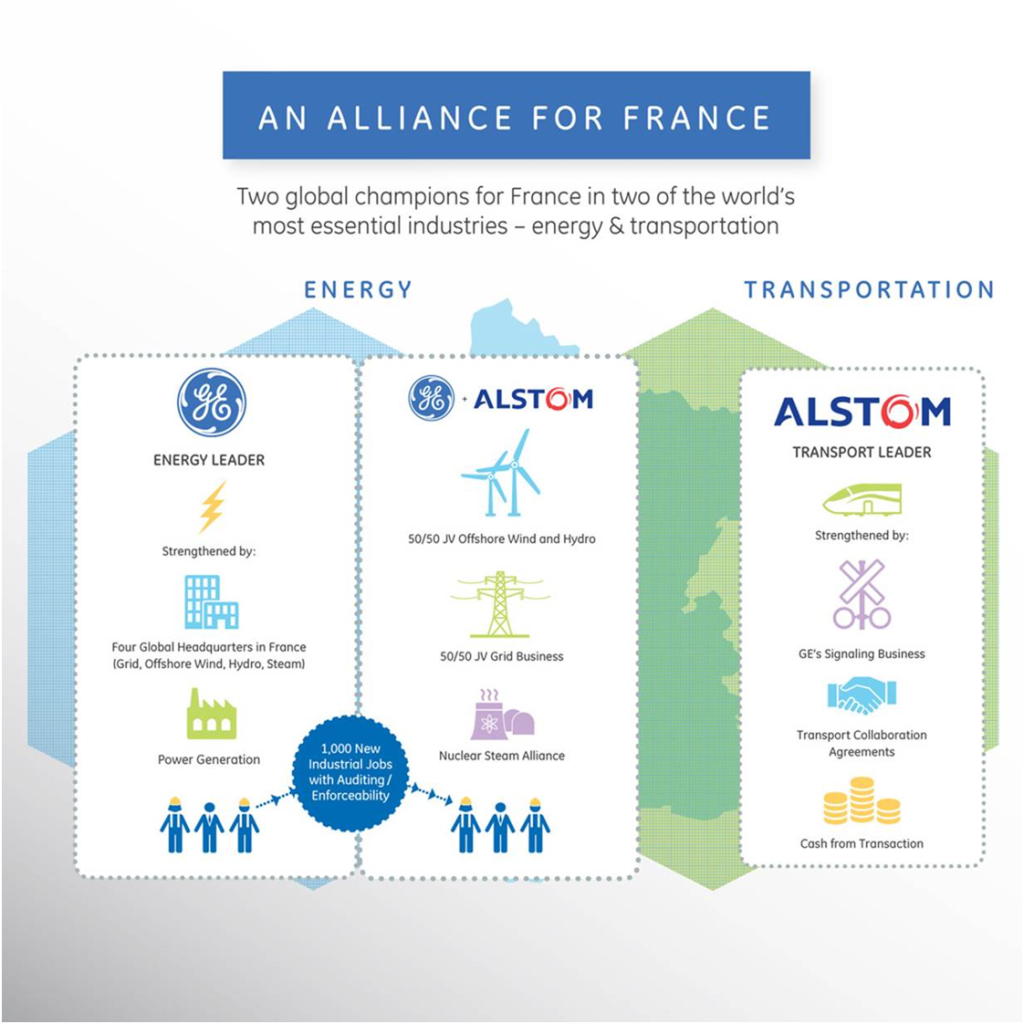
Let’s not count this as a “done deal” quite yet. I do believe it is now very likely to be seen through by all parties (GE, Alstom, French government, possibly various international courts). The important role of Alstom’s minority shareholders and their reaction to the GE acquisition is somewhat unclear as is the role the French government’s strong minority ownership position will play. GE has made significant concessions regarding job retention among the French workforce, and has promised to add another 1000 jobs in the country. This could have ripple effects on its global workforce, especially if workforce reductions take place.

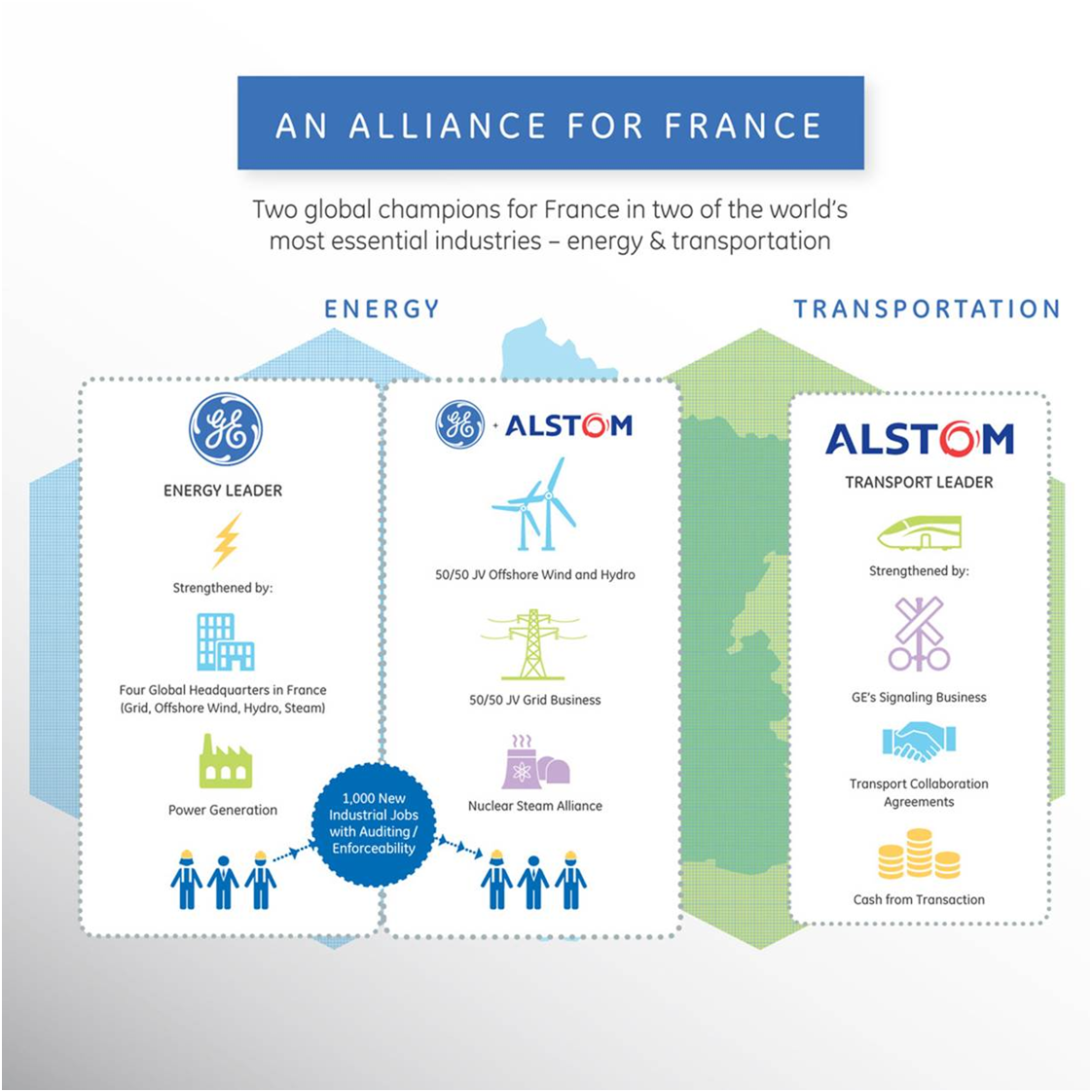
The following chart (used with permission of General Electric) illustrates the current state of the acquisition and the alliance formation.

alliance1

Posted on

U.S. Sales of Distribution Automation Components, Including Equipment, Systems and Services, Estimated at more than $700 Million in 2013, Forecast to Increase to $950 Million by 2016

Newton-Evans Research Publishes New Edition of Nine Market Snapshot Reports on Distribution Automation Topics Covering the Electric Power Industry in the United States.

June 4, 2014. Ellicott City, Maryland. The Newton-Evans Research Company has announced its latest publication of a set of 9 U.S. distribution automation market two-page summaries. The new series of market overview reports (executive market summaries) includes supplier listings, representative products, and estimated market size for each topic, vendor market share estimates and market outlook through 2016. Electric utilities accounted for about 91% of all purchases of distribution automation related goods and services. A majority of distribution automation equipment purchased by American utilities and industrial firms is produced or assembled in the United States.

The Distribution Automation series ($975.00) includes U.S. 2013 market size, market share estimates and 2014-2016 market outlook for these product and service categories:
DA01 – Automatic Circuit Recloser Controls
DA02 – DA/DMS System Components (including distribution network analysis; distribution network condition monitoring and fault location and characterization)
DA03 – Voltage Regulators
DA04 – Capacitor Bank Controllers
DA05 – Fault Indicators (covering both fault current indicators and faulted circuit indicators)
DA06 – Pole Top RTUs
DA07 – Line Mounted Monitoring Devices
DA08 – Communications Components for DA (covering PLC/DLC; cellular and 900Mhz)
DA09 – Engineering Services for Distribution Automation Projects (covering consulting engineering services, related services provided by manufacturers; DA services provided by smart grid consulting specialists).

Other topical series currently available include: the 2014-2016 series on medium voltage equipment (18 market overviews).

Additional series to be released during June-August 2014 cover high voltage equipment (16 market segment overviews), T&D control systems (11 market segment overviews), substation automation (13 market segment snapshots), power transformers (11 market segment snapshots), and protective relays (8 market segment snapshots).

Further information on this new series of U.S. T&D market snapshots is available from Newton-Evans Research Company, 10176 Baltimore National Pike, Suite 204, Ellicott City, Maryland 21042. Phone: 410-465-7316 or visit www.newton-evans.com/our-reports for a brochure or to order any of the related report series or more than 85 planned individual report summaries online. For those interested in subscriptions to multiple report series, please call or email us for special introductory pricing offers. For more information send an inquiry to info@newton-evans.com

Posted on

U.S. Sales of Medium Voltage Equipment, Components and Related Services Accounted for More than $11 Billion in 2013, Forecast to Reach $13 Billion by 2016.

May 19, 2014. Ellicott City, Maryland. The Newton-Evans Research Company has announced the publication of a series of 18 electric power distribution market two-page snapshot market summaries. The new series of market overview reports (executive market summaries) includes supplier listings, representative products, and estimated market size for each topic, vendor market share estimates and market outlook and growth factors through 2016. Electric utilities accounted for nearly two-thirds of purchases of the medium voltage product categories in this series, with industrial and commercial segments accounting for about one third of the value of MV equipment shipments. A majority of the included equipment and products continue to be manufactured and/or assembled in the United States.

The Medium Voltage equipment market overview series is priced at $1,500 for all 18 market summary reports, or at $150.00 for individual report summaries. Each snapshot report include product definitions, estimates of 2013 U.S. market size, supplier market shares and the outlook through 2016 for these categories: MV01 – Air Insulated Metal Clad Switchgear; MV02 – MV Motor Controllers; MV03 – MV Gas Insulated Switchgear; MV04 – Automatic Circuit Reclosers; MV05 – Outdoor Distribution Circuit Breakers (5-38kv); MV06 – Load Interrupter Switchgear; MV07 – Overhead Disconnect Switches (15-38kv); MV08 – Sectionalizers; MV09 – Fused Cutouts; MV10 – Pad Mounted Switchgear; MV11 – Submersible Switchgear; MV12 – Bus Duct and Bus Bar ; MV13 – Substation Class Pad Mounted Capacitors; MV14 – Current/Instrument Transformers; MV15 – Fault Current Limiters; MV16 – Fault Current Indicators and Faulted Circuit Indicators; MV17 – Current Limiting Fuses and Fuse Links; and MV18 – Surge Arresters.

Other U.S. T&D market snapshot series to be updated during the next three months include power transformers (11 market segment snapshots), protective relays (8 market segment snapshots) and substation automation components (13 market segment snapshots). The next market overview series to be released covers 12 component topics related to distribution automation. The DA series is planned for publication in June, 2014.
Further information on each series of U.S. T&D market snapshots is available from Newton-Evans Research Company, 10176 Baltimore National Pike, Suite 204, Ellicott City, Maryland 21042. Phone: 410-465-7316 or visit www.newton-evans.com for a brochure or to place an order for any of the related report series or more than 85 individual T&D report summaries online. For subscriptions to all of the currently available report series, please call or email us for special introductory pricing offers. For more information send an inquiry to info@newton-evans.com

Posted on

More Estimates on The U.S. Market for Distrubution Automation

From 2008 onward, Newton-Evans Research Company has completed one or two client-based, proprietary studies each year to provide mid-term and longer-term outlooks for one or more components of the burgeoning Distribution Automation market comprised of U.S.-based electric power utilities. The primary focus of these studies has centered on various DA field equipment types and associated controllers as well as DA software and platforms, located in the field, at the substation level or at the MV operations control center.

Research Methodology
These studies have included several weeks of primary research based on direct communications with major and mid-size utilities, requesting their insights regarding DA plans through 2020. These studies also included secondary research methods to learn about documented plans for DA among other North American utilities and to better understand the likely impact of economic growth projections and electric utility revenue outlook and CAPEX spending. Overall economic information used in the preparation of our range estimates was also based on NGO and a variety of government outlook documents.

The following observations are based on survey completions provided by scores of electric power utility officials during 2012-2014.

DA expenditure allocation among three purchasing categories
The overall indications from the surveys completed prior to 2014 pointed to somewhat more than one-half of the 2013-2015 DA budgets going to the procurement of field equipment, with an equal percentage of the remaining budget allocated for platforms and software, and for DA controller devices.

Over the longer term horizon (2016-2020) the DA expenditure outlook indicated a slight shift in spending patterns, suggesting increases in the percentage of program funding allocated to DA field equipment, and slightly lower percentages going toward platforms, software, and DA controller devices.

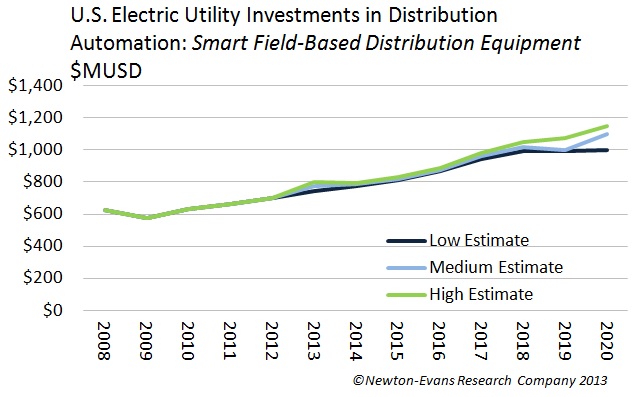
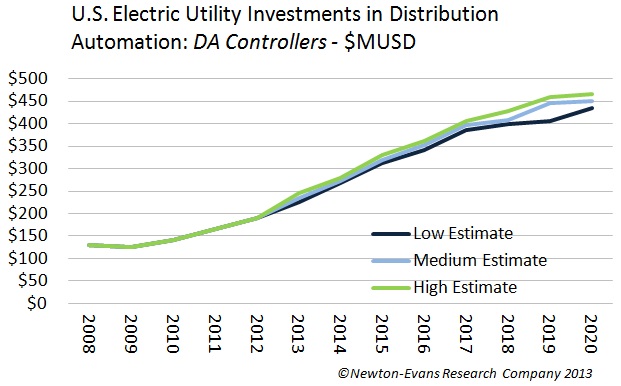
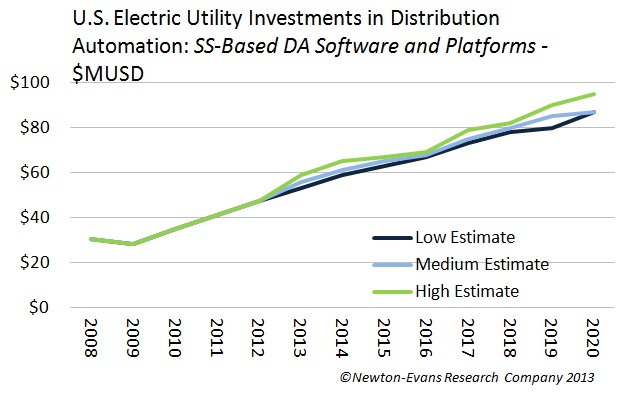
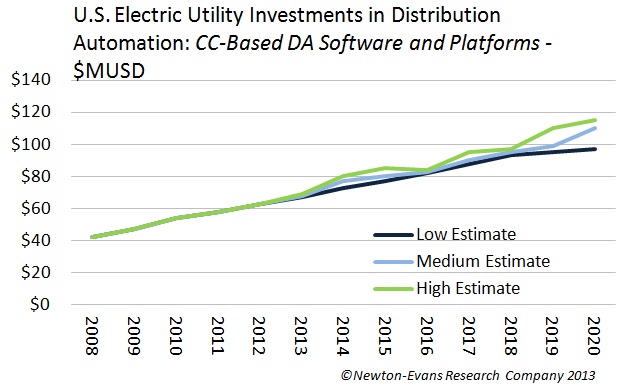
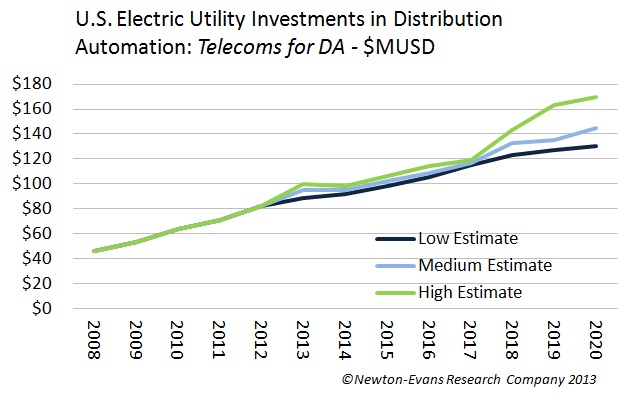
The following series of charts represent the Newton-Evans consensus view of low, mid-range and high estimates of likely DA spending for five components:

  • DA smart field-based distribution equipment
  • DA controllers
  • substation-based DA platforms and software
  • control center-based DA platforms and software
  • Telecoms for DA

US_DistAutoEquip_Invest-2020

US_DistAutoControllers_Invest-2020

US_DistAutoSSPlatforms_Invest-2020

US_DistAutoCCPlatforms_Invest-2020

US_DistAutoTelecoms_Invest-2020

Specific DA communications network developments are excluded from this outlook. The mid-range outlook is based in large part on the utility survey responses and a cautiously optimistic assessment of the near-term and mid-term.

The low range outlook takes into account the possible continuation of unclear energy policies at the federal and state levels, federal and local government budget woes, minimal growth in electric utility industry revenues and a continuation of relatively flat electricity consumption patterns.

The high range outlook factors in a stronger economic outlook for the periods from late 2013 thorough 2016, based on the economic analysis information reported by several external organizations.

References were made to recent publications provided by several organizations including The Conference Board, Moody’s Analytics, The World Bank, The Federal Reserve and the Bureau of Economic Analysis.

The historic DA spending baseline years in this study have been derived from the larger and more comprehensive mid-2010 study of North American utilities conducted by Newton-Evans Research Company.

The forthcoming update to the report series, “Overview of the 2014-2016 U.S. Transmission and Distribution Equipment Market: Distribution Automation Series” goes into more detail with respect to the market for specific DA equipment and spending categories such as Automatic Circuit Recloser Controls; DA/DMS System Components; Voltage Regulators; Capacitor Bank Controllers; Fault Indicators; Pole Top (and Pad Mount) RTUs; Line Mounted Monitoring Devices; Communications Components for DA; and Engineering Services for DA.

See our reports page for topic listings and pricing details, and be sure to send us an email at info@newton-evans.com or call 1 800 222 2856 to place your order.