Posted on

Presenting the 25th Annual ARC Industry Forum Accelerating Digital Transformation in a Post-COVID World February 8-17, 2021 – Online


Newton-Evans Research is pleased to offer its hundreds of utility contacts an opportunity to participate in the upcoming ARC Advisory Annual Forum during February 8-17, 2021 with complimentary registration.  Many of the scheduled sessions during this period directly impact IT and OT developments that are being planned or already underway within the electric utility community.  Newton-Evans has long been supportive of technology transfer that can benefit all infrastructure component industries.


Propelled by recent global health and economic crises, industrial innovation is accelerating.  Leading companies progressed along their digital transformation journey and quickly adapted to the changed business reality.   They supported remote connected workers far earlier than expected, and leveraged advanced technology to support the remaining front-line workers in the plant, in offices and out in the field.  With what they have learned, they are re-thinking how to manage operations using shared data, analytics, distributed work, and digital twins.  Join us to learn from your peers as executives charged with driving transformation are seizing this moment to innovate and deliver real value for both IT and OT applications developments.
    • Cybersecurity and Safety
    • AI and Machine Learning
    • Asset Performance Management
    • Blockchain for Industry
    • Supply Chain Transformation
    • IT/OT/ET Convergence
    • Automation Innovations
    • Industrial IoT Platforms & Edge Devices
    • Digital Twins & Connected Smart Machines
    • Smart Cities Transformation

Digital Transformation Council (End Users Only)

The Digital Transformation Council is the place to Connect, Collaborate, Learn, and Share with peers who are digitizing and transforming their organizations.  DTC is an end user only community; technology suppliers are not allowed to participate.

Need for digital transformation for industrial organizations and cities will continue to accelerate and evolve for some time.  Every organization and municipality will need to innovate, change, and adapt.

So, where to begin? How can you determine which technologies and techniques to consider, which to prioritize, and which to reject?  The answer will certainly be different for each organization, but a good starting point is to understand the critical dimensions of the problem, because this can serve as the basis for planning.  Council members can benefit from access to a community of peers.

Digital Transformation Council Mission

The Digital Transformation Council seeks to enable industry, energy, and public sector professionals driving or impacted by digital transformation to keep abreast of the many emerging technologies and business trends, to learn from others on similar journeys, and to leverage these trends and technologies to achieve transformational growth.

Council members benefit from access to community of peers.  They can tap the latest thinking from thought leaders, download research documents from the Council Library, participate in quarterly web meetings and other events, interact with ARC analysts, and request facilitated meetings with suppliers or other community members

Join us at the 25th Annual ARC Industry Forum to learn more about how digitizing factories, cities, infrastructure and supply chain will benefit technology end users and suppliers alike. Discover what your peers are doing today and what steps they are taking in their respective journeys. Visit ARC Industry Forum for up to date information on the speakers and agenda.

One key session at the ARC Forum Day 5 – Feb 16 at 2:30 pm EST is titled “The Future Electric Grid” – and that panel discussion in itself should make your registration worthwhile.

Learn More about ARC’s Digital Transformation Council.
The 4th Annual Meeting will be held Monday afternoon at the Forum.

Forum Fee

As an electric utility end-user of technology, you are welcome to register as a DTC Member.  DTC is an end-user only community, you are invited to visit ARCweb to learn more about this community. You may unsubscribe from this community at any time.  Please use your business email to receive your complimentary ticket. If for some reason, you can not use your business email to register for this event, please Contact ARC so that we can approve your registration.

ARC Forum main page:  https://www.arcweb.com/events/arc-industry-forum-orland0

ARC Forum Agenda:  https://www.arcweb.com/events/arc-industry-forum-orlando/agenda-2021

ARC Forum Registration:  https://www.arcweb.com/events/arc-industry-forum-orlando#register


Posted on

Newton-Evans Research Reports Planned for 2021


Newton-Evans is planning to publish the following reports during 2021:

First Quarter 2021

U.S. Market Overviews: Power and Distribution Transformer Series:  2021-2023

U.S.Market Overviews:  High Voltage Equipment Series:  2021-2023

Second Quarter 2021

World Market for Substation Automation:  2021-2023 – Four Volume Set of Reports

U.S. Market Overviews: Medium Voltage Equipment: 2021-2023

Third Quarter 2021

U.S. Market Overviews:  Substation Series:  2021-2023

U.S. Market Overviews: Control Systems Series: 2021-2023

Fourth Quarter 2021

World Market for EMS, DMS, SCADA and OMS: 2021-2023 –  Four Volume Set


Posted on

Network Transformers – Linchpins for Underground Electricity Distribution Networks

North American Study of Network Transformer Use and Plans in Progress through August 2020.

Preliminary Findings Suggest Increased Use of Network Transformers Likely as Underground Distribution

Increases in  Dense Urban Centers and on Large Commercial and Industrial Campuses

August 18, 2020.   Ellicott City, Maryland.  The Newton-Evans Research Company is conducting a major study of usage trends and plans for network transformers used to supply power to grid-type secondary distribution networks and systems in areas of high load density, typical of large urban areas, and are designed for use in vault type or subway type applications, in scores of cities and some suburban areas  and large C&I campus-like settings across the North American grid.

Network transformers may be oil-type or dry-type units, and of either single-phase or 3-phase design. Underground submersible units being purchased currently are likely to comply with IEEE standards requirements approved in 2016 (C.57.12-24) and for 3-phase units <2500kva (C.57.12-40) as approved in 2017.  Usage of network transformers is limited to underground networks found in major metropolitan areas served by IOUs, large municipal utilities and in a few high-density suburban areas served by distribution cooperatives

Product distribution channels used include purchasing direct from the manufacturer, distributors, and occasionally, manufacturer representatives or sales agents.  Major IOUs serving large cities having underground distribution networks tend to use blanket purchasing arrangements with selected manufacturers.

Most currently installed units across North America utilities are oil type units.  About three-quarters of respondents to date prefer to purchase network transformers paying a higher initial cost and minimal service requirements, while one-quarter prefer a lower initial cost with an ongoing service agreement.

Product safety has been ranked as the most important feature of network transformers among the initial group of respondents, followed closely by operating life expectancy.  Product efficiency of operation and prior field experience with equipment manufacturers were also important among this group.

Significant volume users of network transformers were unanimous in reporting that new underground, submersible transformers must meet current IEEE requirements and all network transformers are expected to comply with IEEE C57.12-40.2017.

When asked to indicate whether network transformers were being used in conjunction with other devices, network protectors and protective relays were especially prominent as noted by respondents.  A few also noted use of surge arresters on the high voltage side of the transformer and some have also reported including network transformers in their utility transformer asset management software.

For utility engineering and operations personnel who may wish to participate in the study, please send an email request to cnewton@newton-evans.com and a survey link will be forwarded.  A report of findings will be shared with participants.  All submissions are held in confidence. Only aggregated information is used in report preparation.  Generous stipends/donations are available. The field work will be completed in August, 2020.

– 30 –

Posted on

North American Study of Voltage Regulator Use and Plans Now Underway.

Preliminary Findings Suggest Increased Reliance on VRs Likely Given the Continuing Growth in Use of DERs and PBRs


August 4, 2020.   Ellicott City, Maryland.  The Newton-Evans Research Company is conducting a major study of usage, trends and plans for voltage regulators used to assist in maintaining voltage stability and reliability across the North American grid.

While the use of single-phase VRs can be found among all types and sizes of electric utilities across North America, three-phase units tend to be found primarily among larger investor-owned utilities, and among some G&T cooperatives.

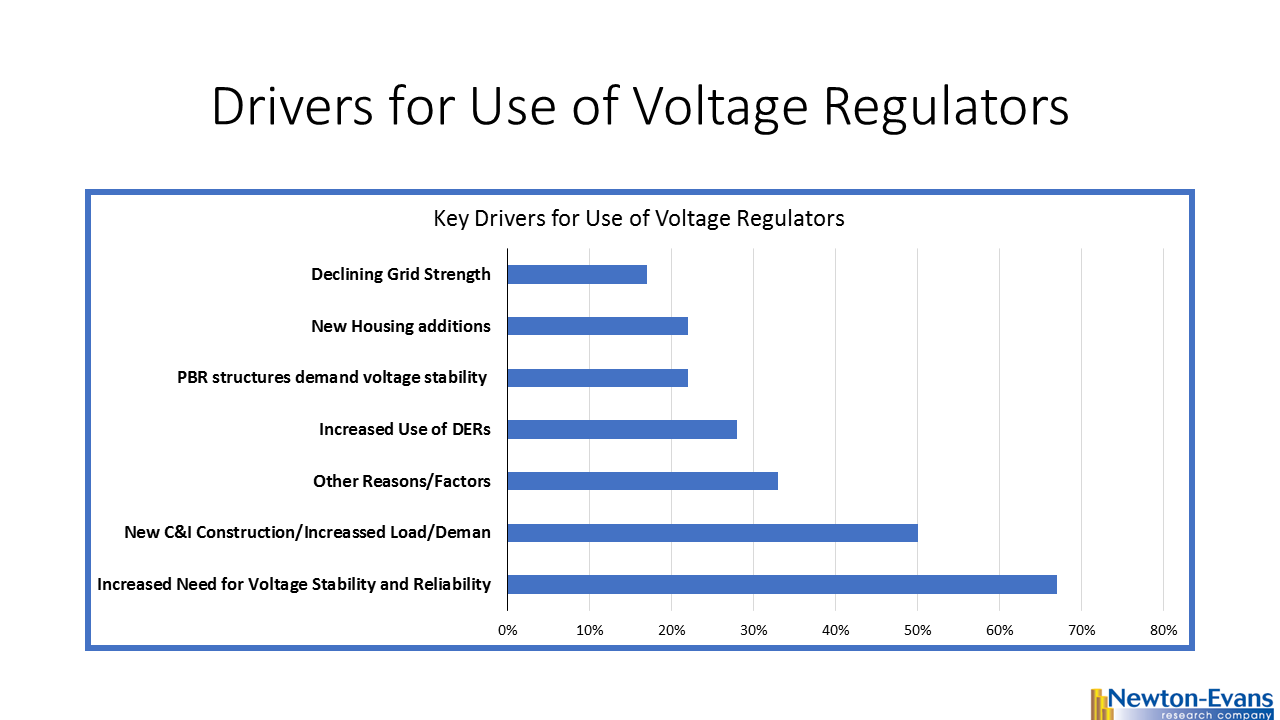
The key drivers for using VRs in the distribution grid today are led by the increased requirements for voltage stability and reliability, as reported in the responses from two-thirds of the initial 20 utility participants to date.  Importantly, C&I construction activities, linked with subsequent increases in load/demand, also have been ranked highly as a driver for increased use of VRs.  In addition, the increased implementation of DERs on the grid, a key factor in today’s grid voltage fluctuations, provide yet another key reason for using VRs to help provide grid stabilization.

Additional topics being studied include phase-to-ground voltages used in conjunction with VR; the use of VRs with other voltage improvement devices such as distribution feeder capacitors and substations capacitors; purchasing methods and preferences; installation methods, requirements for unit compliance with the latest IEEE requirements, wish lists for new VR product capabilities and a number of other pertinent topics.

For utility engineering and operations personnel who may wish to participate in the study, please send an email request to cnewton@newton-evans.com and a survey link will be forwarded.  Findings will be shared with participants.  All submissions are held in confidence. Only aggregated information is used in report preparation.

Posted on

Initial Thoughts on the Executive Order on Securing the United States Bulk Power System

On May 1, 2020, the President issued an Executive Order that forbids American electric utilities from purchasing (or utilizing) grid-related equipment obtained from countries viewed as adversaries.

There is not a clear definition of “adversary” provided in the executive order at this point in time.  It seems that such a listing must be made public for utilities to know what to do in the coming months.  Neither is there a clear definition of which products and equipment types are included, although common sense suggests that any “smart grid” equipment or device that can communicate externally would or should be closely evaluated.

However, this layman’s interpretation of the order puts the onus of having to identify the source country and component manufacturer for each component in the supply chain, and that is going to be a real challenge for some.  This is because there is an increasingly complex multi-layered array of capital equipment, devices, systems and software in use at hundreds of American electric utilities. The onus will fall to an even greater extent upon the manufacturers and integrators serving the electric utility community.

There is a reasonable requirement for electrical equipment manufacturers to be able to identify the source country of origin (COO) for every component of a smart device – even down to the foundry level in some instances.  This has been true for Milspec-related federal procurement for decades.

Importantly, domestic and international electrical equipment suppliers –both manufacturers and distributors – will now have to provide more depth to their equipment certificates that ensure traceability of origin, including tracing components from trusted sources located in approved countries.

It will come as no surprise that the initial list of “blacklisted” countries will very likely include China, North Korea, Iran and Russia, even though that list has not yet been officially made public.  Fortunately, there is very little use of finished “smart” goods from these countries in operation in the U.S. at this time.

Just as important- or perhaps more so – for software systems as for hard goods and components, it will be critical to identify the specific locations used for developers of source code for all smart grid software modules, programs, apps and packages.

What is quite clear to me is that, in the US, and among Western nations in general, electric utility standards and procurement officials must be prepared to ascertain the sources of already deployed smart devices throughout the electric power grid that could adversely affect electric grid operations at some point in time.  This is in addition to the thousands of smart grid projects now in the planning phases here at home and throughout the free world.

Among the plethora of smart grid devices now in use, the most important to vet will be digital relays – both loose relays and those embedded in generators, transformers, switchgear and other equipment.  Next in importance are the hundreds of thousands of communications-centric transmission and distribution level monitoring and control devices including dynamic line rating devices, line monitors, pole-top RTUs, smart controllers for capacitor banks, voltage regulators, automatic reclosers and sectionalizers.

Smart substation equipment (protective relays, electronic measurement devices, precision time measurement devices, power quality monitors, synchrophasors, et al) is now deployed in a majority of the nation’s 65,000 primary T&D substations.  At the consumer level, smart meters are at the top of the list of devices to be assessed, already deployed by the millions of units, whose component assemblies will likely need to be authenticated.  Digital fault recorders are installed in hundreds of critical manufacturing sites. Motor controls and associated relays are installed in thousands of manufacturing plants and in power generation facilities.

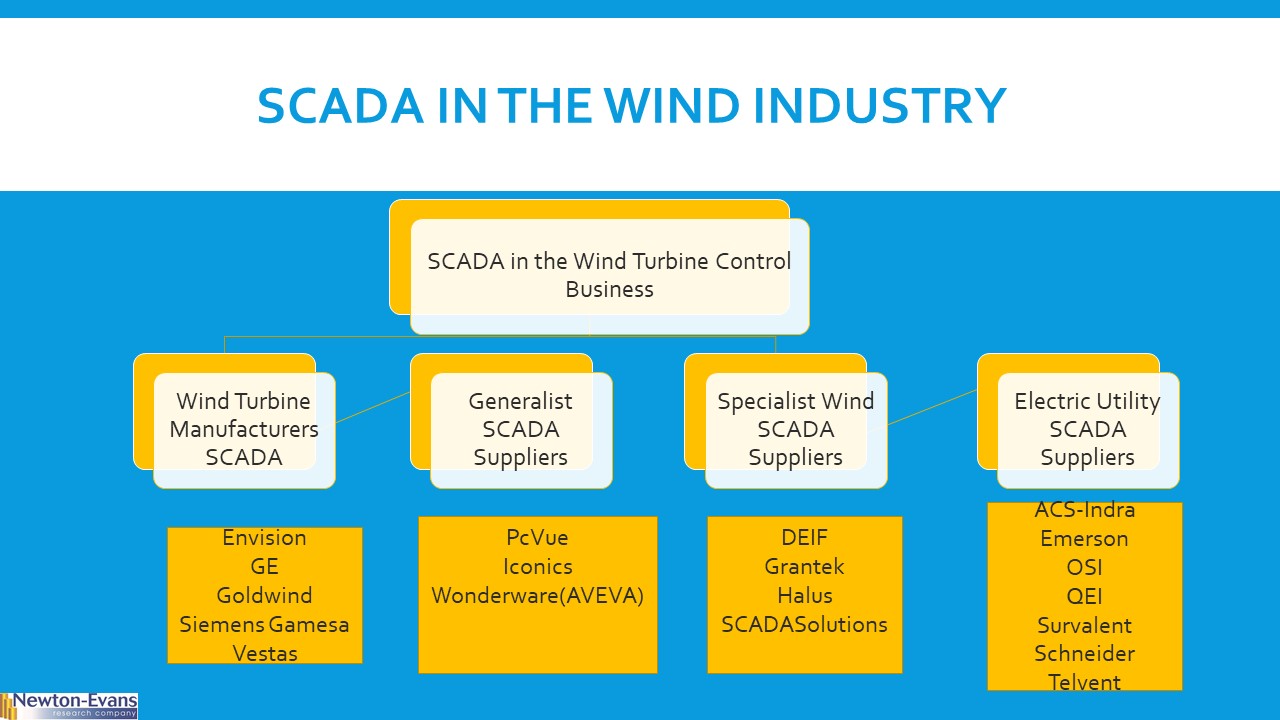
Moving into the sector of distributed energy resources, there are smart devices and attendant communications modules involved in, and embedded with, both wind and solar generation as well as in energy storage.  Wind turbine controls, smart inverters, small secondary substations whose final assembly may occur in the Western nations will have to verify sources of components, motherboards and microchips.

– Chuck Newton

Posted on

U.S. Electric Power Utility Capital Investment in Grid Modernization: Effects of COVID-19 Pandemic on Near-Term and Mid-Term Outlook

U.S. Electric Power Utility Capital Investment in Grid Modernization:  Effects of COVID-19 Pandemic on Near-Term and Mid-Term Outlook

Interim Report By Charles Newton, Newton-Evans Research Company

This article has been developed based on findings from surveys completed by officials from 22 U.S. electric utilities comprising about 10% of served end-use customers.  To date, the mix of participating utilities includes several IOUs, along with public power utilities and electric cooperatives.

The study is being undertaken to determine the effects of the COVID-19 pandemic on utility grid modernization plans involving capital expenditures.  Newton-Evans has requested the participation of major and mid-size American electric utilities in an attempt to gauge whether or not CAPEX investments will continue to be made as planned earlier, and whether grid modernization projects will continue as scheduled or will likely be deferred for some time.

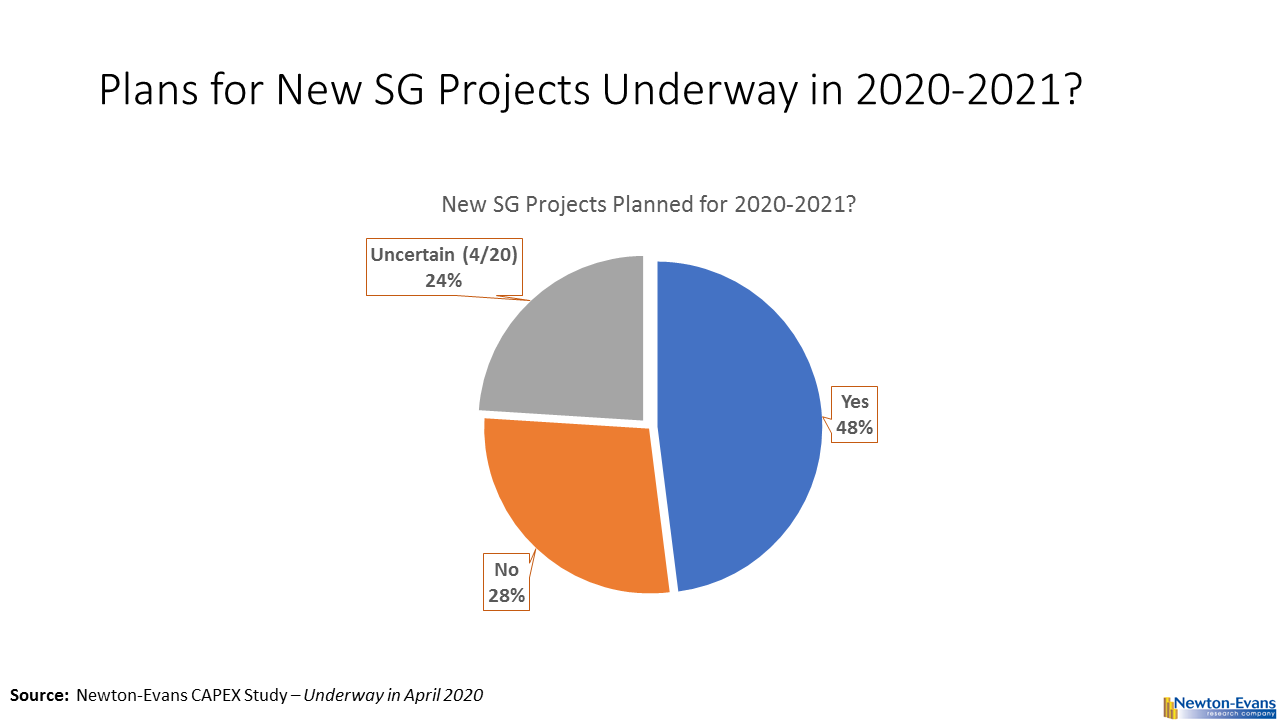
Figure 1 indicates that nearly one-half (48%) of the surveyed utilities continue to have plans to launch new smart grid projects either in 2020 or in 2021.

Figure 1.


Continue reading U.S. Electric Power Utility Capital Investment in Grid Modernization: Effects of COVID-19 Pandemic on Near-Term and Mid-Term Outlook

Posted on

CAPEX Outlook Survey for America’s Electric Power Utilities

If you have insights into your utility’s plans for its near-term CAPEX planning affecting grid modernization projects, we request your help. . Newton-Evans will value your participation in our current study of the capital spending outlook for the nation’s electric utilities in light of the current pandemic.  Newton-Evans will retain your observations in confidence, and will provide you with a complimentary 40-page report of findings gathered from among electric power industry officials located throughout the United States.  The secure online survey is located here: https://www.surveymonkey.com/r/ElectricUtilCAPEXsurvey

Some reasons to participate include:

  • Help industry manufacturers, T&D consultants and systems integration firms prepare to meet the nation’s electric utility demand for equipment and systems during late 2020 and 2021.
  • Provide fellow utility planners to better understand specific grid modernization activities that IOUs, public power utilities and cooperatives are preparing to undertake.
  • Keep up with industry trends by having your own copy of the highly regarded Newton-Evans’ CAPEX report to share with management in mid-May.

A special “thank you” gift is is also available for participants at the end of the 12-question (largely multiple choice) survey.  To date, we have well-thought-out responses in hand from major IOUs, public utilities and electric co-ops.  Looking forward to your survey participation, we thank you kindly for sharing your insights.  We are closing off survey data collection work on Friday, May 15, 2020.
 

Posted on

Energy Management and Market Operations Systems (EMMOS) Conference to be held in San Diego, California During September 13-16, 2020

April 24, 2020.  The 27th annual three-day conference of the Energy Management and Market Operations Systems (EMMOS) Users Group will be held in San Diego, California during September 13-16, 2020, starting with a welcoming reception at the beautiful Kempton Hotel Palomar, San Diego on the evening of Sunday, September 13.

This year’s conference agenda will feature topical speakers and roundtable sessions, technical training class, a tour of the SDGE control center and vendors’ exhibition.  The conference will be held in conjunction with the OSISoft PI Generation and T&D conference, which is being held during the same week in San Diego.

Featured conference sessions at the 2020 gathering of North American and international control systems and market operations management and staff will include topics such as:  Design Matters, Protection and Control, Block Chain, 5G Networking Applications, Big Data, Grid Analytics, Situational Awareness, and others.  Presentations will be delivered by representatives from IOUs, ISOs, RTOs and the T&D Consulting community.  Please contact Mr. Reza Alaghehband at Reza@emmos.org for proposals and suggestions.

Panel discussion topics: “Contingency Plans for Control Centers Operating Under Emergency Conditions” and “Current and Future Utility Industry Technology Solutions and Challenges”

Technical Tour:  The 2020 conference will include a control center tour and will also feature a micro grid tour.

Vendor Exhibition:  An Energy Management and Market Systems focused vendor exhibition will be held on Monday evening and will include a cocktail and hors d’oeuvres reception.

Training workshop/tutorial:  A 4-hour training workshop on “Power Network Applications and Tuning” will be held as part of the conference.  Participants will receive a certificate of completion.

The annual EMMOS conference attendees include electric power operations officials involved with transmission, distribution, generation, Market Systems, as well as IT managers, planning engineers, consultants, ISO staffs, visualization and situational awareness engineers, and related systems personnel involved with control and/or market systems and substation modernization, distribution automation, outage management and geographic information systems.

The EMMOS website is now open and available for registrations for this September’s conference.

Further information on the upcoming 2020 EMMOS conference, including registration information and hotel booking arrangements can be found on the EMMOS website at www.emmos.org.   Exhibitor opportunity information is available from Mr. Dave McGinnis at davemcginnisalt@yahoo.com .  Recommendations for additional topical presentations are welcomed and should be submitted to Mr. Reza Alaghehband at Reza@emmos.org.

In the event that the conference has to be cancelled, refunds will be made to registrants or optionally can be applied to the 2021 EMMOS conference. In the event that it becomes necessary to cancel the physical conference, we will plan to conduct a live streamed video conference with speakers and roundtable discussions.  The virtual conference would be available to remote attendees at a substantially reduced price.


Posted on

Transmission & Distribution World Partnership with Newton-Evans Research Company

Over the years since the early 1980’s, Newton-Evans’ articles written by Chuck Newton have appeared in more than 60 editions of Transmission and Distribution World.  Recent articles can be found here on the T&D WORLD website: https://www.tdworld.com/home/contact/20973495/charles-w-newtonThe following articles are among those now available on the T&D WORLD website.

Energy Policy and the Impact of Renewables and New Market Participants
Mar 13, 2020. This article is Part 2 of a series on current policy trends, first presented at the Little Rock, Arkansas EMMOS Users Conference in September 2019. Part 1 addressed grid modernization from an energy policy perspective.

COVID-19 Epidemic Impact on Protective Relays and Grid Modernization
Mar 13, 2020. What will be the likely economic consequences to grid modernization plans and budgets now in place, seeing the COVID-19 epidemic disruptions, and even havoc, in a significant number of the world’s industrialized and developing nations?

Grid Modernization from an Energy Policy Perspective in 2019
Nov 21, 2019.  This paper is part of a two-part series on current policy trends, first presented at the Little Rock, Arkansas EMMOS Users Conference in September 2019.

A Researcher’s Perspective on the North American Protective Relay Marketplace
Jun 02, 2019.  Charles Newton, Newton Evans Research Company, offers his observations on a recent survey on the protective relay marketplace.

IEC 61850: A Research Perspective
Jan 25, 2019.  Comparison of the findings of Newton-Evans studies on adoption of IEC 61850 by North American and international electric utilities.

Posted on

Update to 2019 Market Outlook for Protective Relays and Grid Modernization Efforts

Refreshing the Outlook for P&C Investments Specifically and for Grid Modernization

The Newton-Evans study of protective relays that was completed several months ago was based on a 2019 multi-month survey-based study of protection and control engineering department heads and senor staff members at key electric power utilities in 30 countries. A total of 97 utility P&C managers and staff discussed their usage patterns and plans for relay applications, protocols and telecommunications architectures as well as their investment plans for protection and control activities during the field collection phase of the study. In addition to utility surveys, more than 30 industry officials from several protective relay manufacturing firms around the world also participated in the study.

The report series provides updated information on a variety of “universally-applied” protective relay types including generator, transmission line, distribution feeder, transformer and motor protection units.

Estimates and forecasts contained in the 2019-2022 report were premised on five sources of information:

  • In-depth utility surveys and interviews of 98 utility protection and control officials located in 30 countries conducted in 2019.
  • Relay manufacturer surveys and channel member interviews together with available financial information from suppliers.
  • Protection and Control consulting firms in six countries.
  • Excerpts from related multi-client and commissioned studies undertaken and completed by Newton-Evans Research Company.
  • Economic and financial global market outlook information developed by a number of respected public and private sources (e.g., World Bank, UNDP, IMF, Bloomberg, and others).World and Regional Economic Outlook: Implications and Viewpoints for the Protective Relay Market

Continue reading Update to 2019 Market Outlook for Protective Relays and Grid Modernization Efforts

Posted on

Transmission & Distribution World – New Article by Chuck Newton

Grid Modernization from an Energy Policy Perspective in 2019

by Chuck Newton

This article has just been published in the November 21, 2019 online edition of Transmission & Distribution World.  The article is part one of a two-part series on current policy trends, first  presented by Chuck Newton at the Little Rock, Arkansas EMMOS Users Conference in September 2019.  The link to the T&D World article is here:  https://www.tdworld.com/smart-grid/grid-modernization-energy-policy-perspective-2019 .

I hope you find the article informative and helpful in navigating the fairly complex regulatory and policy-making organizations that affect and drive the U.S. electric power industry – affecting utilities, equipment manufacturers, systems and services providers, the engineering consulting community and the many millions of residential, commercial and industrial electric power users.

Kind Regards,

Chuck

Posted on

Wide Variations in Networking Technologies Used for Substation Communications Noted

November 8, 2019.  Ellicott City, Maryland.  With nearly 100 officials from 30 countries participating in the 2019 Newton-Evans study of trends in protection and control practices, there were some wide variations noted in the use of networking technologies across the world.

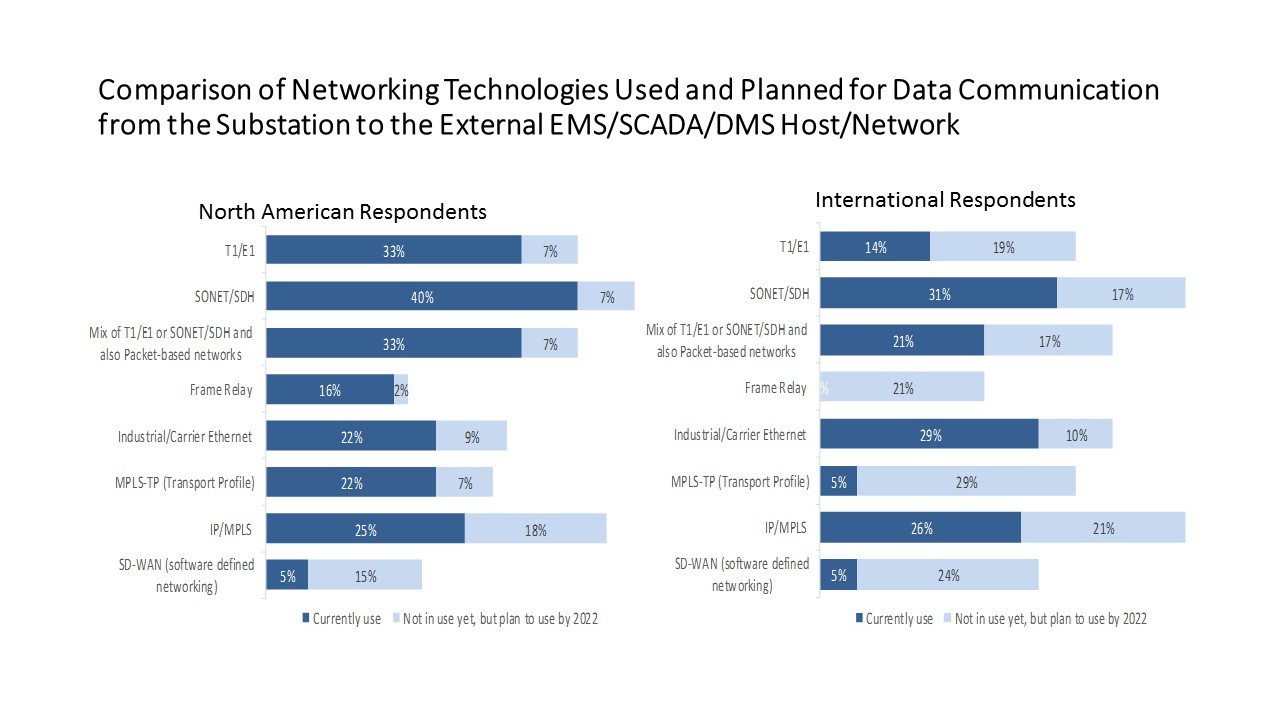
Among 55 North American utility respondents, the most prevalent networking technologies in use during 2019 included SONET/SDH (40%), T1/E1 (33%) and a mix of T1/E1, SONET and packet-based (33%). This seems to imply that SONET is the leading technology among the sample. However, the two networking technologies to watch out for in the next 4 years are IP/MPLS and SDN; 18% plan to use IP/MPLS and 15% plan to use SDN by 2022.

The most prevalent networking technologies used in 2019 among the 42 international utility survey participants included SONET/SDH (31%), Industrial Carrier Ethernet (29%) and IP/MPLS (26%). Based on the survey sample, the leading technologies planned for development by 2020 include MPLS-TP (29%) and SD-WAN (24%).

The Worldwide Study of the Protective Relay Marketplace in Electric Utilities: 2019-2022 measures current market sizes and contains projections on a world region basis for the next few years. More than 35 topics are covered in the utility survey portion of this study with participation from nearly 100 utility P&C officials from countries around the world.  The complete four-volume study of protection and control practices and trends is available from Newton-Evans Research Company.  Details are available at https://www.newton-evans.com/product/the-worldwide-study-of-the-protective-relay-marketplace-in-electric-utilities-2019-2022/ .

Posted on

U.S. Market for Distribution Transformers Standing at $3 Billion, Based on Findings from Recent Newton-Evans Study

7 November, 2019.  Ellicott City, Maryland.  Based on the findings obtained in a recently completed study of the distribution transformer market in the United States, Newton-Evans provides the following information summary.

Distribution Transformer Market Size Estimates

The aggregated U.S. market for three groupings of distribution transformers stood at about $3 Billion in 2018 as seen in the above chart.  The market was segmented by Newton-Evans as shown here to include residential pole and pad mount units; dry type transformers, and small power/large distribution transformers ranging from 1-25 MVAs.

Institutional Barriers to U.S. Market Entry for Distribution Transformers

The third quarter 2019 Newton-Evans study included survey questions for both end-users and suppliers about any institutional barriers they see to potential market entry by non-North American manufacturers.

Among utility respondents, nearly one-half indicated compliance with recently enacted DOE regulations and recommendations for energy efficient distribution transformers as being a key barrier to market entry by foreign-based suppliers (outside of the NAFTA region). One quarter indicated “buy American” programs at their utility was also a deterrent. About 1 in 5 respondents indicated that Underwriters Lab certification was also important, and several respondents had other supporting comments to offer.

Suppliers commented that the enactment of tariffs also served as a deterrent to foreign manufacturers, while one of the largest domestic suppliers of overhead distribution transformers cited the importance of rapid post-storm response times as being a key factor in re-supplying utilities quickly. Another major U.S. transformer manufacturer cited three factors: UL Certificate requirement, DOE Efficiency requirements and “Buy American” initiatives.

Continue reading U.S. Market for Distribution Transformers Standing at $3 Billion, Based on Findings from Recent Newton-Evans Study

Posted on

Newton-Evans Surveys Underway

Outlook Study for HV and MV Equipment Purchasing Plans
Newton-Evans Research is conducting a study of U.S. electric utility plans for T&D equipment purchases over the coming 36 months. If you work in power transmission or distribution and specify or procure equipment, you can help the utility community by participating in the study. In turn, we will share back the findings and provide an honorarium as well. Aggregated equipment demand levels will have an influence on prices and options for capital equipment used in power transmission and distribution.
Continue reading Newton-Evans Surveys Underway

Posted on

Progress Report on the 2016-2018 Study of Protective Relays

This week the staff at Newton-Evans Research is in the midst of conducting pre-testing of our 2016 survey design with our panel of leading utility contributors. After reviewing the results and feedback from our panel, we will finalize the North American version of the survey and begin requesting participation from utilities, ISO/RTO organizations, industrial firms and rail transport organizations. The pre-testing process will then be undertaken with our international utility panel.

This periodic study was last undertaken in 2012, with guidance provided in the four volume set of reports for the P&C community through 2014. The report series has been relied upon by relay manufacturers, substation automation developers and control systems integrators around the world for more than three decades. The reports are referenced by standards organizations and the operational consulting community looks to the series for guidance on protection and control status, learning where the “real world” of utilities is today and understanding the technical drivers and operational trends that will impact utility and supplier planning over the next few years.

We are hoping to receive participation from more than 100 key electric utilities in this year’s study. Typically we do obtain cooperation from 100 or more utilities. It is more difficult to obtain high levels of cooperation today, with concerns about security and competitive activities. We are trying not to be intrusive in our questioning, so would-be participants can safely and securely provide information without having to be concerned with cyber security policy issues.

The richly illustrated Executive Summary from this new study will be about 40 pages in length and will enable participants to “benchmark” the findings relative to their own P&C activities and plans and compare with other utilities within their size range and utility type.

For interested parties, keep in mind that the pre-publication price offer for the four volume set of report is $5,500.00 through May, 2016. Once the study is published, the report series price will be $5,950.00.

A brochure with order form for the 2016-2018 series is available here.

Posted on

The Year in Summary (2015)

2015 was another busy year for Newton-Evans Research. Some of the studies conducted this past year covered new research topics. While our work was focused on client-commissioned studies, we obtained many insights from operational and engineering perspectives that will assist our research programs in 2016 as we once again conduct our flagship multiclient studies of protection and control, substation modernization, and operational control systems with utilities around the world. For over 30 years Newton-Evans has observed and reported on the fundamental shifts in operational systems and electric power infrastructure technology developments and usage patterns. In 2016, there will be additional changes in usage patterns, plans and outlooks among operational end engineering officials to note, both in North America and internationally.

Continue reading The Year in Summary (2015)

Posted on

Bumps in the Road to Grid Modernization – Caution Ahead?

The T&D Industry and Grid Modernization Efforts in the second half of 2015 – A Middling Performance – So What Lies Ahead for 2016?

While a number of energy industry pundits suggest that the T&D markets for infrastructure equipment and control systems always go up, I will revert to what another Newton stated a few centuries ago in his Third Law of Motion (“What goes up must come down”).

An informal survey of marketing/product managers being undertaken concurrently with the development of this article strongly suggests that we are in a “down” or at best, a “flat” year for much of T&D infrastructure and for the systems that monitor and control distribution networks. There are some exceptions as noted below.

A more formal study of CAPEX and OPEX plans among the world’s utilities will follow in the fourth quarter. The findings from this scheduled study will enable suppliers of equipment, systems and services to plan more appropriately for the coming two years. This will be the sixth edition of the Newton-Evans CAPEX/OPEX report that began with the financial crisis of 2008 and continued through 2013. Now that low load growth and low capital investments have again hampered the bumpy road to grid modernization, the timing for this study will be helpful.

In preliminary discussions with U.S.-based manufacturers, integrators and industry observers, it is clear that we have entered into a period of further uncertainty and limited investment capabilities for utilities, with some major infrastructure and grid modernization projects being delayed or deferred for months or even years. The significant industrial consumers of electric infrastructure products and smart grid equipment and systems are, in some cases, in a more difficult position than are electric utilities. With falling commodity prices, and the widening spread of corporate bond costs versus Treasury bond costs, the ability of many companies and utilities to source capital for investment is not as “low-cost” as current interest rates would have it. Continue reading Bumps in the Road to Grid Modernization – Caution Ahead?

Posted on

First Quarter 2015 Projects Underway at Newton-Evans Research:

Study for CIGRE WG D2.38 – Operational Readiness for Cyber Threats. The Newton-Evans staff is conducting an international survey of electric utility IT and OT organizations to learn about the current status of preparations and readiness to minimize the impact of cyber threats. Utilities that participate with us in this “pro bono” study for CIGRE will be entitled to share in the findings and recommendations from the survey and from the guidance to be set forth in a 2016 CIGRE technical brochure.

2015-2017 Substation Automation U.S. Market Overview Series: Newton-Evans is in the process of releasing a new series of market synopses concerning 14 components of electric power substation modernization in the United States. Fourteen report summaries are available individually or as a complete series. Taken together the fourteen components reported in the series accounted for an estimated $1.7 Billion in 2014 shipments to U.S. utility and industrial customers. Growing at an average rate of about six percent, Newton-Evans expects 2017 shipment values to reach nearly $2 Billion.

Included in the series are these individual topics: SA01 – Remote Terminal Units; SA02 – Programmable Logic controllers; SA03 – Substation Automation Platforms; SA04 – Multifunction Meters and Recorders; SA05 – Inter-Utility Revenue Meters; SA06 – Digital Relays; SA07 – Digital Fault Recorders; SA08 – Sequence of Events Recorders; SA09 – Power Quality Recorders; SA10 – Substation Reclosers; SA11 – Substation Automation Integration Specialists; SA12 – Substation Communications; SA13 – Substation Voltage Regulators; SA14- Substation Precision Timing Clocks. The report summaries are available individually at $150 per report, or the group of 14 report summaries is available for only $975.00.

2015-2017 Protective Relay U.S. Market Overview Series: Newton-Evans is now underway with work to update the 2012 series on protection and control. A total of ten market summaries will become available on April 10. The P&C series will include the following topical summaries:
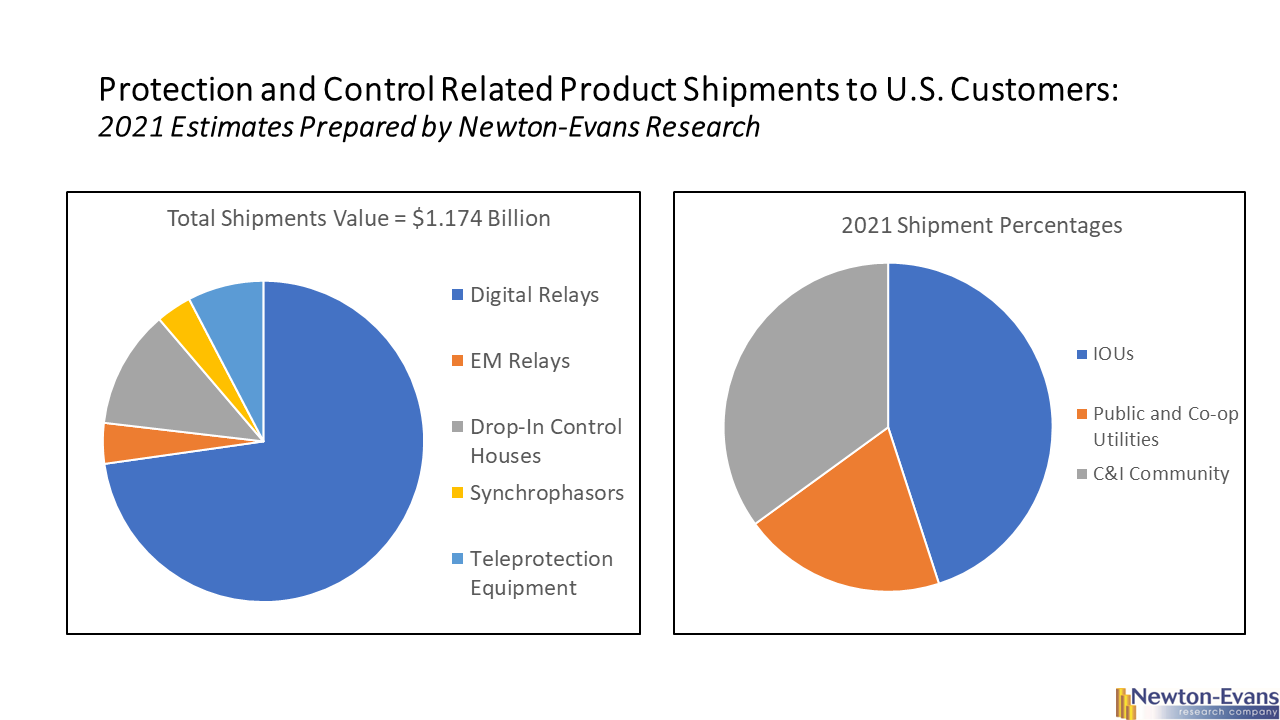
PR01 – Feeder Relays; PR02 – Transmission (Distance, Overcurrent, Line Differential) Relays; PR03 – Generator Relays’ PR04 – Bus and Busbar Relays; PR05 Transformer Protection Relays; PR06 – Motor Control Relays; PR07 – Electro-Mechanical Relays; PR08 – Drop-In Control Houses; PR09 – Synchrophasors (PDUs/PDCs); PR10 – Teleprotection. The report summaries will be available individually at $150 per report, or the group of 10 report summaries will be available for $875.00.

Worldwide Study of the Protective Relay Marketplace In Electric Utilities (2015-2017). Newton-Evans staff is preparing to undertake a major update to the four volume flagship study of protective relay use in utilities around the world. We need to hear back from interested parties as to whether this study should be scheduled for a spring kick-off or whether we should defer work on this massive study until autumn 2015. Early commitments will mean lower subscription prices and earlier reports availability. Please provide your thoughts and information requirements on the study’s timing and desired content to us.

Commissioned Studies:  Privately funded studies this first quarter include North American assessment of the recloser market; cyber security topics; ADMS market overview; software module pricing for AMI-OMS related systems; new compilation of North American EHV/HV and MV substations, transmission and distribution line mileage totals. (By state and by type and size of utility).

Posted on

Utility Plans Call for Continuation of Substantial Investment in North American Distribution Grid Automation Programs

Findings Corroborate Earlier Newton-Evans Studies Regarding “Mixed” Placement of Controls of Field Devices

The Newton-Evans Research Company today released key findings from its newly published study of electric utility plans for distribution automation. Entitled “North American Distribution Automation Market Assessment and Outlook: 2015-2017” the 89-page report includes coverage of more than 35 DA-related issues.

Progress Being Made with Distribution Automation Programs:
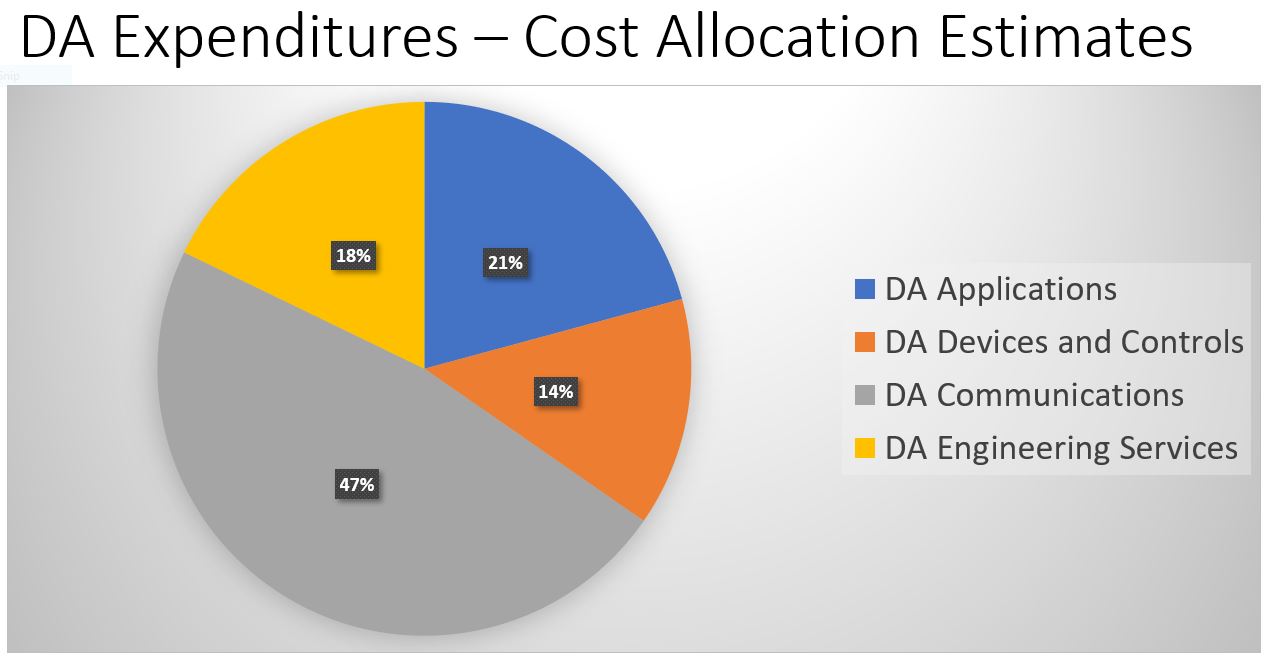
North American utilities are making good progress in developing and implementing new DA applications and telecommunications network upgrades. The overall DA market among North American utilities is approaching one billion dollars and will continue to grow each year for the foreseeable future.

DA Controls Placement:
The placement of DA controls for field devices remains mixed. While some see controls being distributed to field locations, others are placing controls on substation automation platforms, while an even larger group is using control center systems-based approaches (centered on SCADA-DMS systems).

The outlook for controls placement in the future shows that utilities are bringing more controls for fault detection, isolation and service restoration (FDIR/FLISR) and for volt/var control (VVC) into the control center as shown in these charts.

FLISRcontrols VVCcontrols

Automatic Fault Sensing:
Devices providing information such as hot line status and fault indications are becoming a mainstay in many utility DA programs. IOUs and Canadian utilities were more likely to be using automatic fault sensing devices than were their counterparts at electric cooperatives or public power utilities. Usage patterns and plans for AFS devices were strongest among the respondent subgroup of very large utilities (those serving more than 500,000 customers). Of the subgroup using AFS devices, about one-third actively utilize the status of such devices in their DA schemes.

Integration of Communications and Controls for Distributed Generation into DA System Architecture:
By year-end 2014, only about 16% of utilities indicated some use of DA-related communications/controls while another 14% plan to integrate these for DG purposes by year-end 2017. In a related question, well over one third of the respondents indicated that they have a trial deployment to manage distributed energy resources within the DA system either underway or planned.

More than 30 additional topics are covered in the 2015-2017 Newton-Evans DA report. Seventy five major and mid-size utilities were surveyed and interviewed to gather the information for the report. This group provides a substantial sample, accounting for 20% of served customers and 19% of primary feeders across North America.

A supplemental North American DA market outlook synopsis for the years 2015 through 2020 will be released in March. The outlook supplement will provide DA market outlook information based on type, size and regional location of utilities.

Additional information on the North American Distribution Automation Market Assessment and Outlook: 2015-2017 report is available from Newton-Evans Research Company, 10176 Baltimore National Pike, Suite 204, Ellicott City, Maryland 21042. Phone 1-410-465-7316 or write to info@newton-evans.com

Posted on

2014 Autumn Electric Power Conference Season Well Underway

For the electric power industry, late summer through mid-autumn brings a number of conferences to the forefront each year or at least every two years.

This year is no exception. From the international CIGRE Conference held in Paris every two years, to the annual EMMOS conference and Southeast Distribution Apparatus Conference, there are lessons to be learned and topics of interest to those following industry trends. The CIGRE conference provides information on key electric power topics, while EMMOS focuses on large control systems used by utilities and independent systems operators (ISOs). The SDAC offers briefings and training on a variety of power distribution topics, ranging from meter management to control systems to cyber security.

CigreLogo
In late August I attended and participated in my 10th CIGRE conference. This year set a new record for attendance (more than 3,000 delegates and another 5,000 visitors) and the number of exhibitors and working group sessions also reached new heights. One of the more interesting observations for me has been to witness the growth in CIGRE participation by utilities and T&D equipment and systems companies from North America. Delegates are either actively volunteering on working groups or doing booth duty for an increasing presence of large-to-small North American companies whose equipment, systems and services are part of the exhibition.

Continue reading 2014 Autumn Electric Power Conference Season Well Underway