Posted on

Part Two: A Look at Major Substation Component Equipment – Excerpts from the 2024-2026 Market Overview Series on Substation Automation

The 2024-2026 edition of Market Overview for Substation Automation includes 14 topical reports on modern substation components.  This month’s article presents some highlights from 7 more of these market overview reports. In May, we provided another seven summaries of modern substation components.  Read the article that follows below this article for that information.

More information on the entire 14-report series of substation automation components can be found here: https://www.newton-evans.com/product/overview-of-the-2024-2026-u-s-transmission-and-distribution-equipment-market-substation-automation-series/.  The complete 2024-2026 series is priced at $1,450.00, with individual 3-5 page report summaries available for $195 per report. Each report provides component definitions, revenue estimates of key suppliers, market share assessments, outlook through 2026, and revenue split between sales to utilities and commercial-industrial buyers. 

Sequence of Events Recorders: A sequence of events recorder (SER) is an intelligent standalone microprocessor-based system, which monitors external inputs and records the time and sequence of the changes occurring with any substation activities. Sequence of events recorders usually have an external time source such as a GPS or radio clock configured with Precision Time Protocol (PTP). When wired inputs change state, the time and state of each change is recorded.

SERs enable rapid root cause analysis after multiple events have occurred due to the secure recording of the sequence of events in the order of occurrence. SERs are therefore utilized as a diagnostic tool to minimize plant downtime. SERs are often interfaced with a SCADA system, distributed control system (DCS),or programmable logic controller (PLC). (Per Wikipedia).

Our shorter definition is: a sequence of events recorder is a microprocessor module within the electric power substation that logs time-stamped events. The SER functions can also be performed by other smart substation devices such as multi-function meters and recorders. 

The total utility substation market for dedicated, stand-alone SOE/SER units is in decline due to the inclusion of SOE/SER functionality in other smart substation devices and systems. However, the decline among utility users is being offset by the application of SOE/SER devices among non-utility DER asset owners and operators, hence our outlook is for low-to-moderate growth over the mid-term years.  See report SA08 for detailed information.

Power Quality Recorders: A power quality recorder (PQR) is a microprocessor module that most often is located within the substation that provides and enables regulatory power quality application, measurement, comparison, and profiling of power quality parameters at the individual electrical system interfaces: (e.g. generation, transmission, sub-transmission and distribution system levels). Source: Siemens Corporation.  Substation-based PQ recorder sales have plateaued in recent years as single functions (like recording) tend to become one function of a multi-functional “system-like” instrument.  Non-utility DER assets will likely procure power quality monitors to track power quality being produced by their generation assets prior to uploading to transmission lines.  It is difficult to separate out specific units that ONLY perform power quality recording, so the authors are attempting to allocate costs back to the specific PQ function being studied.  See report SA 09 for detailed information.

Reclosers: An Automatic Circuit Recloser (ACR) is a medium voltage circuit breaker equipped with a mechanism that can automatically close the breaker after it has been opened due to a fault. The market size estimates below include 1phase and 3phase hydraulic units, which category continues to represent as much as 17%-24% of the total recloser business in the U.S. Key factors influencing demand include:

  • Aging and obsolescence of installed base of older reclosers
    • Regulatory decisions on reliability improvements mandated
    • DMS installations and growth in DA activities will likely spur additional ACR installations
    • Utilities represent the bulk of the recloser market – 90%+ of total demand. Substations using recloser technology typically will have four units installed.
    • Customer density and feeder length both affect system protection choices (reclosers versus fuses or sectionalizers).
    • Ease of installation, maintenance-free operation, visual break and SCADA connectivity

See report SA10 for detailed information.

Substation Communications devices include Ethernet switches, hardened routers, teleprotection comms equipment, serial device servers and media converters. Key U.S. market participants in this multi-hundred million dollar market include CISCO, SEL, Siemens, Belden, GE Vernova, ABB and Hitachi Energy, along with many other suppliers of these devices.  See SA12 for details on this market.

Voltage Regulators: A voltage regulator (VR) is an electrical device designed to automatically maintain (regulate) a constant voltage level. VRs may use an electromechanical mechanism, or passive or active electronic components. Depending on the design, it may be used to regulate one or more AC or DC voltages. This overview provides information only on substation-based single and three phase VR units. The larger portion (60-70%) of the total VR market is for single phase units placed along MV feeder paths. In both applications, VRs are often paired with power capacitors

Electric utilities also use mechanical automated units (AVRs) to adjust voltage levels as loads fluctuate on each feeder in an MV distribution network. MV AVRs are basically transformers with multiple taps used to change the turns ratio and thereby alter output voltage. A voltage regulator may be a simple “feed-forward” design or may include negative feedback control loops. It may use an electromechanical mechanism, or electronic components. Depending on the design, it may be used to regulate one or more AC or DC voltages.

In an electric power distribution system, voltage regulators may be installed at a substation (1p/3p) or along distribution lines (1p) so that all customers receive steady voltage independent of how much power is drawn from the line. The DA portion of the VR market is primarily for automated control of single-phase units installed along MV distribution lines.  See report SA13 for detailed information on the substation voltage regulator market.

Substation Timing Synchronization Devices/Clocks: Special clocks used for precise timing indications for improving grid reliability, gaining a better understanding of the power system operation, predicting and preventing systems-wide faults, and testing and verifying operation of protective devices. (Source: http://www.arbiter.com/news/technology.php?id=4)

Similar to the findings obtained from equipment manufacturers in a major Newton-Evans study of timing synchronization, IRIG-B was the most frequently mentioned timing reference used by

U.S. utilities as recently as 2014, as cited by 87% of a survey sample comprised of 30 US electric power utilities. NTP (37%) and direct GPS signals (30%) were mentioned as the next most important references. IRIG-B continues to be widely used in mid-2024.

In that same referenced Newton-Evans study, 21% indicated that their utility would be specifying Precision Timing Protocol (PTP) Standard IEEE 1588 within five years for use as the substation timing references. One utility had already begun standardizing on the PTP standard. Importantly, as American utilities migrate to IEC 61850, time synchronization becomes ever more critical to reliable operations.  Much of the increase in demand for timing synchronization devices is a result of the proliferation of synchrophasor measurement units across North America.  The North American Synchrophasor Initiative (NASPI) provides a great deal of information on their website here https://www.naspi.org/ .

More than 80% of US utilities have recently indicated that they rely on a stand-alone clock for embedded GPS. The utility industry’s migration to Ethernet and IP-based telecommunications to/from substations will likely include a changeover from “legacy” approaches (typified by IRIG- B) to IEEE-1588 to enable more precise network monitoring and sequence of events recording.  See report SA14 for details.

Substation Automation Integration Specialists are firms (or corporate business units) that can assist with or provide a full or partially automated substation on a turnkey basis. Such firms include dedicated businesses such as listed in the SA platforms report SA03 (NovaTech, SEL Automation Services, Subnet Solutions, Eaton-Cybectec), or can be business units of larger companies engaged in the electric power automation business as EMS/SCADA suppliers, RTU manufacturers or protection and control specialists.

Three “tiers” of substation integration providers are included in our assessment:

  • Specialist substation automation integration services
    • SCADA /P&C industry participants with substation devices (RTUs, FEPs, Relays, IEDs, platforms) offering substation integration expertise
    • T&D Engineering Services firms with substation integration expertise

See report SA11 for information that describes the substation automation integration specialist companies in each tier along with revenue estimates for each tier.

We hope you enjoy reading this summary of market information on substation components.  In July, we will provide readers with part one of a two-part series describing high voltage substation equipment as used in the United States.
Posted on

A Look at Major Substation Component Equipment – Excerpts from the 2024-2026 Market Overview Series on Substation Automation

The 2024-2026 edition of Market Overview for Substation Automation includes 14 topical reports on modern substation components.  This month’s article presents some highlights from 7 of these reports. In June, we will provide another seven summaries of modern substation components.

More information on the 14-report series of substation automation components can be found here: https://www.newton-evans.com/product/overview-of-the-2024-2026-u-s-transmission-and-distribution-equipment-market-substation-automation-series/.  The complete 2024-2026 series is priced at $1,450.00, with individual 3-5 page report summaries available for $195 per report. Each report provides component definitions, revenue estimates of key suppliers, market share assessments, outlook through 2026, and revenue split between sales to utilities and commercial-industrial buyers.

Remote Terminal Units: A Remote Terminal Unit is a microprocessor-controlled electronic device that interfaces objects in the physical world to a distributed control system or to SCADA by transmitting telemetry data to the system from substation-based RTUs and pole-top- installations, and by using messages from the supervisory system to control connected objects. RTUs are evolving into substation gateways, controllers and servers, depending upon the manufacturer and the application/intended use. See the separate report on substation automation platforms – (SA01 in this series). 

Programmable Logic Controllers (PLCs) are microprocessor-based devices used to control industrial processes or machines. They provide advanced functions, including analog monitoring, control and high-speed motion control as well as share data over communication networks. During the 1980s and 1990s, hundreds of units were sold annually for use in electric power substations, led by Schneider’s Modicon and Allen-Bradley.  Programs to control machine operation are typically stored in battery-backed or non-volatile memory. A PLC is an example of a hardened real time system since output results must be produced in response to input conditions within a bounded time, otherwise unintended operation will likely result.

PLCs are designed for multiple inputs and output arrangements, extended temperature ranges, immunity to electrical noise, and resistance to vibration and impact.  Programs to control machine operation are typically stored in battery-backed or non-volatile memory. A PLC is an example of a hardened real-time system since output results must be produced in response to input conditions within a bounded time-frame, otherwise unintended equipment operation will/may result.  SA02 in this series.

Substation Automation Platforms: A substation automation platform is a substation-resident computing platform that includes some sort of hardware architecture and a software framework (including application frameworks) that may better classify the platform as a gateway, an automation controller or a data concentrator. A single programmable automation platform can perform an expanding array of communications, automation, control and cyber security functions in the electric utility substation.

SEL’s RTAC and 2032 units are quite strongly represented as of mid-year 2024, especially in mid- size cooperatives and municipal utilities. Together with NovaTech’s ORION along with Eaton’s Cybectec and GE’s older D400 (now replaced with the G100/G500 offerings) have been long- term participants in development and provision of substation automation platforms. These four firms accounted for nearly three-quarters of the 2023 market. The larger global firms are also active as noted in the table below. Note that substation platform providers may also provide complete substation modernization consulting and engineering services and can provide project management for large automation/modernization projects. Note too that some feature-rich, smart RTU equipment also serve as substation automation platforms.  Revenue for these advanced RTUs is not included here.  Newton-Evans estimates for substation automation platform sales in 2024 were in the $125-175 million range.  SA03 in this series.

Multifunction Meters and Recorders: Substation Multifunction Meters, Panel Meters and Recorders are units that can display substation data locally and/or transmit substation data back via RTU or SS controllers and platforms to SCADA and energy management systems. Panel meter sales had plateaued by the early 2000’s, as the functionality of these meters could by then be duplicated by digital relays. However, due to cyber security issues, operational complexity and visualization issues, panel meters are making somewhat of a comeback and finding their niche support base growing once again. Measurements of energy consumption and power quality are among the key attributes of leading multifunction meters and recorders. Waveform capture, harmonics, and alarm limits are also recorded in advanced multifunction meters and recorders. I/O capabilities are provided in these devices for communicating with SCADA and related energy monitoring systems.  Newton-Evans estimates for sales of multifunction meters and recorders 2024 are in the $65-90 million range.  See SA04 for more information on meters and recorders.

Substation Inter-Utility Revenue Meters are metering products capable of collecting and storing incoming and outgoing substation power flows by performing various measurements. The devices are sold in the low thousands of units annually. As the role of distributed generation resources increases across the U.S., there will likely be a need for additional inter- utility and DER provider-to-utility revenue meters.  See SA05 for more information.

Digital Protective Relays: A digital protective relay uses a microcontroller with software-based protection algorithms for the detection of electrical faults. Such relays are also termed as microprocessor type protective relays. As renewable energy sources grow in importance, the need will grow for system protection and control for solar, wind, and other renewable energy installations. New relay designs or adaptations of existing protective relays will be developed to meet the requirements for thousands of DER applications during the remaining years of the 2020’s.  There are opportunities for protective relay managers to work directly with renewable systems developers (such as Pure Power Engineering, Trimark, among several others).

The Hubbell acquisitions of RFL Electric just a few years ago, and more recently, the company’s acquisition of Beckwith Electric are harbingers of additional acquisitions of existing smaller independent relay manufacturers likely to occur over the mid-term.  These will likely include international manufacturers in the mix.  See report SA06 for more information.

Digital Fault Recorders: A digital fault recorder is a microprocessor device level module installed within the substation (or industrial location) that records electric power faults. DFRs are more capable than are power disturbance monitors, which also provide some level of information on electric power faults. Disturbance monitoring equipment (DME) tend to be lower-cost and easier to install and use than are DFRs. DME also provide information on several power fault components and can be used for some root cause analyses.  Special purpose, dedicated DFR units tend to have performance features and capabilities that go beyond the increasingly popular relay-centric approach to fault recording. This portion of the DFR market was about $30-$40 million as of 2021.  Relays are increasingly being used to provide basic fault recording and sequence of events recording functions as a lower-cost alternative for fully-featured DFRs from the leading U.S. providers. Perhaps $15-25 million of relays applied to this function. 

Newton-Evans believes that there will be some level of growth in use of dedicated DFR technology due to the continued deployment of synchrophasor technology across the United States. As well, the increasing demands from regulatory authorities for precise electric power fault information and root cause analysis will affect the increase in use of DFRs and related equipment (including IEEE 1588-compliant clocks).  See report SA07 for more information.

Be sure to check in with our site next month for coverage of another seven components of modern digital substations.

Posted on

The U.S. Market for Power Transformers in Perspective: April 2025 Edition

Newton-Evans Research has been assessing the increase in demand for power transformers of all size ranges since the COVID pandemic. Many observers have focused on the growth of the data center and artificial intelligence market as being the principal driver for this increase in demand. Additionally, there are equally important – but somewhat less impactful – market drivers that are also increasing the demand for power transformers.

The Trump administration’s dual focus on expanding mining operations and reshoring of manufacturing, the Biden administration’s prior push on increasing U.S.-based semiconductor fabrication operations and its earlier focus on clean hydrogen production, are each adding to the increase in demand for power transformers. Add to this the typical utility-driven demand to replace hundreds of aged-out large power transformers annually and one can see the demand for medium and large power transformers being likely to continue over the short-term and medium-term economic cycles – likely through 2030.

The recent administration decision to apply tariffs to imported finished goods of all types and the duties planned to be applied to commodities and key components of electrical equipment could certainly put a damper on at least part of the planned increase in demand for large power transformers.
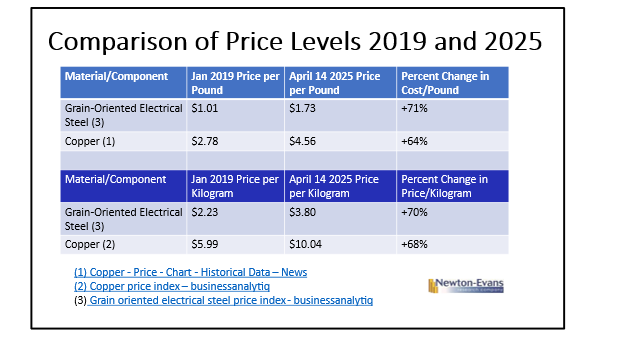
Commodity price increases, especially for electrical steel and for copper, coupled with the surge in demand from utilities and the C&I community, have necessitated that such costs be passed along to the buyer. See Table 1 for a look at the significant price increases for these two key components from January, 2019 to April, 2025.

FIGURE 1.

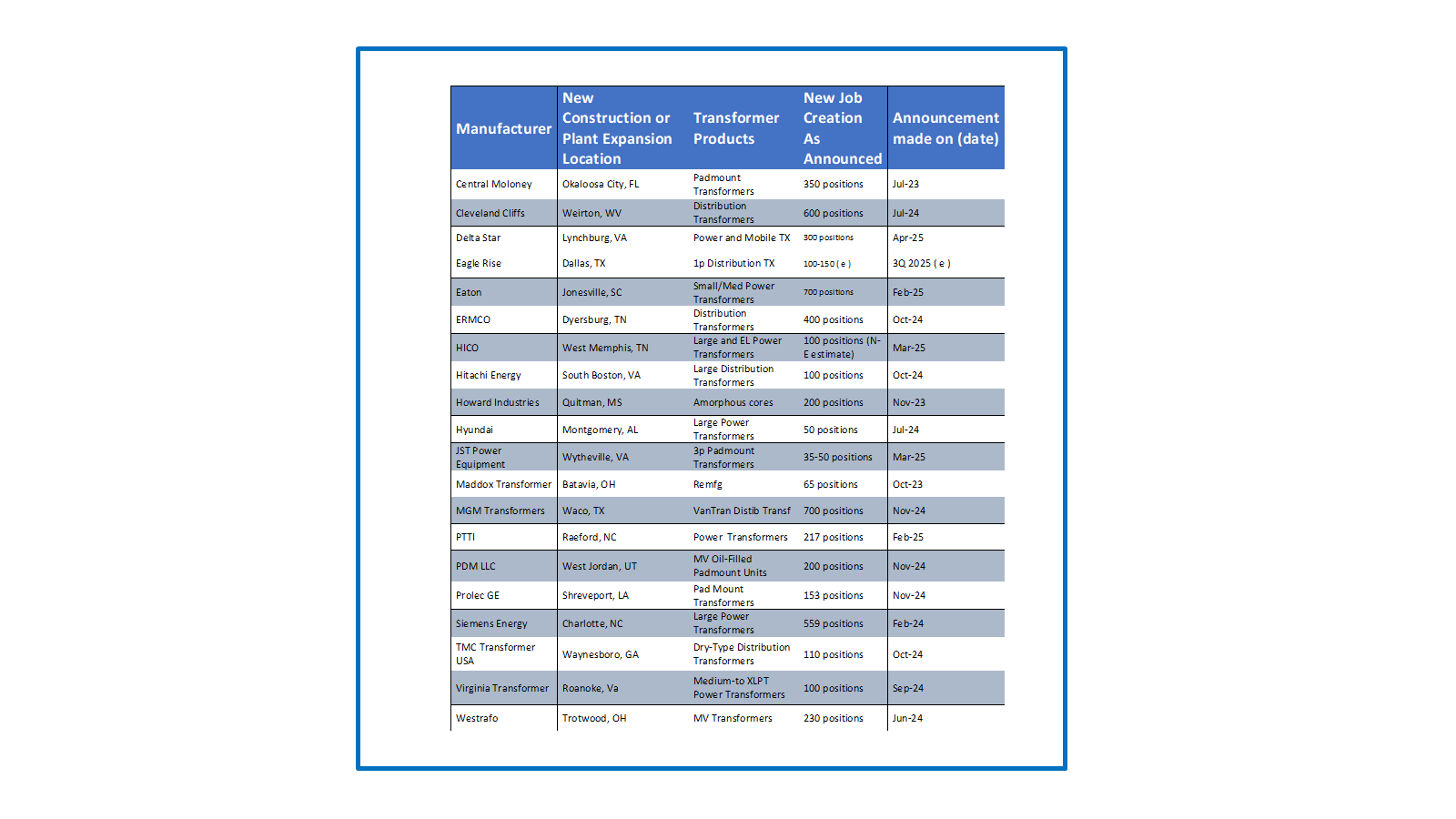
So, the question before us is this: How do we shorten the lead time between order placement and scheduled delivery of a medium to large power transformer? Certainly, development of additional manufacturing facilities and expansion of existing factories is going to help. Figure 2 lists the known plans among transformer manufacturers to expand existing manufacturing facilities or to construct new facilities in the United States over the next 12-36 months. This new capacity will help shorten the currently extensive lead times between order placement and delivery of power transformers. There are 20 transformer manufacturers on our list of known sites planned for expansion or new facility construction spread over 11 states across the U.S. Seven of the listed suppliers are expanding power transformer production capacity. Nearly 3,000 manufacturing and support positions are being added among this group (which is likely not all-encompassing).

FIGURE 2.

If the IEEE PES, NEMA and others could form a task force to standardize on design and performance characteristics to a reasonable extent for large power transformers, that would also help shorten unit production times. A recent article from Wood-Mackenzie focused on the efforts of U.S. mining companies now seeking to mine extensively for copper, given the high level of demand for power and distribution transformers. (3)

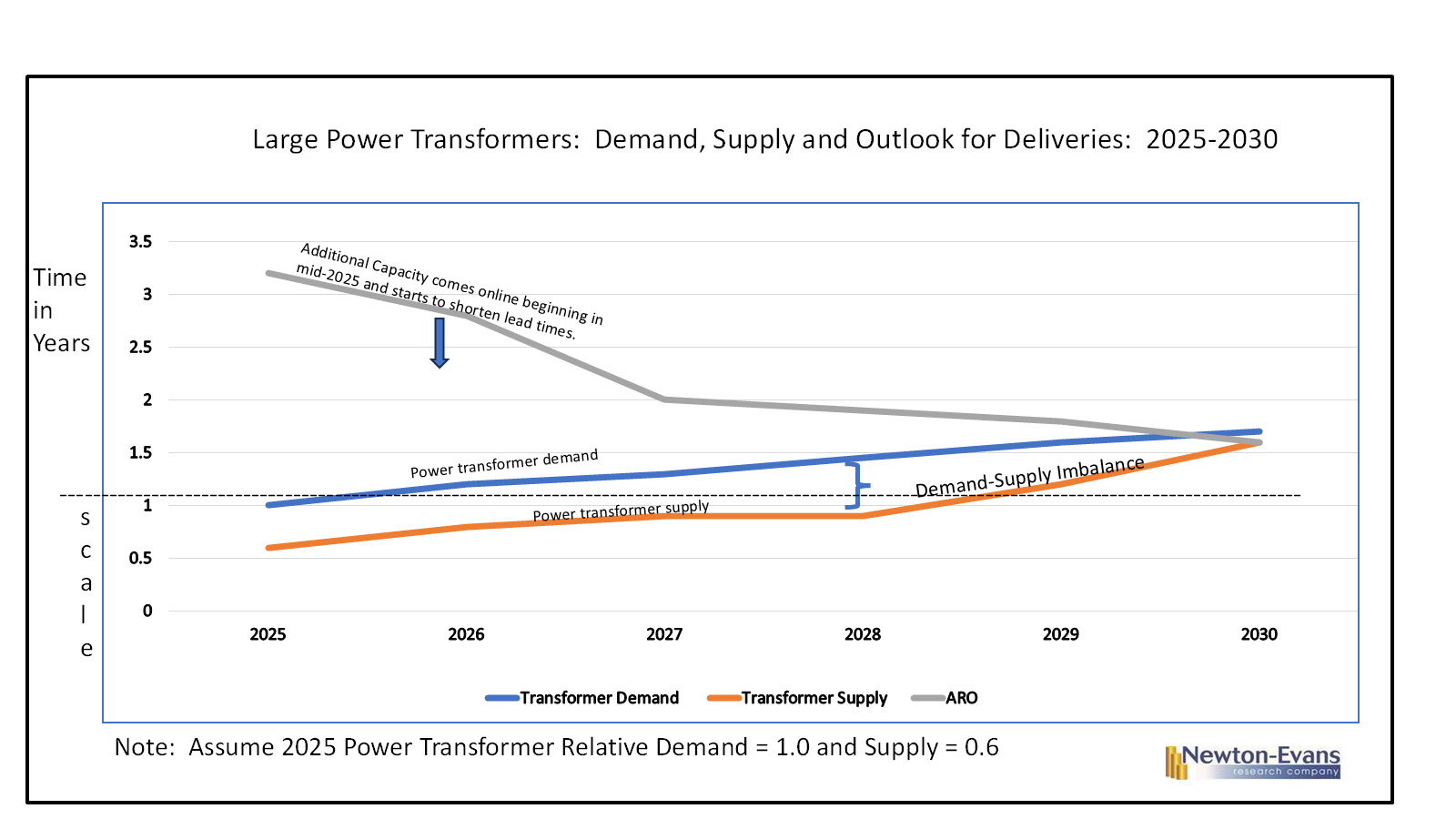
In Figure 3 below, I have attempted to scale perceived unit demand and supply capacity through 2030. Note that relative current imbalance between power transformer supply (orange line) and demand (blue line). The third line (grey line) indicates the view that the increased unit production capacity will have a positive effect on closing the multi-year gap between power transformer order placement and shipment of completed units.
FIGURE 3.

Next month, we will address the distribution transformer industry segment and look at what will likely shape up as a somewhat similar supply-demand imbalance curve, and the time lags affecting deliveries. We will separate pole-mount and pad-mount data as best as we can.

In the meantime, our Market Overview series on Power and Distribution Transformers provides up-to-date coverage on 14 transformer-related topics. Purchasers of this series will be provided with a complimentary update in the third quarter 2025. More information can be found at https://www.newton-evans.com/product/overview-of-the-2024-2026-u-s-transmission-and-distribution-equipment-market-transformer-series/ ,

Posted on

Newton-Evans Research Company Introduces Comprehensive and Cost-Effective Market Overview Package for the Electric Power Industry

The Newton-Evans Research Company is pleased to announce a new, cost-efficient purchasing option for its extensive series of electric power T&D (Transmission and Distribution) equipment, systems, and services market overviews.
Now Available: All 86 Report Summaries for $7,500
This special package includes every summary from our seven major report groupings, as well as an exclusive June 2025 Market Update. The update will analyze the impact of newly imposed or revised U.S. tariffs on T&D equipment and includes an updated spending outlook through 2027.

What’s Included:
Each market overview provides:
• A technical description of the specific product, system, or service
• A list of key market participants
• Market size and share estimates
• A market outlook through 2026
• Sample pricing data (for most topics)
Report Categories (2024–2026 Updates):

Our 86 individual topic reports span seven major categories:

  1. High Voltage Equipment
  2. Medium Voltage Equipment
  3. Power and Distribution Transformers
  4. Control Systems
  5. Distribution Automation
  6. Substation Automation
  7. Protection & Control
    Each category includes between 8 and 18 individual research topics.
    For category details and topic descriptions, please visit our Reports page: www.newton-evans.com/our-reports
    This is the only series of its kind—a vital resource for professionals who need to know the key players, current trends, and future projections in the electric power sector.

Posted on

HV Substations and Equipment Expenditures Estimated at $11 Billion in 2023


The Newton-Evans HV Equipment Market Overview series of reports for 2024-2026 includes a total of 15 market snapshots or overviews for a variety of HV equipment.  The HV equipment totals for major components of substations and transmission network installation excludes additional billions spent on substation construction activities for both new substations and existing substation upgrades.

An excellent guide to substation project costs is the MISO Transmission Cost Estimation Guide for 2024, which can be found here: https://cdn.misoenergy.org/MISO%20Transmission%20Cost%20Estimation%20Guide%20for%20MTEP24337433.pdf .  This guide provides a wide array of related cost assumptions that include ancillary equipment related costs as well as some estimates of current-year equipment prices and project overhead costs.

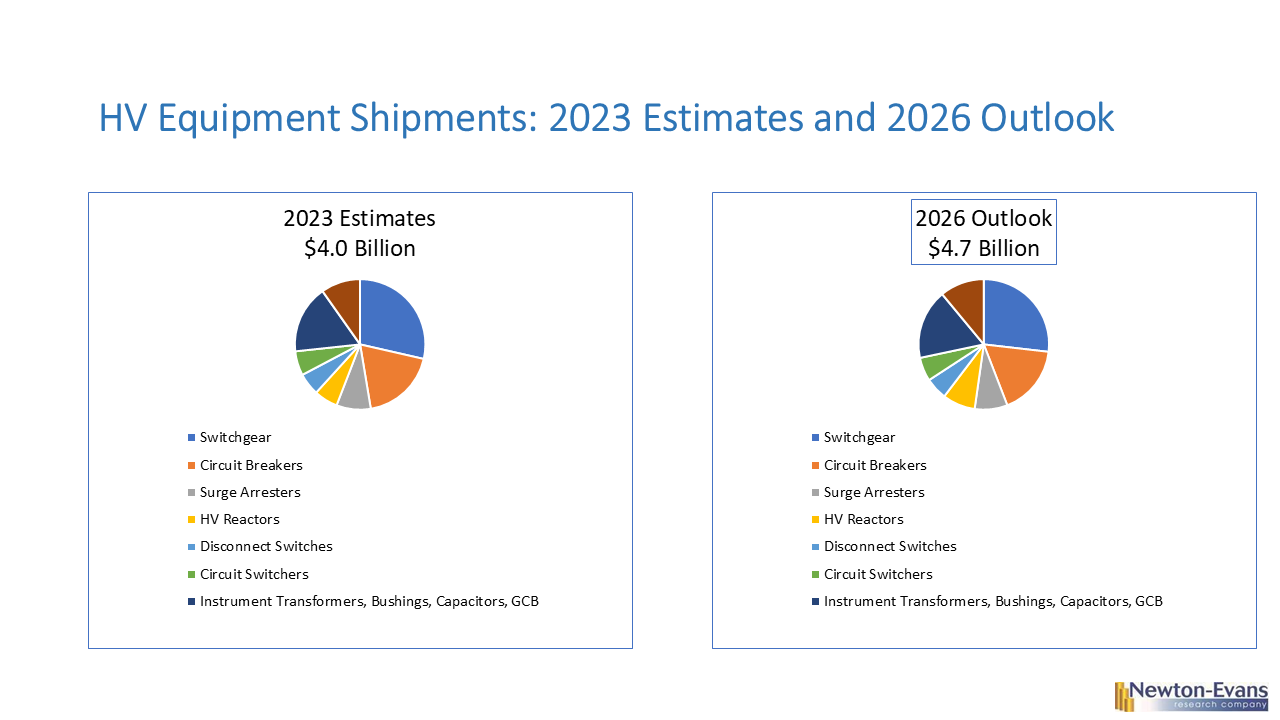
The Newton-Evans’ estimated outlay of expenditures for  U.S. HV substation construction activities reached about $4 billion in 2023, a similar level as was the total estimated spending for all HV equipment categories other than power transformers, which, as a separate category, reached about the $3 billion level.  The estimates shown in Figure 1 includes total estimated spending for HV equipment being purchased in conjunction with new substation developments (bundled procurements) as well as the amounts purchased for equipment retrofits and upgrades in existing substations and network locations (“loose” procurements).

The total estimated spending shares for switchgear shown below includes both air-insulated and gas-insulated types.

Power transformers and P&C topics are treated separately from HV equipment in our market overview series of studies. The entire range of power transformers included in the total costs for HV substations amounted to an additional $3+ billion.  You can read up on U.S. power transformer market estimates here: https://www.newton-evans.com/a-mid-2024-assessment-of-the-u-s-power-transformer-industry/ .  The updated P&C series of market overviews will be published in early Autumn.

A listing of all HV equipment summary reports included in this year’s series of market overviews can be found here: https://www.newton-evans.com/product/overview-of-the-2024-2026-u-s-transmission-and-distribution-equipment-market-high-voltage-series/ .

Figure 1. HV Equipment Market Estimates and Outlook

A listing of all HV equipment summary reports included in this year’s series of market overviews can be found here: https://www.newton-evans.com/product/overview-of-the-2024-2026-u-s-transmission-and-distribution-equipment-market-high-voltage-series/

Posted on

Substation Automation and Integration Services – Guiding the Way to the Digital Substation

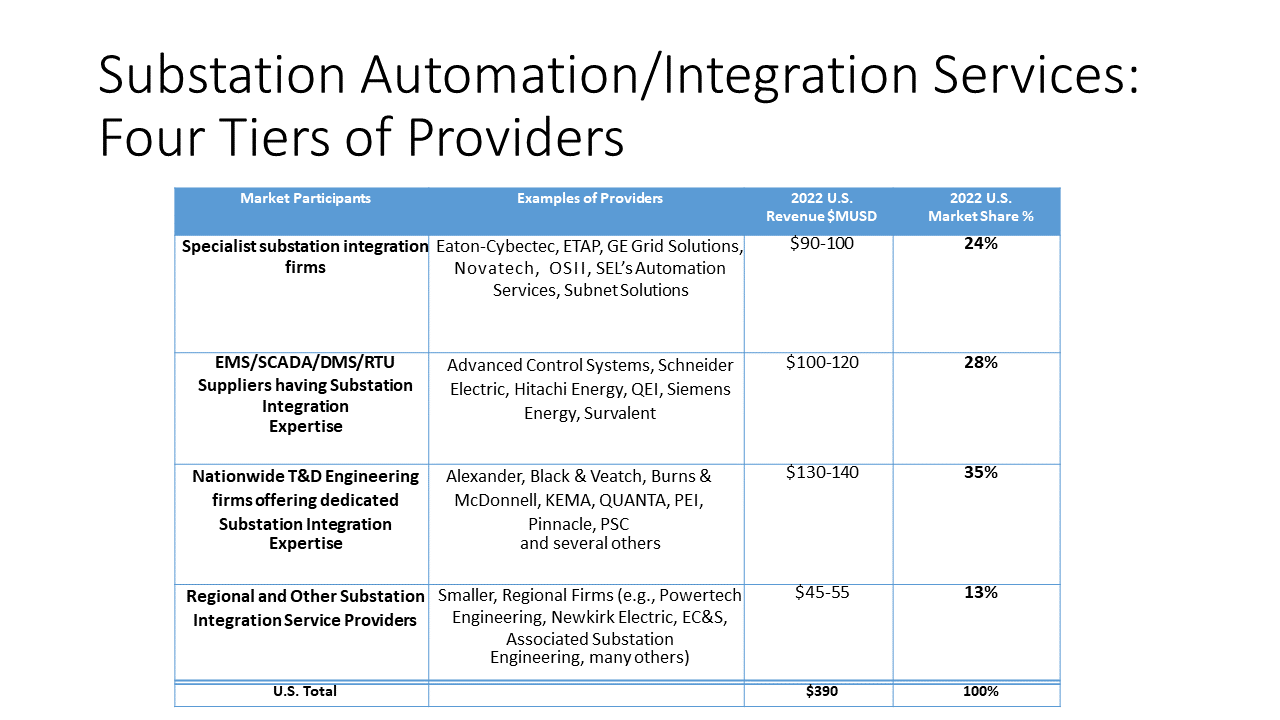
Substation Automation Integration Specialists are firms (or business units of large electrical equipment manufacturers) that can assist with or develop and provide a full or partially automated electric power substation on a turnkey basis, leading to “digital substations.” These companies help utilities and C&I firms toward digital substations.  Such firms include dedicated businesses (see examples below) or can be business units of larger companies engaged in the electric power automation business as EMS/SCADA suppliers, RTU/PLC/PAC/gateway manufacturers or protection and control specialists.  As well, T&D engineering firms, from the nation’s TOP 10 in size and reach, to dozens of smaller but capable regional service businesses are involved in helping utilities and C&I firms integrate and automate (or digitize) the nation’s nearly 70,000 utility T&D substations and another several thousand substations that are managed and operated directly by C&I firms, including large renewables installations.


Four “tiers” of substation integration providers are included in our assessment:

  • Specialist substation automation integration service revenues in 2022.es
  • SCADA industry participants with substation devices (RTUs, FEPs, Relays, IEDs, platforms) offering substation integration expertise
  • National T&D Engineering Services firms with substation integration expertise
  • Regional T&D Engineering Service firms

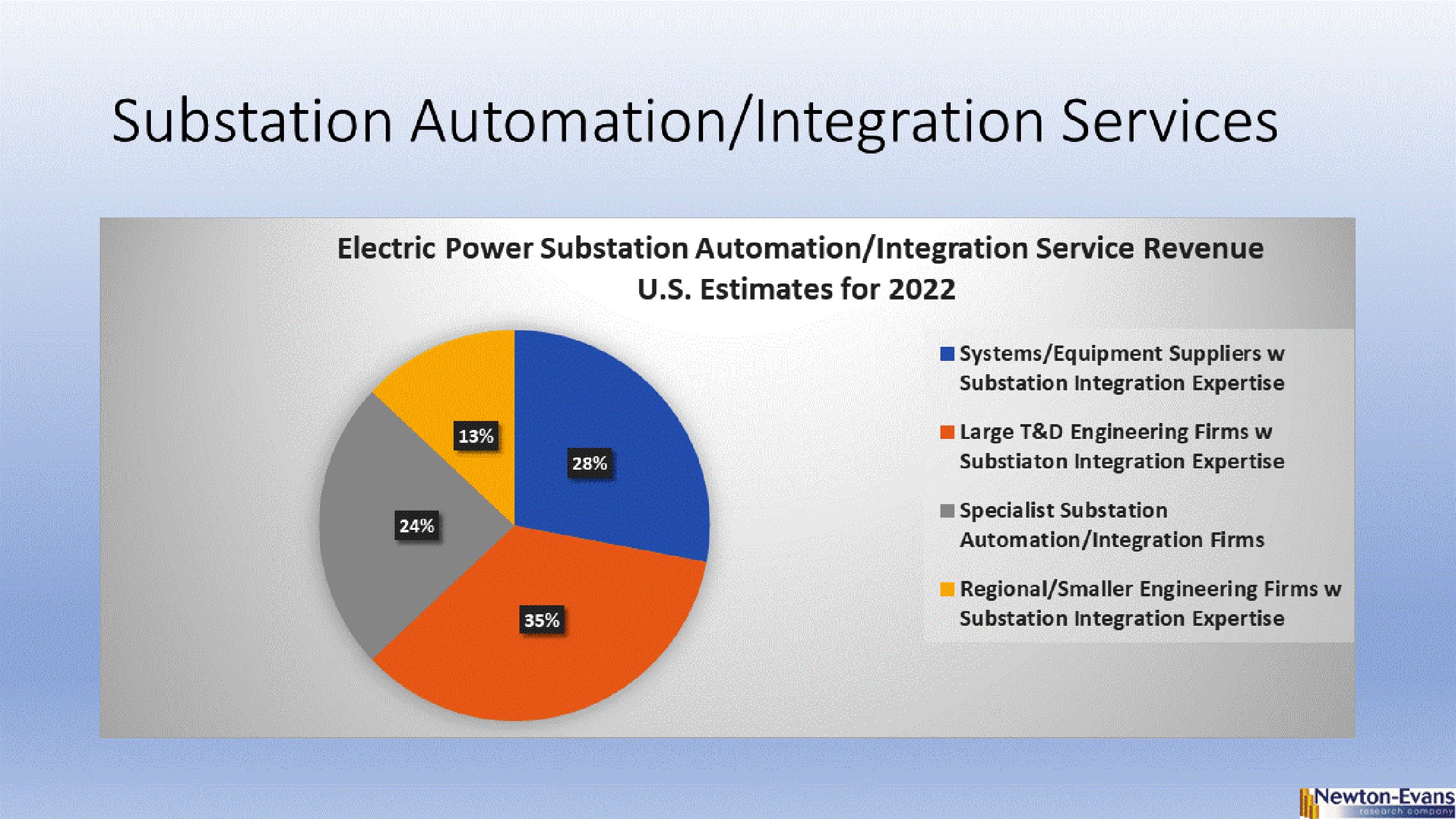
Together, these automation and integration services providers accounted for nearly $400 million of substation automation and integrations services-related revenue in 2022 (Newton-Evans estimate).  Click on chart to expand view.

Turnkey costs for substation integration services range from an estimated $45-55,000 for a small distribution substation having few feeders to upwards of $250,000 for a large transmission substation. Some metro-area MV substations with 20 or more feeders can cost upwards of $300,000 to automate and provide device integration services.

The automation equipment/device costs are in the range of $50,000-250,000 for a distribution substation and can range up to $500,000 for smart equipment and integration services in EHV transmission substations.

These totals shown in the chart below for automation and integration services are but a portion of the total expenditures allocated to electric power substations.  New substation construction (greenfield) and up-rating activities (brownfield) account for a few billion dollars, while substation equipment and communications costs also account for several billion additional dollars.

Posted on

U.S. Substation Automation and Integration Market Expenditures Valued at $2.5 Billion in 2021

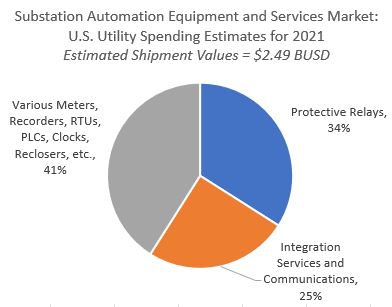
When the estimated sales of 14 product/service topics covered in the newly released 2022-2024 edition of U.S. Substation Automation Market Overview Series are totaled, the estimated value of these product/services purchased by American utilities and industrial substation sites reached $2.493 Billion in 2021. Equipment types reported in the series include RTUs, PLCs, protective relays, multifunction meters and recorders (digital fault recorders, sequence of events recorders, power quality recorders) reclosers, inter-utility revenue meters, automation platforms, time synchronization clocks, voltage regulators, communications equipment and integration services.

The total of spending on substation automation-related equipment and smart devices, along with substation integration services is on the rebound from COVID-era induced spending cutbacks. Newton-Evans Research expects investments in substation modernization to continue to grow over the next 24-36 months at a moderate rate of growth. As new substations come onto the grid to support renewable energy sites, these will be highly automated.

While automation budgets will remain a substantial portion of all substation-related budgets, additional investment is necessary to shore up grid resiliency and cyber and physical security defenses at the substation level and so these expenditures will share in the overall investment plans. The need for substation physical expansions and upratings will also continue to cause substations investments to rise.

Newton-Evans Research also finds that there are three distinct tiers of substation integration service providers. These include substation automation specialist firms, SCADA industry participants having substation devices and which also provide integration services and T&D engineering service firms having substation integration expertise.

Individual substation market overview reports are priced at $195.00 and the entire 14-report series is available for $1,150.00. Each market overview report includes a segment description, estimated market size, market shares for key participants and the U.S. market outlook through 2024.

Posted on

Sizing the Market for Electric Power Grid Modernization In an Era of Pandemic

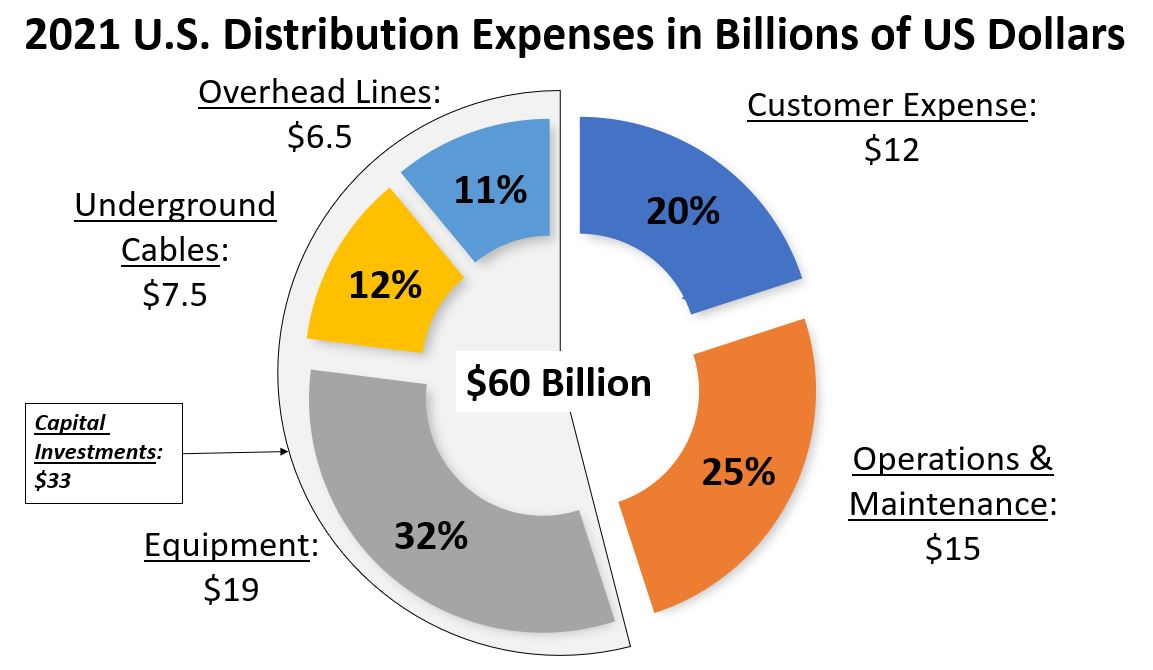
According to the U.S. Department of Energy’s Energy Information Administration, annual spending on electricity distribution systems by major U.S. utilities continued to increase year-over-year through 2019, with major utilities spending some $57.4 billion on electric distribution in that last pre-pandemic year. More than half of utility distribution spending in 2019 went toward capital investment ($31.4 billion) as utilities worked to replace, upgrade, and extend existing infrastructure. Another $14.6 billion was invested in operations and maintenance (O&M), and $11.5 billion was appropriated for customer expenses, which included advertising, billing, and customer service.

In 2019, much of the $31.4 billion distribution system capital investment (40%) was spent on power lines, both underground (23% of investment) and overhead (17% of investment). Distribution lines are added or expanded to accommodate new neighborhood development or higher electricity flows as sales increase.1
Keep in mind that when spending by municipal electric utilities and electric cooperatives are added to the EIA totals, the amounts reported by EIA actually would increase by about 25-30%, at least in our estimation.  The bulk of this additional non-IOU spending was for distribution expenditures.

We have increased these amounts for 2020 and 2021, if only to account for inflationary pressures on prices of electrical equipment and systems. Thus, our view is that, in 2021, about $60 Billion was spent in total, on electric power distribution activities in the United States. Of this amount, $33 Billion was estimated for capital investment, and about $20 Billion of the total went for distribution equipment and systems.


Fig. 1

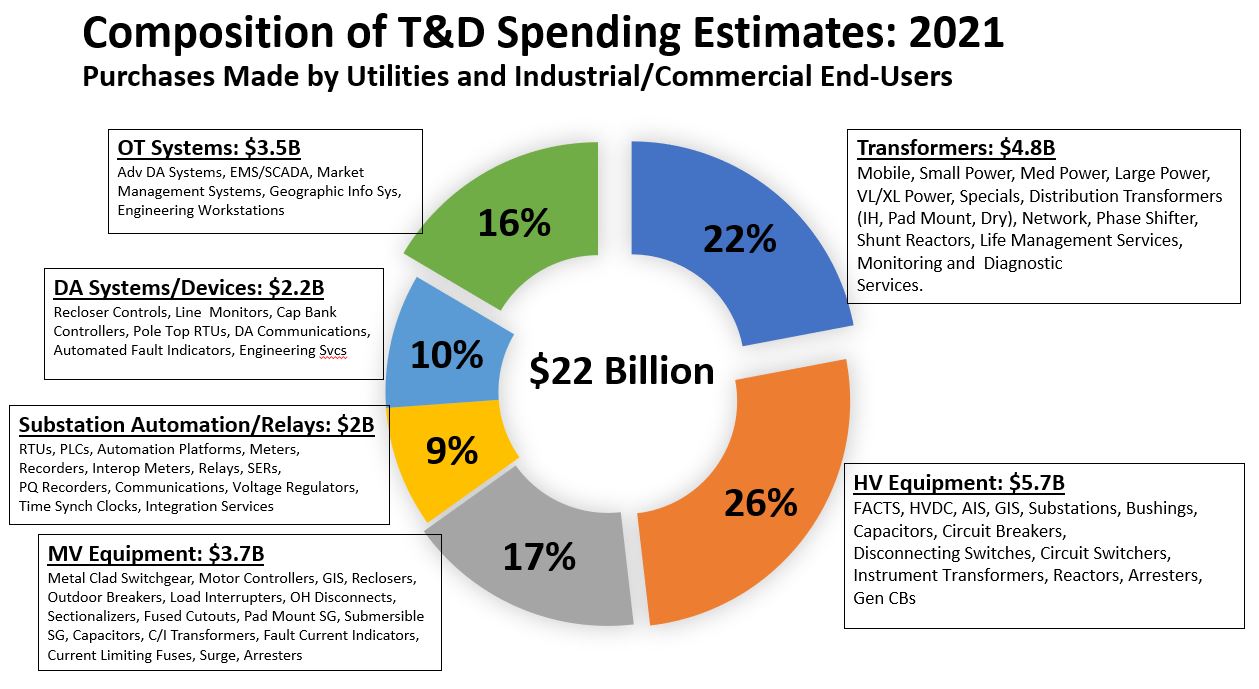
Newton-Evans’ recent year studies of U.S. combined utility and industrial/commercial spending for dozens of specific T&D products, equipment types and systems suggest about $22 Billion was invested in about 70 specific T&D equipment types in 2021.2 Note that this estimate includes spending for both transmission and distribution. In fact, the total expenditures for T&D procurements likely exceeded 100 billion dollars. See Figure 2.


Fig. 2

This $22 Billion shown in the above chart excludes additional billions of dollars invested in power lines, underground cables, electric power poles, meters and ancillary equipment as well as customer-related spending, certain substation construction and O&M services.

One recent Newton-Evans’ study of capital investment changes brought on by the COVID pandemic, resulted in an expected drop in CAPEX from 2019 to 2020, followed by stabilization and a moderate increase in spending for some areas in 2021. Some respondents cited this as a “deferral” of investments rather than a cancellation of investments at the time of the study.3 Nonetheless, total capital investment by U.S. electric utilities during the 2020 and 2021 years likely centered around the $130 Billion mark.4

If the nation (and the entire world) can move on from the ongoing pandemic era, to an endemic period, grid modernization investment may recover some of the momentum lost or deferred from the past 24 months. As well, the significance of the passage of the Infrastructure Investment and Jobs Act in November, 2021, cannot be overstated. More than $60 Billion dollars of funding under this new act has been allocated to the energy sector, most of that amount earmarked for modernization of the electric grid.

Sources:
1. U.S. Department of Energy, Energy Information Administration
2. Newton-Evans’ Market Overview Series on various T&D Topics
3. Newton-Evans Research Study of Capital Investment among U.S. Utilities in Midst of Pandemic Conditions (1-2 Quarters, 2020)
4. Newton-Evans Calculations of 1.28 x EEI/EIA estimate of $107 B. Newton-Evans’ estimate very similar to estimate prepared by Statista, which itself was sourced in part from S&P Global Market data.

Posted on

40% off “The World Market for Substation Automation and Integration Programs in Electric Utilities: 2017-2020.”

In 2017 Newton-Evans completed its eleventh worldwide study of the market for substation automation and integration systems in electric utilities. This 4-volume report series measures current market sizes for several sub-categories of equipment and services in North America and by World Regions. It also estimates and forecasts demand for substation automation equipment through year-end 2020, and profiles utility requirements as well as broader product and market requirements.
Continue reading 40% off “The World Market for Substation Automation and Integration Programs in Electric Utilities: 2017-2020.”

Posted on

Control Systems, Protective Relaying and Substation Automation Report Series Year-End Discount

Research findings from recently completed Newton-Evans studies see an upswing in cyber security investments worldwide, while substantial differences for communications protocols and methods are also evident. Order all 3 of Newton-Evans Research Company’s flagship studies on electric power control systems, substation automation and protective relays and save $9,800 off the initial retail price! Here is what is included:

Continue reading Control Systems, Protective Relaying and Substation Automation Report Series Year-End Discount

Posted on

U.S. Investor-Owned Electric Power Utility Automation Market Report

A recently published compilation of survey findings by Newton-Evans Research highlights electric power automation trends among investor-owned utilities (IOUs).

    • For control systems, IOUs tend to use more OMS analytics, are more likely to have an advanced DMS (or have plans for one), use synchrophasors for wide area monitoring, and want cybersecurity features designed as an integrated part of the control system rather than added on.

Continue reading U.S. Investor-Owned Electric Power Utility Automation Market Report

Posted on

Utility Plans Call for Continuation of Moderate-to-Substantial Investment in North American Distribution Grid Automation Projects

Findings Corroborate Earlier Newton-Evans Studies Regarding “Mixed” Placement of Controls of Field Devices

The Newton-Evans Research Company today released key findings from its newly published study of electric utility plans for distribution automation. Entitled “North American Distribution Automation Market Assessment and Outlook: 2018-2020” the 74-page report includes coverage of more than 30 DA-related issues.

Progress Being Made with Distribution Automation Programs
North American utilities are making progress, by and large, in developing and implementing new DA applications and installing telecommunications network upgrades to accommodate DA device transmissions. The overall DA market among North American utilities is approaching $1.5 billion and is expected to continue to grow in the near-term and mid-term.
Continue reading Utility Plans Call for Continuation of Moderate-to-Substantial Investment in North American Distribution Grid Automation Projects

Posted on

Growing Use of Specialized Consultants to Assist with Utility Cyber Security Activities Reported in Control Systems Study

Related Substation Automation Study Examines Use of Encryption for Data Transmission To/From Control Center Systems

The Newton-Evans Research Company has released additional cyber security-related findings from two major report series. The research shows that reliance on outside assistance for cyber expertise is gaining ground – especially among international utilities, while the use of encryption for operational data transmission is growing across the world.
Continue reading Growing Use of Specialized Consultants to Assist with Utility Cyber Security Activities Reported in Control Systems Study

Posted on

Control Systems, Protection & Control and Substation Automation Report Series from Newton-Evans Research Find Common Ground in Key Areas of Cyber Security and Communications

Research findings from recently completed Newton-Evans studies see an upswing in cyber security investments worldwide, while substantial differences for communications protocols and methods are also evident.

Control Systems Report Series
Similarities between North American and International Utilities:
1. Support activities managed by line-of-business by about one-half of all respondents
2. Fiber optic cable dominates linkages from control centers to key substations
3. Cloud computing interest remains relatively low
Continue reading Control Systems, Protection & Control and Substation Automation Report Series from Newton-Evans Research Find Common Ground in Key Areas of Cyber Security and Communications

Posted on

U.S. Electric Power T&D Market Overview Briefs Now Available

Newton-Evans is updating its series of “top line” market overview briefs called “Overview of the 2017-2020 U.S. Transmission and Distribution Equipment Market.” The reports included in this series are grouped into seven categories based on the types of T&D Equipment, systems or services covered: Control Systems, Substation Automation, Protective Relays, Transformers, Medium Voltage Equipment, High Voltage Equipment, and Distribution Automation. Reports in some of these product categories have been published this week and are now available for ordering on our reports page.
Continue reading U.S. Electric Power T&D Market Overview Briefs Now Available

Posted on

Four Major Types of Substation Integration Service Providers Account for More than $1 Billion in Annual Revenues

The Newton-Evans Research Company has released additional findings from its newly published four volume research series entitled: The World Market for Substation Automation and Integration Programs in Electric Utilities: 2017-2020.
Continue reading Four Major Types of Substation Integration Service Providers Account for More than $1 Billion in Annual Revenues

Posted on

Global Outlook for Substation Automation and Integration Continues to Show Impressive Growth

The Newton-Evans Research Company has released a new report on global substation automation markets based on the company’s 2016-2017 world market studies of substation automation and integration activities. The objective of this market outlook report by Newton-Evans Research Company, according to CEO Chuck Newton is “to provide world regional substation modernization market sizing, including country-specific activities for the largest countries in each region. As such, the outlook report complements the survey-based volumes covering North American and International substation automation markets, also completed in November.”
Continue reading Global Outlook for Substation Automation and Integration Continues to Show Impressive Growth

Posted on

International Utilities Planning to Expand Investments in Substation Modernization

The Newton-Evans Research Company has released findings from its International market study, the second of four reports collectively titled: “The World Market for Substation Automation and Integration Programs in Electric Utilities: 2017-2020.” The international study compares the current round of research findings with several earlier substation modernization tracking studies conducted by the firm. A total of 90 large and mid-size electric power utilities from 22 countries actively participated in the world market study.
Continue reading International Utilities Planning to Expand Investments in Substation Modernization

Posted on

Midpoint Of 2017 North American Study Finds Increase In Substation Construction And Retrofit Plans Over 2014 Findings

The Newton-Evans Research Company has reached the midpoint of its triennial tracking study of change and automation occurring in the world’s electric power substations.
Continue reading Midpoint Of 2017 North American Study Finds Increase In Substation Construction And Retrofit Plans Over 2014 Findings