Posted on

A Look at Modern Electric Power OT/IT Systems:  Part 1

For October’s and November’s lead articles, we have developed overviews describing electric utility-related control systems on the OT side and in December will cover key administrative and business management systems from the IT side.  This month’s lead article discusses the various aspects of energy management systems, supervisory control and data acquisition systems, and advanced distribution management systems.

Before a discussion of these three control systems begins, we must acknowledge the brave new world of OT being re- shaped and updated by the inclusion of artificial intelligence (AI) and machine learning (ML) in each of these control systems types.  By late 2022, we began to see artificial intelligence playing a role in the project development side of major EMS, SCADA and ADMS suppliers.  By 2025, commercial adaptation of AI has become widespread among energy systems suppliers for several critical applications, including improved load forecasting, dynamic load balancing, improving renewables integration efforts, and related areas including energy storage.

AI is enabling smarter, more efficient, and more sustainable electric power usage. AI’s ability to analyze vast data sets and identify complex patterns helps to optimize every stage, from energy generation and distribution to consumption. Over the coming years, AI will be integrated into more aspects of grid management and grid operations, improving reliability, safety and security for the world’s grid operators, large and small.  Across the U.S., Ai will also play a pivotal role for ISOs and RTOs, as they continue to deal with integration requirements of non-utility participation in the transmission market.

An Energy Management System (EMS) is a suite of generation and transmission applications software tools used to monitor, control, and optimize the performance of generation and transmission systems designed to reduce energy consumption, improve the utilization of the system, increase reliability, and predict electrical system performance as well as optimize energy usage to reduce cost.

By 2019 vendors were taking note from the term ADMS and began using the term AEMS to indicate significant new capabilities including the integration of renewables and energy storage and their impact on grid operations and voltage stability.  Coupled with the rapidly increased speed of processing and analyzing contingencies, and the ability to dispatch and curtail distributed energy resources, these developments have helped enhance operator capabilities and visibility into the real-time electric network. As the power generation mix and transmission requirements have become more complex, AEMS developments and capabilities are keeping pace with such needs.  More recently, new iterations of generation management systems (GMS) have been developed that now include many of the generation-side applications that were (and continue to be) components of an EMS as described in our report on GMS (OT/IT11).

Three major components of a modern EMS include:

  1. Native Services: data acquisition and control; graphical user interface; linkage/connectivity options to other systems; large database capabilities. There are many objectives of an energy management software including an application to maintain the frequency of a Power Distribution System and to keep tie-line power close to the scheduled values.
  2. SCADA Services: load shedding, load restoration, network status; sequential control, switch order management, playback of historical events
  3. Advanced Power Systems Applications (or Network Application Services): to include generation dispatching and control [AGC], transmission security management; voltage transient stability; unit commitment; state estimation, contingency analysis, demand forecast, and dispatcher training simulator. Added to these improved capabilities from earlier generations of EMS, are the abilities to work closely with and to better manage the influx of distributed energy resources and energy storage installations, the bulk of which may not be owned or operated directly by the utility. Finally, the adoption of the Common Information Model (CIM) across the industry has been a helpful development.

Sources: GE Digital Energy, ETAP, Hitachi Energy, OSII, PSC Consulting, Siemens Energy, Schneider Electric.

Among the benefits of modern EMS installations are the enhanced decision-making on the part of system operators enabled with AI.  The role of digital twins will enable a more real-life training environment for new operators, as the newest iteration of simulation systems.  Overall operational efficiency will be improved, providing greater grid stability, earlier detection of system anomalies, reduction in outage downtime and improved system safety for all.

Supervisory Control and Data Acquisition (SCADA) is a type of industrial control system (ICS). Industrial control systems are computer-controlled systems that monitor and control industrial processes that exist in the physical world. SCADA systems historically distinguish themselves from other ICS systems by being comprised of large-scale processes that can include multiple sites, and large distances. In addition, electric power distribution SCADA remains a more-or-less “open loop” type of control system, with human operators monitoring and supervising the actions of the control computer as it acquires data continuously from power substations and other remote locations, including third party operated distributed energy resource sites in an electric utility network, now marking more than 4,000 distinct utility-scale generation sites across the U.S.

Newton-Evans believes that there is a significant opportunity for providers of SCADA-related systems and application software to help manage the operations of commercially-owned utility-scale wind and solar power resources, as SCADA systems become more capable, adaptive, and scalable.  By doing so, there will be somewhat of a more “closed loop” look-and-feel, but human operators will continue to play an important role and adapt to changing distribution network environments.

For more information on renewables SCADA opportunities, see https://www.newton- evans.com/scada-systems-for-the-renewables-energy-industry-and-adms-for-utilities/

Advanced Distribution Management Systems (ADMS) and Advanced Distribution Automation are terms used to describe the extension of intelligent control over electrical power grid functions to the distribution level and beyond. It is related to distribution automation that can be enabled via the smart grid.  If we were to include all the possible components of a comprehensive ADMS, the U.S. market value would exceed $1 Billion.  In this report, we are attempting to isolate ADMS core functions in a separate manner and retain individual product categories or sub-markets for OMS, GIS, WFMS, GMD, DERMS and others.

Typically, electric utilities with energy management systems have extensive control over transmission-level equipment, while Distribution SCADA offers increasing control over distribution-level substation-based data acquisition equipment (RTUs, PLCs and/or platforms and gateways). ADMS implementations provide additional utility operator monitoring and control capabilities over smart components in the distribution network beyond the substation using primarily wireless communications. In many ADMS installations, the same platforms are used, with additional applications implemented to provide coordination and control of automated field devices.

Gartner has defined an ADMS similarly, as follows: An advanced distribution management system (ADMS) is the software platform that supports the full suite of distribution management and optimization. An ADMS includes functions that automate outage restoration and optimize the performance of the distribution grid. ADMS functions being developed for electric utilities include fault location, isolation and restoration; volt/volt-ampere reactive optimization; conservation through voltage reduction; peak demand management; and support for microgrids and electric vehicles. https://www.gartner.com/en/information-technology/glossary/advanced-distribution-management-systems-adms

West Monroe further defines ADMS as: The ideology of an ADMS is simple—a modular system with an OMS, DMS, and Distribution SCADA (D-SCADA) at its core (as depicted in Figure 1).

However, we found that utilities and vendors use the term differently. To a utility, an ADMS is the aggregate system (at least one module addition to an OMS) to manage outages and operate the distribution system in a safe and efficient manner. https://www.westmonroe.com/perspectives/resource/advanced-distribution-management-systems-adms-the-core-of-the-utility-of-the-future

The U.S. Department of Energy’s NREL has also provided a detailed roadmap for ADMS and states on its website:

The “advanced” elements of an ADMS go beyond traditional distribution management systems by providing next-generation control capabilities. These capabilities include the management of high penetrations of distributed energy resources (DERs), closed-loop interactions with building management systems, and tighter integration with utility tools for meter data management systems, asset data, and billing. https://www.nrel.gov/grid/advanced-distribution-management.html
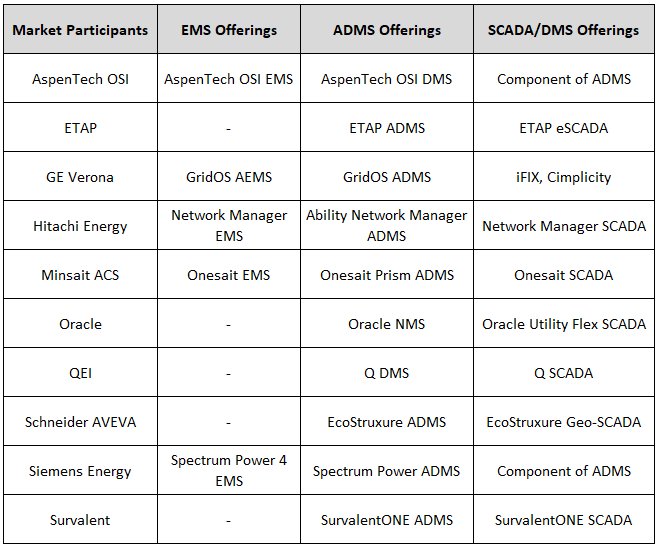
U.S. market size estimates, shares and outlook for each system type are reported in the OT/IT Market Overview Series of 12 topical Newton-Evans’ reports.
Posted on

Wind Turbine Controls Usage Patterns Study Underway

During April and early May, Newton-Evans Research is conducting studies on the American wind power market.  Of specific interest is the  wind turbine controls segment of the fast-growing renewables business.

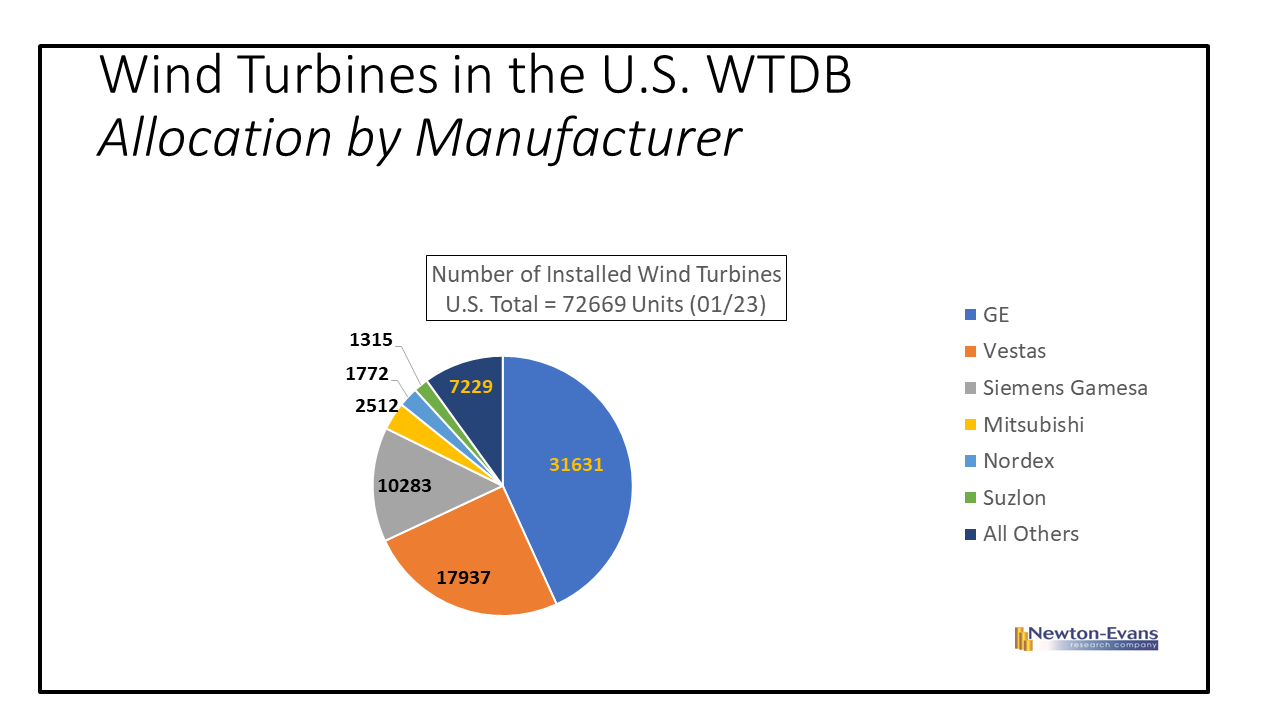
We are researching the types and brands of control devices and control systems that are in use among the more than 72,000 wind turbines installed in the United States as of January 2023.¹

Importantly, most controls within the wind turbine itself are provided by the OEM – the wind turbine manufacturer.  In the U.S., that likely means one of six manufacturers that account for 90% of all utility-scale wind turbine installations as of January 2023.  Three of the six (GE, Vestas, Siemens Gamesa) accounted for a whopping 82% of wind turbine installations.  Three others (Mitsubishi, Nordex and Suzlon) account for nearly 6,000 operational wind turbines operating throughout the country.  In addition to the major OEMs, there are more than 10 other manufacturers having at least 50 or more operational U.S. wind turbine installations.  See Figure 1. (Click on the figure to expand the view).

When it comes to wind turbine controls, multi-site wind farm operators and owners have more say in determining control devices and control systems selections as needed, especially for controls that reside external to the wind turbine.   Larger wind farms configured with wind turbines from multiple manufacturers also tend to have more interest in procuring PLCs, SCADA systems and plant-wide and multi-plant control and monitoring systems.  Wind farm operators and owners also tend to make more of the turbine control selections when it comes to retrofitting wind turbines.

There are more than a dozen wind controls specialist firms actively marketing and installing pitch and yaw controls, and/or condition monitoring systems in the United States.  Many wind turbine control specialists active in the U.S. are headquartered in European countries having extensive wind power installations and decades of wind power experience, led by firms based in Denmark, with others in Spain, Germany, Austria and Italy.  Some companies provide their own fine-tuned PLCs and wind-specific SCADA systems (you can read our 2021 article on renewables SCADA here): https://www.newton-evans.com/scada-systems-for-the-renewables-energy-industry-and-adms-for-utilities/.

We are still seeking a few additional participants to two short surveys.  One survey is geared to wind farm operators/owners, and can be answered by experienced wind turbine technicians.  The second survey addresses the OEM and wind turbine controls supplier community.  If you qualify to participate, please contact Chuck Newton (cnewton@newton-evans.com) and a link to the appropriate survey will be forwarded. 

Note:  1. Wind turbine installation data is provided by the U.S. Geological Service:  https://eerscmap.usgs.gov/uswtdb/

Posted on

Energy Management and Market Operations Systems (EMMOS) Conference to be held in San Diego, California During September 13-16, 2020

April 24, 2020.  The 27th annual three-day conference of the Energy Management and Market Operations Systems (EMMOS) Users Group will be held in San Diego, California during September 13-16, 2020, starting with a welcoming reception at the beautiful Kempton Hotel Palomar, San Diego on the evening of Sunday, September 13.

This year’s conference agenda will feature topical speakers and roundtable sessions, technical training class, a tour of the SDGE control center and vendors’ exhibition.  The conference will be held in conjunction with the OSISoft PI Generation and T&D conference, which is being held during the same week in San Diego.

Featured conference sessions at the 2020 gathering of North American and international control systems and market operations management and staff will include topics such as:  Design Matters, Protection and Control, Block Chain, 5G Networking Applications, Big Data, Grid Analytics, Situational Awareness, and others.  Presentations will be delivered by representatives from IOUs, ISOs, RTOs and the T&D Consulting community.  Please contact Mr. Reza Alaghehband at Reza@emmos.org for proposals and suggestions.

Panel discussion topics: “Contingency Plans for Control Centers Operating Under Emergency Conditions” and “Current and Future Utility Industry Technology Solutions and Challenges”

Technical Tour:  The 2020 conference will include a control center tour and will also feature a micro grid tour.

Vendor Exhibition:  An Energy Management and Market Systems focused vendor exhibition will be held on Monday evening and will include a cocktail and hors d’oeuvres reception.

Training workshop/tutorial:  A 4-hour training workshop on “Power Network Applications and Tuning” will be held as part of the conference.  Participants will receive a certificate of completion.

The annual EMMOS conference attendees include electric power operations officials involved with transmission, distribution, generation, Market Systems, as well as IT managers, planning engineers, consultants, ISO staffs, visualization and situational awareness engineers, and related systems personnel involved with control and/or market systems and substation modernization, distribution automation, outage management and geographic information systems.

The EMMOS website is now open and available for registrations for this September’s conference.

Further information on the upcoming 2020 EMMOS conference, including registration information and hotel booking arrangements can be found on the EMMOS website at www.emmos.org.   Exhibitor opportunity information is available from Mr. Dave McGinnis at davemcginnisalt@yahoo.com .  Recommendations for additional topical presentations are welcomed and should be submitted to Mr. Reza Alaghehband at Reza@emmos.org.

In the event that the conference has to be cancelled, refunds will be made to registrants or optionally can be applied to the 2021 EMMOS conference. In the event that it becomes necessary to cancel the physical conference, we will plan to conduct a live streamed video conference with speakers and roundtable discussions.  The virtual conference would be available to remote attendees at a substantially reduced price.


Posted on

40% off “The World Market Study of SCADA, EMS, DMS and OMS in Electric Utilities: 2017-2019”

In 2017, Newton-Evans published its 14th survey-based study of the market for electric power control systems (EMS, SCADA, DMS and OMS). Thirty-two of the 68 North American utilities indicated they are planning an upgrade to their existing SCADA system by year-end 2019.

“Do you plan to add any new/replacement or upgraded/retrofitted systems by 2019?” 
Continue reading 40% off “The World Market Study of SCADA, EMS, DMS and OMS in Electric Utilities: 2017-2019”

Posted on

Market for “Smart” RTUs Linked to Increase in Sensor Data

According to Schneider Electric, one of the world’s leading RTU manufacturers, Smart RTUs “combine the monitoring and communication capabilities of a remote terminal unit (RTU) with the processing and data-logging power of a programmable logic controller (PLC).” Two recent Newton-Evans studies take a look at Smart RTUs both inside the substation and outside in the field.

Continue reading Market for “Smart” RTUs Linked to Increase in Sensor Data

Posted on

Control Systems, Protective Relaying and Substation Automation Report Series Year-End Discount

Research findings from recently completed Newton-Evans studies see an upswing in cyber security investments worldwide, while substantial differences for communications protocols and methods are also evident. Order all 3 of Newton-Evans Research Company’s flagship studies on electric power control systems, substation automation and protective relays and save $9,800 off the initial retail price! Here is what is included:

Continue reading Control Systems, Protective Relaying and Substation Automation Report Series Year-End Discount

Posted on

U.S. Investor-Owned Electric Power Utility Automation Market Report

A recently published compilation of survey findings by Newton-Evans Research highlights electric power automation trends among investor-owned utilities (IOUs).

    • For control systems, IOUs tend to use more OMS analytics, are more likely to have an advanced DMS (or have plans for one), use synchrophasors for wide area monitoring, and want cybersecurity features designed as an integrated part of the control system rather than added on.

Continue reading U.S. Investor-Owned Electric Power Utility Automation Market Report

Posted on

47% of Electric Utilities Surveyed Plan to Upgrade or Retrofit Their SCADA System by Year End 2019

In 1Q 2017, Newton-Evans published its 14th survey-based study of the market for electric power control systems (EMS, SCADA, DMS and OMS). Thirty-two of the 68 North American utilities indicated they are planning an upgrade to their existing SCADA system by year-end 2019.
Continue reading 47% of Electric Utilities Surveyed Plan to Upgrade or Retrofit Their SCADA System by Year End 2019

Posted on

Growing Use of Specialized Consultants to Assist with Utility Cyber Security Activities Reported in Control Systems Study

Related Substation Automation Study Examines Use of Encryption for Data Transmission To/From Control Center Systems

The Newton-Evans Research Company has released additional cyber security-related findings from two major report series. The research shows that reliance on outside assistance for cyber expertise is gaining ground – especially among international utilities, while the use of encryption for operational data transmission is growing across the world.
Continue reading Growing Use of Specialized Consultants to Assist with Utility Cyber Security Activities Reported in Control Systems Study

Posted on

Control Systems, Protection & Control and Substation Automation Report Series from Newton-Evans Research Find Common Ground in Key Areas of Cyber Security and Communications

Research findings from recently completed Newton-Evans studies see an upswing in cyber security investments worldwide, while substantial differences for communications protocols and methods are also evident.

Control Systems Report Series
Similarities between North American and International Utilities:
1. Support activities managed by line-of-business by about one-half of all respondents
2. Fiber optic cable dominates linkages from control centers to key substations
3. Cloud computing interest remains relatively low
Continue reading Control Systems, Protection & Control and Substation Automation Report Series from Newton-Evans Research Find Common Ground in Key Areas of Cyber Security and Communications

Posted on

U.S. Electric Power T&D Market Overview Briefs Now Available

Newton-Evans is updating its series of “top line” market overview briefs called “Overview of the 2017-2020 U.S. Transmission and Distribution Equipment Market.” The reports included in this series are grouped into seven categories based on the types of T&D Equipment, systems or services covered: Control Systems, Substation Automation, Protective Relays, Transformers, Medium Voltage Equipment, High Voltage Equipment, and Distribution Automation. Reports in some of these product categories have been published this week and are now available for ordering on our reports page.
Continue reading U.S. Electric Power T&D Market Overview Briefs Now Available

Posted on

Multi-Part Newton-Evans Research Study Reveals Significant Growth Likely for Advanced DMS Systems and Applications

The Newton-Evans Research Company continues to assess its findings from the firm’s comprehensive 2017 study of EMS, SCADA, DMS and OMS usage patterns among utilities from more than 30 countries.
Continue reading Multi-Part Newton-Evans Research Study Reveals Significant Growth Likely for Advanced DMS Systems and Applications

Posted on

Newton-Evans Study Finds Heavy Use of IP/MPLS and Continued Reliance on Utility-Operated Telecommunications Networks for EMS/SCADA and DMS Systems

The latest findings from the Newton-Evans Research Company study of control systems used in the electric power industry point to heavy reliance on IP/MPLS networks for wide area communications from substations and other field locations to central site control systems.
Continue reading Newton-Evans Study Finds Heavy Use of IP/MPLS and Continued Reliance on Utility-Operated Telecommunications Networks for EMS/SCADA and DMS Systems

Posted on

Newton-Evans Study Finds Differences in Spending Plans for Electric Utility Control Systems Over the 2017-2019 Years

Nearly half of North American electric utilities participating in the 2017-2019 Newton-Evans Research study plan to upgrade or retrofit their SCADA system by 2019. Twenty-two percent plan to upgrade or retrofit their energy management system (EMS), and twenty-five percent will upgrade or retrofit their outage management system (OMS). Twenty-six percent of North American utilities in the survey sample are adding a new or replacement distribution management system (DMS) or advanced DMS by 2019.
Continue reading Newton-Evans Study Finds Differences in Spending Plans for Electric Utility Control Systems Over the 2017-2019 Years

Posted on

Findings from International Study of EMS, SCADA, DMS, and OMS Indicate Differences in Usage Patterns and Development Priorities When Compared to North American Companies

The Newton-Evans Research Company has published report findings from the company’s recently completed study of EMS, SCADA, DMS and OMS usage patterns in international electric power utilities. This is the second of four volumes of its 14th global market assessment of operational control systems – a survey-based study conducted by Newton-Evans since 1984.

Here are some observations gleaned from interviews and surveys with 31 utility participants from 25 countries:

Systems in Use
All utilities that participated in the survey are operating SCADA systems, and 74% also have an energy management (EMS) installation. Fifty-two percent use a distribution management systems (DMS) and 61% use an outage management system (OMS).

Continue reading Findings from International Study of EMS, SCADA, DMS, and OMS Indicate Differences in Usage Patterns and Development Priorities When Compared to North American Companies

Posted on

Coming Soon: The World Market Study of SCADA, EMS, DMS & OMS in Electric Utilities: 2017-2019

Here is a brochure and order form:
http://www.newton-evans.com/2017EMSSCADABrochure.pdf

Newton-Evans’ World Market Study of SCADA, Energy Management Systems, Distribution Management Systems and Outage Management Systems in Electric Utilities: 2017-2019 is a four volume, multi-client market report. Participants in this market study include utility engineers and managers from investor-owned utilities, municipal and provincial utilities, cooperative utilities within the United States and Canada, together with national power systems throughout the world.
Continue reading Coming Soon: The World Market Study of SCADA, EMS, DMS & OMS in Electric Utilities: 2017-2019

Posted on

Early Survey Findings Point to Continuing Development of EMS, SCADA, DMS and OMS Capabilities during 2017-2019 among North American Electric Power Utilities

The Newton-Evans Research Company has released preliminary findings from its current study of EMS, SCADA, DMS and OMS usage patterns in North American electric power utilities, one of four component reports of the company’s global market assessment series on operational control systems.

Among the initial observations gleaned from interviews and surveys with over 60 officials from a broad range of U.S. electric utilities:
Continue reading Early Survey Findings Point to Continuing Development of EMS, SCADA, DMS and OMS Capabilities during 2017-2019 among North American Electric Power Utilities

Posted on

Interest in Combining Control Systems on a Common Platform Among North American Electric Utilities

The following is excerpted from the Newton-Evans Research study, “World Market Study of SCADA, Energy Management Systems, Distribution Management Systems and Outage Management Systems in Electric Utilities: 2013-2015.” Read more about it on our reports page here.

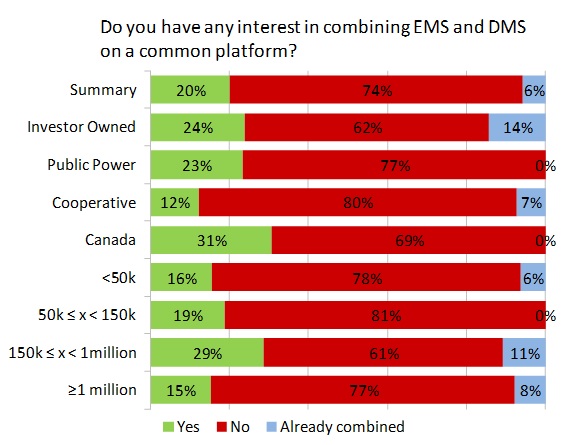
Do you have any interest in combining EMS and DMS on a common platform?
In 2013, utility interest in combining these two systems was observed to be about the same as it was in 2010. A total of 26% of respondents had interest or had already combined their EMS and DMS systems. In 2010, 27% of utilities surveyed expressed an interest in doing this. Cooperatives showed less interest in combining, while Investor Owned utilities had more interest.


(Summary from the 2012 survey)

In the 2010 survey, there was some interest in combining EMS and DMS on a single platform; 27% of respondents answered “yes” they had an interest in combining the two. There was more interest among Canadian respondents (36%), IOUs and public power utilities (each at 32%), compared with only 13% of cooperatives (this sub-group of distribution cooperatives is less likely to use EMS technologies). Similarly, larger utilities were somewhat more interested in this combination of EMS and DMS than were smaller utilities.

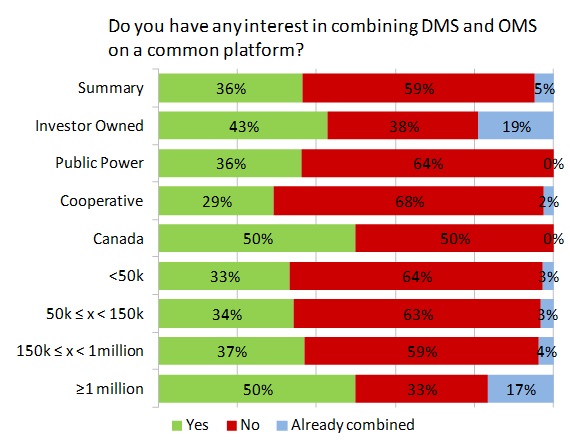
Do you have any interest in combining DMS and OMS on a common platform?
Similar to what had been reported in the 2010 study, the 2013 study indicated that 41% of utilities either have interest in combining DMS and OMS (36%), or have already combined them (5%).

Do you have any interest in combining DMS and OMS on a common platform?
(Summary from the 2012 survey)

Overall, 40% of the 92 utilities responding to this part of question 3 expressed interest in a combined DMS/OMS platform. The highest level of interest was noted among Canadian respondents (64%); the lowest amount of interest was among U.S. cooperatives (17%). Fifty percent of utilities serving more than one million customers were interested in combining DMS and OMS capabilities on a single platform. Questions 3a and 3b are new questions added to the 2010 survey.