Posted on

Newton-Evans Research Company Introduces Comprehensive and Cost-Effective Market Overview Package for the Electric Power Industry

The Newton-Evans Research Company is pleased to announce a new, cost-efficient purchasing option for its extensive series of electric power T&D (Transmission and Distribution) equipment, systems, and services market overviews.
Now Available: All 86 Report Summaries for $7,500
This special package includes every summary from our seven major report groupings, as well as an exclusive June 2025 Market Update. The update will analyze the impact of newly imposed or revised U.S. tariffs on T&D equipment and includes an updated spending outlook through 2027.

What’s Included:
Each market overview provides:
• A technical description of the specific product, system, or service
• A list of key market participants
• Market size and share estimates
• A market outlook through 2026
• Sample pricing data (for most topics)
Report Categories (2024–2026 Updates):

Our 86 individual topic reports span seven major categories:

  1. High Voltage Equipment
  2. Medium Voltage Equipment
  3. Power and Distribution Transformers
  4. Control Systems
  5. Distribution Automation
  6. Substation Automation
  7. Protection & Control
    Each category includes between 8 and 18 individual research topics.
    For category details and topic descriptions, please visit our Reports page: www.newton-evans.com/our-reports
    This is the only series of its kind—a vital resource for professionals who need to know the key players, current trends, and future projections in the electric power sector.

Posted on

40% off “The World Market Study of SCADA, EMS, DMS and OMS in Electric Utilities: 2017-2019”

In 2017, Newton-Evans published its 14th survey-based study of the market for electric power control systems (EMS, SCADA, DMS and OMS). Thirty-two of the 68 North American utilities indicated they are planning an upgrade to their existing SCADA system by year-end 2019.

“Do you plan to add any new/replacement or upgraded/retrofitted systems by 2019?” 
Continue reading 40% off “The World Market Study of SCADA, EMS, DMS and OMS in Electric Utilities: 2017-2019”

Posted on

Market for “Smart” RTUs Linked to Increase in Sensor Data

According to Schneider Electric, one of the world’s leading RTU manufacturers, Smart RTUs “combine the monitoring and communication capabilities of a remote terminal unit (RTU) with the processing and data-logging power of a programmable logic controller (PLC).” Two recent Newton-Evans studies take a look at Smart RTUs both inside the substation and outside in the field.

Continue reading Market for “Smart” RTUs Linked to Increase in Sensor Data

Posted on

Control Systems, Protective Relaying and Substation Automation Report Series Year-End Discount

Research findings from recently completed Newton-Evans studies see an upswing in cyber security investments worldwide, while substantial differences for communications protocols and methods are also evident. Order all 3 of Newton-Evans Research Company’s flagship studies on electric power control systems, substation automation and protective relays and save $9,800 off the initial retail price! Here is what is included:

Continue reading Control Systems, Protective Relaying and Substation Automation Report Series Year-End Discount

Posted on

U.S. Investor-Owned Electric Power Utility Automation Market Report

A recently published compilation of survey findings by Newton-Evans Research highlights electric power automation trends among investor-owned utilities (IOUs).

    • For control systems, IOUs tend to use more OMS analytics, are more likely to have an advanced DMS (or have plans for one), use synchrophasors for wide area monitoring, and want cybersecurity features designed as an integrated part of the control system rather than added on.

Continue reading U.S. Investor-Owned Electric Power Utility Automation Market Report

Posted on

94% of Electric Utilities Surveyed are notified of a feeder main fault event via SCADA/DMS

A Newton-Evans survey of 53 Distribution Electric Utilities shows that the overwhelming majority of respondents are notified of a feeder main fault via SCADA/DMS.

How are you notified of a feeder main fault event? (Check all that apply)
Ninety-four percent of respondents reported that they are notified of a feeder main fault event via SCADA/DMS. Forty-two percent said OMS is the source of this notification, and 25% indicated their DA system provides notification of a feeder main fault event. Many respondents indicated that more than one system – sometimes as many as four – all provide feeder main fault event notification.
Continue reading 94% of Electric Utilities Surveyed are notified of a feeder main fault event via SCADA/DMS

Posted on

47% of Electric Utilities Surveyed Plan to Upgrade or Retrofit Their SCADA System by Year End 2019

In 1Q 2017, Newton-Evans published its 14th survey-based study of the market for electric power control systems (EMS, SCADA, DMS and OMS). Thirty-two of the 68 North American utilities indicated they are planning an upgrade to their existing SCADA system by year-end 2019.
Continue reading 47% of Electric Utilities Surveyed Plan to Upgrade or Retrofit Their SCADA System by Year End 2019

Posted on

New Distribution Automation Tracking Study Finds Utilities Implementing DA Control Logic Either In The SCADA Control Center Or In Field Devices

Initial findings from a current Newton-Evans tracking study indicate that more North American electric utilities developing Distribution Automation applications are implementing control logic for FLISR (fault location, isolation, and service restoration) and Volt-VAR in the SCADA control center. This study follows up on a 2014 survey-based study of DA that gathered responses from 75 electric utilities in the U.S. and Canada. Here are some highlights from the first 30 survey participants so far.
Continue reading New Distribution Automation Tracking Study Finds Utilities Implementing DA Control Logic Either In The SCADA Control Center Or In Field Devices

Posted on

Control Systems, Protection & Control and Substation Automation Report Series from Newton-Evans Research Find Common Ground in Key Areas of Cyber Security and Communications

Research findings from recently completed Newton-Evans studies see an upswing in cyber security investments worldwide, while substantial differences for communications protocols and methods are also evident.

Control Systems Report Series
Similarities between North American and International Utilities:
1. Support activities managed by line-of-business by about one-half of all respondents
2. Fiber optic cable dominates linkages from control centers to key substations
3. Cloud computing interest remains relatively low
Continue reading Control Systems, Protection & Control and Substation Automation Report Series from Newton-Evans Research Find Common Ground in Key Areas of Cyber Security and Communications

Posted on

Multi-Part Newton-Evans Research Study Reveals Significant Growth Likely for Advanced DMS Systems and Applications

The Newton-Evans Research Company continues to assess its findings from the firm’s comprehensive 2017 study of EMS, SCADA, DMS and OMS usage patterns among utilities from more than 30 countries.
Continue reading Multi-Part Newton-Evans Research Study Reveals Significant Growth Likely for Advanced DMS Systems and Applications

Posted on

Newton-Evans Study Finds Heavy Use of IP/MPLS and Continued Reliance on Utility-Operated Telecommunications Networks for EMS/SCADA and DMS Systems

The latest findings from the Newton-Evans Research Company study of control systems used in the electric power industry point to heavy reliance on IP/MPLS networks for wide area communications from substations and other field locations to central site control systems.
Continue reading Newton-Evans Study Finds Heavy Use of IP/MPLS and Continued Reliance on Utility-Operated Telecommunications Networks for EMS/SCADA and DMS Systems

Posted on

Findings from International Study of EMS, SCADA, DMS, and OMS Indicate Differences in Usage Patterns and Development Priorities When Compared to North American Companies

The Newton-Evans Research Company has published report findings from the company’s recently completed study of EMS, SCADA, DMS and OMS usage patterns in international electric power utilities. This is the second of four volumes of its 14th global market assessment of operational control systems – a survey-based study conducted by Newton-Evans since 1984.

Here are some observations gleaned from interviews and surveys with 31 utility participants from 25 countries:

Systems in Use
All utilities that participated in the survey are operating SCADA systems, and 74% also have an energy management (EMS) installation. Fifty-two percent use a distribution management systems (DMS) and 61% use an outage management system (OMS).

Continue reading Findings from International Study of EMS, SCADA, DMS, and OMS Indicate Differences in Usage Patterns and Development Priorities When Compared to North American Companies

Posted on

Research Findings Point to Upgrade of EMS, SCADA and DMS Capabilities during 2017-2019 among North American Electric Power Utilities to Accommodate Renewables Integration and Demand Response

Emphasis Placed on Extending Applications and Expanding Roles of Distribution Management Systems and Outage Management Systems
Continue reading Research Findings Point to Upgrade of EMS, SCADA and DMS Capabilities during 2017-2019 among North American Electric Power Utilities to Accommodate Renewables Integration and Demand Response

Posted on

Coming Soon: The World Market Study of SCADA, EMS, DMS & OMS in Electric Utilities: 2017-2019

Here is a brochure and order form:
http://www.newton-evans.com/2017EMSSCADABrochure.pdf

Newton-Evans’ World Market Study of SCADA, Energy Management Systems, Distribution Management Systems and Outage Management Systems in Electric Utilities: 2017-2019 is a four volume, multi-client market report. Participants in this market study include utility engineers and managers from investor-owned utilities, municipal and provincial utilities, cooperative utilities within the United States and Canada, together with national power systems throughout the world.
Continue reading Coming Soon: The World Market Study of SCADA, EMS, DMS & OMS in Electric Utilities: 2017-2019

Posted on

Early Survey Findings Point to Continuing Development of EMS, SCADA, DMS and OMS Capabilities during 2017-2019 among North American Electric Power Utilities

The Newton-Evans Research Company has released preliminary findings from its current study of EMS, SCADA, DMS and OMS usage patterns in North American electric power utilities, one of four component reports of the company’s global market assessment series on operational control systems.

Among the initial observations gleaned from interviews and surveys with over 60 officials from a broad range of U.S. electric utilities:
Continue reading Early Survey Findings Point to Continuing Development of EMS, SCADA, DMS and OMS Capabilities during 2017-2019 among North American Electric Power Utilities

Posted on

Newton-Evans Surveys Underway

Outlook Study for HV and MV Equipment Purchasing Plans
Newton-Evans Research is conducting a study of U.S. electric utility plans for T&D equipment purchases over the coming 36 months. If you work in power transmission or distribution and specify or procure equipment, you can help the utility community by participating in the study. In turn, we will share back the findings and provide an honorarium as well. Aggregated equipment demand levels will have an influence on prices and options for capital equipment used in power transmission and distribution.
Continue reading Newton-Evans Surveys Underway

Posted on

The Year in Summary (2015)

2015 was another busy year for Newton-Evans Research. Some of the studies conducted this past year covered new research topics. While our work was focused on client-commissioned studies, we obtained many insights from operational and engineering perspectives that will assist our research programs in 2016 as we once again conduct our flagship multiclient studies of protection and control, substation modernization, and operational control systems with utilities around the world. For over 30 years Newton-Evans has observed and reported on the fundamental shifts in operational systems and electric power infrastructure technology developments and usage patterns. In 2016, there will be additional changes in usage patterns, plans and outlooks among operational end engineering officials to note, both in North America and internationally.

Continue reading The Year in Summary (2015)

Posted on

The Role of ADMS/SCADA in Building a Resilient & Reliable Distribution Grid: Part 1

This is part one of a four part series on ADMS and Distribution Automation. Part one discusses Advanced DA, differences between Distribution SCADA and ADMS, market participants, usage patterns, challenges, priorities, and comments from users.

What utilities have said
Based on a mid-2014 study of the market for Distribution Automation (along with multiple earlier studies), increasing numbers of large utilities have indicated the following:

  • Integrated systems are becoming more desirable
  • Entrenched suppliers of large control systems (EMS primarily) have an “in” but often cannot provide the required component systems for an integrated approach to DMS-OMS-GIS.
  • Many mid-size utilities consider their DSCADA systems (primarily the ACS, OSI and Telvent communities) as suitable platforms for DMS/DA.
  • A high proportion of all respondents do not yet see a need for a separate DMS. This is especially true among the mid-tier utilities.
  • DMS systems can be (and most often are) implemented in a single control center that cuts across state lines in the United States.
  • Typically, operating companies under a large holding corporation operate their own DMS or DSCADA installations.

10 attributes of advanced DA
Here are the 10 attributes of an advanced distribution automation capability based on Intelligrid’s definition:

  1. Real-time Distribution Operation Model and Analysis (DOMA)
  2. Fault Location, Isolation and Service Restoration (FLISR/FDIR)
  3. Voltage/var Control (VVC/VVO)
  4. Distribution Contingency Analysis (DCA)
  5. Multi-level Feeder Reconfiguration (MFR)
  6. Relay Protection Re-coordination (RPRC)
  7. Pre-arming of Remedial Action Schemes (PRAS)
  8. Coordination of Emergency Actions (CEmA)
  9. Coordination of Restorative Actions (CRA)
  10. Intelligent Alarm Processing (IAP)

While ADMS platforms are increasingly used by Tier One utilities, many other utilities continue to rely on their DSCADA system to manage a growing portfolio of ADA functions.

Use of DMS as of Mid-2014 (Participants in Newton-Evans’ Study)

  • Just over 40% of all respondents indicated use of a DMS as of June 2014.
  • IOUs were more likely to indicate having a DMS installation than were respondents from other utility types.
  • All of the surveyed utilities have a DSCADA capability and are likely to be applying SCADA control over basic DA functions such as capacitor bank control and recloser control.

ADMS and DSCADA market participants
The total North American DMS market is made up of ADMS and DSCADA, with some overlapping providers and some different market participants in each category. Among this North America sample of large utilities, GE and ABB/Ventyx led in mentions of current ADMS installations. OSI is also a major supplier of DSCADA and ADMS installations, but their clients tend to be mid-size utilities. All of the mentions for both GE and ABB/Ventyx were made by IOU respondents.

Posted on

Electric Utility SCADA/DMS and OMS Convergence Trends

Here are some more excerpts from our latest study of the World Market Study of SCADA, Energy Management Systems, Distribution Management Systems and Outage Management Systems in Electric Utilities: 2013-2015. The information below was collected from 101 electric utilities in the U.S. and Canada between the 4th quarter of 2012 and 1st quarter 2013. The survey sample consisted of Investor Owned utilities (21%), Public Power (35%), Cooperatives (44%), and Canadian Utilities (13%).

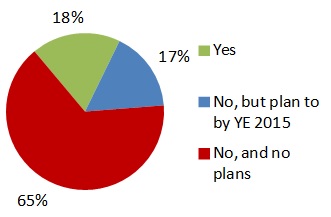
Has your utility converged SCADA/DMS and OMS functions?
A total of 35% of utility respondents either had already converged SCADA/DMS and OMS or planned to do so by the end of 2015. Only 6% of Public Power utilities surveyed had already converged these functions, but another 21% had plans in place to do this by 2015.

Has your utility converged SCADA/DMS and OMS functions? (as of Jan. 2013)
SCADA-OMS_convergence

What functions have been converged/or plan to be converged?
Eighteen respondents said they had either converged SCADA and OMS, or planned to. Some mentioned that their SCADA reported all operations and statuses of monitored devices to their OMS, and some indicated that SCADA and OMS were less tightly integrated (for example, in some cases SCADA might only report switch/breaker status to OMS.) Here are a few of the more specific comments that were mentioned on the survey:

  • AMI system will provide customer meters out to the OMS system on a limited basis.
  • All distribution SCADA functions have been integrated with OMS/DMS through interface applications.
  • SCADA reports all operations/statuses of monitored devices to OMS
  • One way interface from SCADA to OMS (breaker & switch status)
  • Integrated platforms – smart meter “last gasp” info feeding GIS & SCADA systems which then feeds Outage Notification system
  • Topology (coloring feeder); Load Flow; Real Time Metering; Volt-VAR Control; Outage Report
  • SCADA/DMS. SCADA provides the load data to operate the DMS.
  • Multispeak connections between SCADA and OMS
  • Predicted and actual outages
  • Telvent’s ADMS product (OMS&DMS) to be installed on top of upgraded Telvent OASyS DNA SCADA system.
  • Estimated restoration times, extent of outage, number of customers

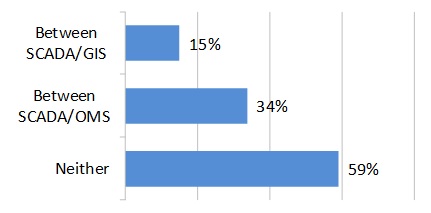
Does your utility currently have real-time linkages between SCADA and GIS or OMS?
Sixty percent of utilities surveyed did not have any real-time linkages in place as of January, 2013. About one-third had real-time linkages in place between SCADA and OMS, while just 15% had real-time linkages between SCADA and GIS.

Larger Investor Owned utilities were more likely to have real-time communications linkages in these situations. Just over half of Investor Owned utilities (52%) had real-time linkages between SCADA and OMS, and 24% had real-time linkages between SCADA and GIS. Fifty-four percent of large utilities (i.e. serving more than 1 million customers) had real-time linkages between SCADA and OMS.

Does your utility currently have real-time linkages between SCADA and GIS or OMS? (as of Jan. 2013)
real-time_linkage

More details about the topics covered in this and other studies are available on our reports page.

Posted on

Interest in Combining Control Systems on a Common Platform Among North American Electric Utilities

The following is excerpted from the Newton-Evans Research study, “World Market Study of SCADA, Energy Management Systems, Distribution Management Systems and Outage Management Systems in Electric Utilities: 2013-2015.” Read more about it on our reports page here.

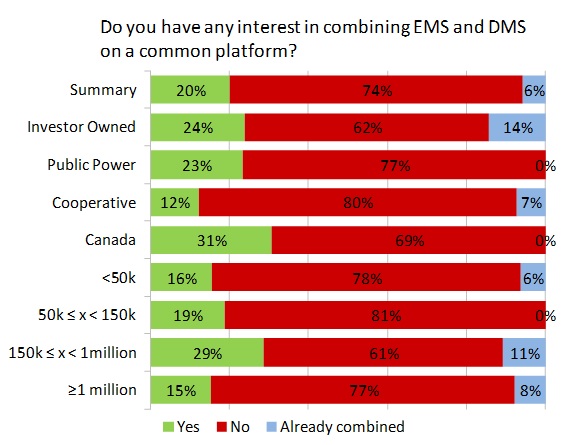
Do you have any interest in combining EMS and DMS on a common platform?
In 2013, utility interest in combining these two systems was observed to be about the same as it was in 2010. A total of 26% of respondents had interest or had already combined their EMS and DMS systems. In 2010, 27% of utilities surveyed expressed an interest in doing this. Cooperatives showed less interest in combining, while Investor Owned utilities had more interest.


(Summary from the 2012 survey)

In the 2010 survey, there was some interest in combining EMS and DMS on a single platform; 27% of respondents answered “yes” they had an interest in combining the two. There was more interest among Canadian respondents (36%), IOUs and public power utilities (each at 32%), compared with only 13% of cooperatives (this sub-group of distribution cooperatives is less likely to use EMS technologies). Similarly, larger utilities were somewhat more interested in this combination of EMS and DMS than were smaller utilities.

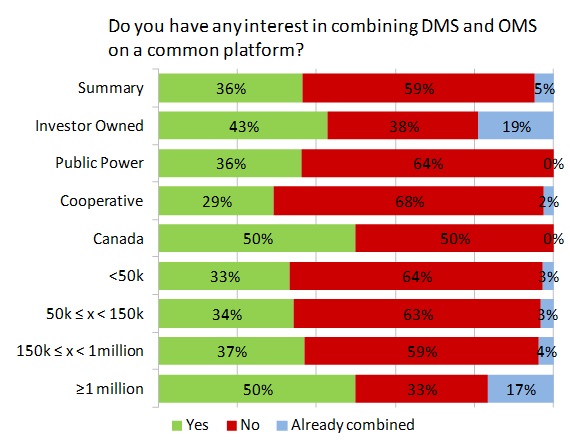
Do you have any interest in combining DMS and OMS on a common platform?
Similar to what had been reported in the 2010 study, the 2013 study indicated that 41% of utilities either have interest in combining DMS and OMS (36%), or have already combined them (5%).

Do you have any interest in combining DMS and OMS on a common platform?
(Summary from the 2012 survey)

Overall, 40% of the 92 utilities responding to this part of question 3 expressed interest in a combined DMS/OMS platform. The highest level of interest was noted among Canadian respondents (64%); the lowest amount of interest was among U.S. cooperatives (17%). Fifty percent of utilities serving more than one million customers were interested in combining DMS and OMS capabilities on a single platform. Questions 3a and 3b are new questions added to the 2010 survey.